The Ulakhan-Sis Mountain Range is in the Sakha Republic, Far Eastern Federal District, Russia. This range is one area of Yakutia – which is one of the most isolated and distant portions of northern Russia. This area is largely unexplored and uninhabited – only being first mapped in 1870. It’s nearest inhabited neighbor to the south is the infamous Kolyma area of Russia that served as Stalin’s brutal gulags.
They’ve been getting a little more exposure lately with climbers and visitors making the treacherous thousand mile trip to the range. What makes it interesting is that the area is marked by fascinating baydzharakhs rock formations. Kigilyakh rock formations are also found on this range, some of them quite impressive.
Baydzherakhs are formed by a cryo-lithic process in which polygonal ice-wedges thaw within the permafrost and reach heights of 15-30 feet. They form a landscape of unearthly spires. Not that different than the Penitentes in the Atacama desert.
North Plains approved a 855 acre expansion to their urban growth boundary to help grow their small town as well as help build much needed housing. A problem plaguing the US and especially the strictly regulated Portland metro urban growth boundary.
The Oregon state legislature attempted to stop the move by slipping in a ban on such votes by local cities into a bill that bans them RETROACTIVELY back to 2023 – an unheard of and unprecedented move to squash local government and maintain their iron fist on Portland urban growth boundaries that has created one of the worst housing crisis in the country.
Applicant Tracking Systems are used by many companies to sift and sort the countless resumes they get. Unfortunately, that means your resume could be filtered out – even if you are perfect for the job. Why? Because you used the wrong keywords.
Jobscan makes a tool that takes a job description and reviews your resume to see if you’ll get past the ATS systems.
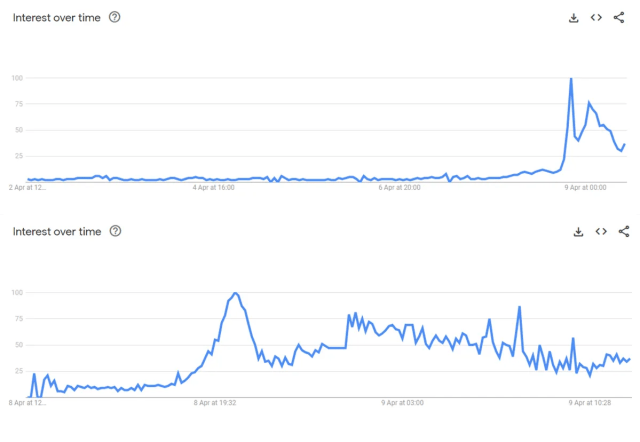
Tiktoker burns eyes flexing the eclipse, and Google says he’s not alone
The Tik Toker dannyboyy_ flexed hard getting what was probably a very expensive flight that traveled through the eclipse path. He did get some great footage:
Co-designed by Teenage Engineering, what makes the Rabbit R1 special is the interface: instead of a grid of apps, you get an AI assistant that talks to your favorite apps and does everything for you.
You could get the R1 to research a holiday destination and book flights to it, or queue up a playlist of your favorite music, or book you a cab. In theory, you can do almost anything you can already do on your phone, just by asking. It remain a lot of questions over exactly how it works and protects your privacy in the way it describes.
Pre-orders are available at the Rabbit website with deliveries expected around March/April 2024.
Let’s hope it does better than the Humane AI pin that is already floundering and laying off staff. At least the Rabbit doesn’t require a monthly subscription.
According to the US Census bureau in 2023-4, Portland has gone from one of that fastest, hippest growing cities in the country to the 6th fastest shrinking major city in the country despite its relatively small size. It’s a worse rate than Detroit.
Portland population declined also in 2022 – For the 3rd year in a row, net migration for Portland is negative. Meaning more people have left the city in total than have moved in. The total city population is shrinking and this is causing demographers and politicians to start sounding alarm bells.
A recent study in late 2023 show this net population shrinkage of over 18,000 people since the pandemic has now become a disturbing long-term trend. A trend that is unique to Portland as many other urban areas around the country and NW region are growing. This will likely have heavy implications on government services, jobs, and is general economic decline. It is causing economists alarm as legislators scramble for answers (answers that are likely painfully obvious – such as nearly the highest tax rate in the country, increasing violent and property crime, high homelessness, and terrible local and state leadership).
Oregon state is also seeing a net population decrease.
Oregon is one of only 17 states to see declining household incomes in 2022, U.S. Census Bureau data shows. According to the U.S. Census Bureau data, Oregon saw a 2.2% drop in median household income in 2022 — the only Western state to see a decline during the same period. However, Oregon State Economist Josh Lehner told KOIN 6 News that Oregon’s income actually rose in 2022, just not as fast as inflation.
A flood of Portlanders are leaving town for the suburbs. “Rents in Portland’s suburbs are up 23% since 2020, compared with about 2% in the center city.” In sum, we have undeniable evidence that a mass movement of once-cosmopolitan renters have fled Portland’s urban core for the suburbs.”
REI has announced it is closing it’s downtown flagship store due to crime and security issues. Despite working with city officials to fix issues, it gave up after nothing was done and it is experiencing it’s highest number of break-ins and thefts in 20 years.
Measure 110 that legalized drugs hasn’t saved any lives. Drug overdose deaths have increased in Portland/Oregon at almost identical rates as 13 other states indicating that the policy argument of harm reduction has been proven incorrect.
“A [homeless] camp took over the parking lot last summer where I teach. Two families left the school due to feeling unsafe. One day a mom messaged me they were late because they couldn’t get out of their car. A female camper had her pants down and was peeing next to their car. Then was doing the dope nod with her pants down. Took six months to clear the camp even though they were violating the rule about proximity to a school.”
Parents are asking the US Department of Education to review Portland Public School’s new disciple and safety guide as being discriminatory and violating the Civil Rights Act of 1964 after increasing school violence. The PPS guide requires the student’s ‘trauma, race, and gender identity’ be the primary criteria for how faculty will respond to cases and threats of violence by students. This has led to cases in which students have threatened to kill other students and choked/physically assaulted them are not reprimanded and immediately put right back into classrooms with people they have victimized.
Oregon students are about 2/3 of a year behind reading levels and 3/4 of a year behind in math skills compared to most other states. Some of the other states doing dramatically better than Oregon: Alabama, Illinois, Louisiana, South Dakota, Georgia, Indiana, Tennessee, Ohio. Only 6 states did worse in math, and Oregon had the second lowest overall state score.
Ex: Seventh grader at Beaumont Middle School in Northeast Portland described feeling terrified after a classmate held a boxcutter to her neck and threatened to slit her throat during school hours several weeks ago. Her classmate was suspended for a few weeks, but is now back at school without supervision, she told members of the Portland school board on Tuesday, adding that she’s experiencing regular panic attacks as a result.
Critics have said that this doesn’t fight racism, instead it’s a quiet racism of lowering standards instead of addressing the actual educational needs of underprivileged students.
Masked Disruptive Protests and Attacks Haven’t Stopped
Portland got a reputation for some of the most violent and destructive riots in 2020; and it’s not that protests have stopped. They largely just changed topics – and are now increasingly attacking public leaders homes including arson attacks.
Just in the last 2 months (Nov 2023 to Jan 2024) we’ve had a list of blocked roads, bridges, and the airport
EV sales in 2024 are only 9% of vehicles sold – and seem to have reached a plateau. Automobile manufacturers such as Ford’s popular F-150 Lightning, GM, and Renault are quietly cutting production back. Even Volvo that pledged to be 100% electric by 2030 just pulled the plug on it’s efforts with Polestar. It certainly doesn’t help that average EV’s cost several thousand dollars more than gas and diesel powered vehicles.
Other shortcoming are starting to come out. Batteries are physical devices – devices that don’t work well in high temps of the Southwest nor in the cold winter temps of the upper states. There’s also range-anxiety, higher tire consumption and higher road wear due to the heavy weight of EV’s, higher repair costs, rising electricity prices, and now a new issue: reliability.
Now we have a few years of reliability data – and Consumer Reports says it’s not that good. The data says that EV’s have lower reliability ratings than standard gas/diesel powered vehicles. The worst reliability is for full plug-in hybrids that have 146% more issues on average.
EVs had 79 percent more reliability problems than a gasoline- or diesel-powered vehicle, on average. Plug-in hybrids fared even worse; these had 146 percent more issues on average than the conventional alternative. But simpler not-plug-in hybrids bucked this trend, with 26 percent fewer reliability problems than conventionally powered vehicles.