Most people have heard of Mehran Karimi Nasseri, the Iranian refugee who was forced to live in the departure lounge of Paris-Charles de Gaulle Airport from 1988 until 2006. His story was made into a book and then the 2004 Tom Hanks movie The Terminal. This is not that story.
Instead, this is set in Japan about a very different man. One I am almost certain I taxied right past in one of my trips to Japan.
Takao Shito is a farmer living in the Narita International Airport in Tokyo, Japan. Unlike other farmers who left when the airport was built in the 1960s, he chose to stay and continue to cultivate his farmland. He’s been offered the equivalent of $1.5 million USD – but refuses to leave the land his family farmed for 100 years. It’s a rare an interesting view into land rights disputes and Japanese culture.
And when I say he lives right in the middle of the airport – I mean it. Here you can see the red spot exactly where his farm is located on the north end of the terminals right between the terminals and runway 34R.
Star Trek TNG B-Sides is a clever fan edited series that re-contextualizes the secondary subplot that arise within episodes of Star Trek: The Next Generation to make them the primary focus. The result is an entertaining series of 15-minute videos that effectively look at things in a different way than the original.
French musician MEZERG kicks out some groovy sounds using one of the silliest musical instruments – a watermelon.
2022 Update: Want to try this yourself? Makey Makey has a directional/gamepad like circuit board with inputs that allow you to hook up anything you’d like to your pc – including fruit.
In 1984 I was given the assignment to help create a completely new version of The Oregon Trail. The text-based version of the game had already been around for more than a decade — but in all that time the game had never been substantially modified, much less redesigned from the ground up. But that was about to change. MECC, the publisher of the game, was ready to replace the aging product with something completely new, and I was selected to be the team leader and lead designer for the project.
Learn how R. Philip Bouchard lead the creation of The Oregon Trail we know today, but also the hunting minigame was made. Fascinating stuff.
Besides hiking down in the canyon itself, I also found a really good article by Annemarie Kruse from REI Adventures. We only had time for our Phantom Ranch hikes, but there are many different trails that can be even more amazing at the right seasons and times of day. She gives her expert opinion and list of trails – along with the best seasons and times to do them. I found them so good, I wanted to include them here too in case the article goes away.
.
Cape Royal Viewpoint
Where: North Rim (open May 15–October 15 only) Distance: 0.6 miles (round-trip) from the parking lot Best time to do the hike: Sunrise, especially from July to September (monsoon season) for incredible cloud drama Highlight from the trail: Sweeping views to the eastern edge of the Canyon, and out toward the rocky badlands of the Painted Desert and Navajo Nation Best for: Beginners who want an easy win with memorable sunrise views
Kolb Studio via the South Rim Trail
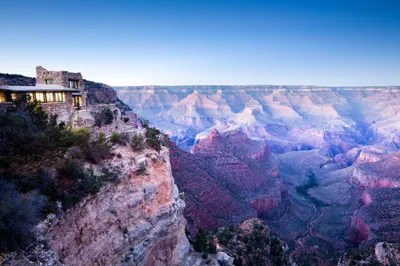
Where: South Rim Distance: 2.5 miles one-way from the Grand Canyon visitor center (check to see if the free shuttle is operating so you can take it back to your car) Best time to do the hike: Mid-September, when air conditioning at the visitor center offers a respite from the heat and the Grand Canyon Conservancy, the park’s nonprofit partner, typically kicks off its annual Celebration of Art. Nearby Lookout Studio (pictured) also affords views, and a gift shop, naturally Highlight from the trail: Passing through the Trail of Time with its geology exhibits en route to the perilously perched Kolb brothers’ photography gallery built in 1905, now a hub for artists exhibiting works inspired by the Canyon Best for: Beginners with a penchant for art and human history
Grand Canyon Lodge via the Transept Trail
Where: North Rim (open May 15–October 15 only) Distance: Four miles round-trip Best time to do the hike: September–October to walk amid changing, fiery-colored aspen groves Highlight from the trail: Hiking directly from the popular lodge to the edge of the Canyon, alternating between dense woodlands and killer cliffside views of the Transept tributary and Bright Angel Canyon Best for: Beginners looking to get their feet wet hiking at North Rim’s high elevation
Toroweap Overlook
Where: North Rim (open May 15–October 15 only) Distance: Two miles round-trip from Tuweep Campground Best time to do the hike: May to June, before the muddy monsoon season Highlight from the trail: Backcountry vibes off the tourist map and the chance to stare down the edge of an abrupt gorge and a 3,000-foot sheer drop, the tallest in the Grand Canyon Best for: Any level of hiker craving a rugged, remote option and prepared for the rough drive (a high-profile vehicle is a must)
Ken Patrick Trail to Point Imperial
Where: North Rim (open May 15–October 15 only) Distance: 5.4 miles round-trip Best time to do the hike: June for spring wildflowers Highlight from the trail: Hiking through a wooded alpine climate to the highest overlook point on the North Rim at 8,803 feet Best for: Intermediate hikers who prefer minimal elevation changes
Bright Angel Trail to Indian Garden Campground
Where: South Rim Distance: Nine miles round-trip Best time to do the hike: October to December for minimal crowds, color-changing cottonwoods, and a festive finish with holiday cocktails outside on the veranda of the historic El Tovar Hotel Highlight from the trail: Descending into Native American history with rock pictographs en route to the turnaround point of Indian Garden campground, a lush, creek-fed oasis once farmed by the Havasupai Best for: Intermediate hikers who want a solid introductory descent into the canyon
South Kaibab Trail to Skeleton Point
Where: South Rim Distance: Six miles round-trip Best time to do the hike: November–October (though it’s good anytime but April, when high winds can overcome this exposed hike) Highlight from the trail: A quick, switchback-laden descent opening up to a ridge and 360-degree panoramas with views to the North Rim, across the river corridor, and then, from Skeleton Point, a rewarding perch about 1,000 feet above the rarely spied Colorado River Best for: Experts looking for jaw-dropping views of the canyon and the river below
Grandview to Horseshoe Mesa
Where: South Rim Distance: Six miles round-trip Best time to do the hike: September–October and March–May for comfortable, snow-free temperatures on a challenging hike Highlight from the trail: One of the most remote trails from the South Rim, this rugged backcountry route doesn’t lead to Phantom Ranch or take you from rim to rim, but does offer an uncrowded option through signature Grand Canyon scenery, deep into the desert and high up to a forested mesa sprinkled with pioneer mining history Best for: Experienced hikers with between a few hours and a half day to explore
Grand Canyon Rim Trail to Hopi Point
Where: South Rim Distance: Five miles round-trip from Bright Angel Trailhead Best time to do the hike: June through July, when shade under the pines offers respite from a blazing summer sun Highlight from the trail: Accessibility may be the draw, but sweeping views of the West Rim from the wide Hopi Point promontory will impress every level of hiker Best for: Beginners and those who’d rather trade elevation for a flat, well-maintained trail
Check out the Cluvens IW-SK zero-gravity esports gaming chair. This scorpion modeled chair can support three curved 27-inch monitors or a single ultrawide 47-inch monitor attached with HDMI/DP ports. All three monitors are supported by the chair’s “scorpion tail” which can also be adjusted for viewing distance and angle. The seat itself reclines as the chair adjusts. The whole thing weighs 120kg and measures 165 x 208 x 119cm when extended, so it’s almost as big (if not, bigger) than a single sized bed.
I love finding old adventure books from my childhood – but eBay and many online shops often charge top dollar. Here’s some cheap sources for rarer paperbacks.
Back in the day before cheap digital displays, travelers all over the world used to listen and use these wonderful displays. They were especially popular in European train stations and airports. I say listen, because I still gets waves of travel nostalgia every time I hear them updating.
They are called split-flap displays – because they consist of flaps with digits/letters printed on them that rotated until the right digit or letter is displayed.
Sadly, with the advent of cheap digital, flip-discs, and dot-style displays, these old flip-style mechanical displays have mostly disappeared.
However, a few people have tried to re-create these mechanical wonders. With 3D printing, many people have made their own.
Probably the biggest/most authentic recent attempt is VestaBoard. At $2250 for a board, it certainly isn’t the cheapest version out there – but it does sound right.
Japanese artist Katsumi Hayakawa’s explores the impression of architectural density through delicate three-dimensional installations. The intricate sculptures were all hand-crafted piece by piece out of paper and glue, creating an awe-inspiring assemblage of multi-layered urban conditions at different scales.