Hiking the Upper Salmonberry River Trail
Somewhere in the coastal range, there is an abandoned rail line that has some epic bridges and tunnels. I had a wonderful 8 mile hike along some abandoned rail in the Oregon coastal mountain range.


Somewhere in the coastal range, there is an abandoned rail line that has some epic bridges and tunnels. I had a wonderful 8 mile hike along some abandoned rail in the Oregon coastal mountain range.
I grew up in the midwest, and morel mushroom hunting was an annual tradition. I have fond memories of my grandfather cooking these at his house and eating them until I was completely stuffed.
So, with at least 2 vendors selling them at the local Saturday farmer’s market, I decided to buy a few pounds and try out some recipes.
The first recipe I tried was this one:
Ingredients:
8 oz. fresh morels, sliced once lengthwise
2 tbsp olive oil
1 tbsp butter
2 cloves garlic, finely minced
3 tbsp good white wine (if you wouldn’t drink it out of a glass, don’t cook with it)
Directions:
In a large pan, saute morels, olive oil, butter, and garlic for five minutes. Add white wine. Continue sauteing for 5 more minutes. Mangia!
Note: Adding anything else to the morels, coating them in anything, or putting them in any sauce or soup is blasphemy, plain and simple. If you want to coat them in batter and drown them in grease, or otherwise hide the texture or flavor of these wonderful harbingers of Spring, send your morels to me, and I will send you some button mushrooms.


It was fantastic. They were light and delicious. I started scarfing them down as fast as I could cook them. My favorite!
Next up was to find a deep-fried sort of recipe like I remember from my childhood.
This one was much more like I remembered, but I put the batter on too heavy during the first batch. The second batch was better – so the key is to keep it light. While more like I remembered as a kid for sure, I found them overly heavy with the breading – but that didn’t stop me from eating them all. It was great to relive some memories of my younger years.


Modern day video games have come a long way from Mario the plumber hopping across the screen. Incredibly intricate environments of games today are part of the lure for new gamers and this experience is brought to life by the characters interacting with the scene. However the illusion of the virtual world is disrupted by unnatural movements of the figures in performing actions such as turning around suddenly or climbing a hill.
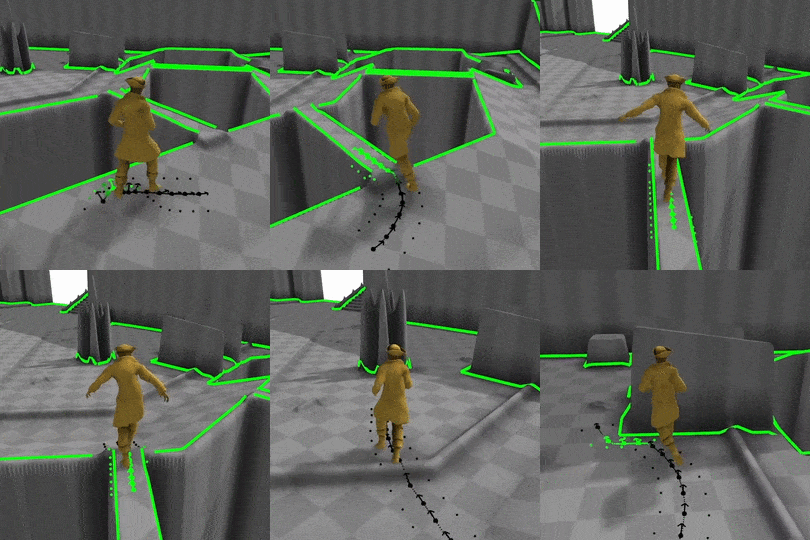 To remedy the abrupt movements, [Daniel Holden et. al] recently published a paper (PDF) and a video showing a method to greatly improve the real-time character control mechanism. The proposed system uses a neural network that has been trained using a large data set of walking, jumping and other sequences on various terrains. The key is breaking down the process of bipedal movement and its cyclic behaviour into a series of sub-steps or phases. Each phase translates to a natural posture for the character while moving. The system precomputes the next-phases offline to conserve computational resources at runtime. Then considering user control, previous pose of the character(including joint positions) and terrain geometry, the consequent frame of the animation is computed. The computation is done by a regression network that calculates future position of the joints and a blending function is used for Motion Matching as described in a presentation (PDF) and video by [Simon Clavet].
This is crazy. These guys tour around the US and live re-enact the classic 80’s Keanu Reeves’ movie “Point Break”. But even better, they come with no lead actor. They grab a few willing fans out of the audience who quickly do 3 different audition quotes, the audience votes for the best one, and that person becomes agent Johnny Utah for the next hour and a half.
It’s a pretty hilarious time – totally recommend it.


Model maker Adam Throgmorton shows off an incredible build – a fully functioning, massively intricate HO-scale replica of an old-school wooden rollercoaster. He reports he worked on it over the course of 6 years.
I’m also going to bet he’s not married since it seems to have its own table in the house. 🙂

Australian photographer Murray Fredericks journeys to the center of Lake Eyre, a desert salt lake. Fredericks drags all of his equipment out into the barren landscape, capturing the dramatic sky reflected in both the inch-deep water and his rectangular mirror. The images are breathtaking color-based works.
Jack Johnson captured this stunning 4K flyover of Japan’s cherry blossom trees. With the help of an app called Litchi, he was able to repeat his drone’s flight path over time to show them gradually blossoming.
When the robot overlords take over, they will amuse themselves at our expense like this…
Ben Einstein does an excellent analysis of the failure of many smart gadget companies.
His analysis breaks down like this:
First generation products are always plagued with bugs, fail whales, and even the occasional mass-recall – most companies can bounce back from these setbacks. But other companies do not. It boils down to risk.
Technical Risk and Product Risk
When it comes to hardware startups, there are two types of risk. They are manageable on their own, but together often spell failure. These risks are: technical risk and product risk.
Technical risk is the chance you can’t deliver a product due to an engineering or manufacturing constraint. Examples from Coin: getting an e-Ink screen, Bluetooth antenna, battery, and microprocessor all working in a 0.76mm thick PVC card.
Product risk, however, is the risk that many overlook. Most products have low product risk. They routinely fail in small ways, but those failures are viewed as mere annoyances. A pop top that breaks off once every 1000 cans of Coke, the Roomba that occasionally misses a spot, an Alexa that mistranslates your command and you try again. Not big deals. But an automated door lock that fails might leave one stranded outside at 2am in a bad part of town or opens the door to robbers, a website that exposes your address and bank accounts for emptying, or your sole payment method that fails you at a fancy dinner are another matter.
You likely have high product risk if any of these are true:
The Goal:
Your goal then is to only have high risk in one of the two risk classifications. Very few companies that have both kinds of risk survive. Tesla and SpaceX are notable exceptions, which should give you an idea of the efforts you will need to go to in order to overcome these risks. The other method is to reduce your feature set to minimize technical complexity or lower user expectations in case of product failure.