Japan Day 4 – Odiaba, a giant Gundam, and the Statue of Liberty?

Japan Day 4 – Odiaba, a giant Gundam, and the Statue of Liberty?
IMG_1997 IMG_8234 IMG_8229

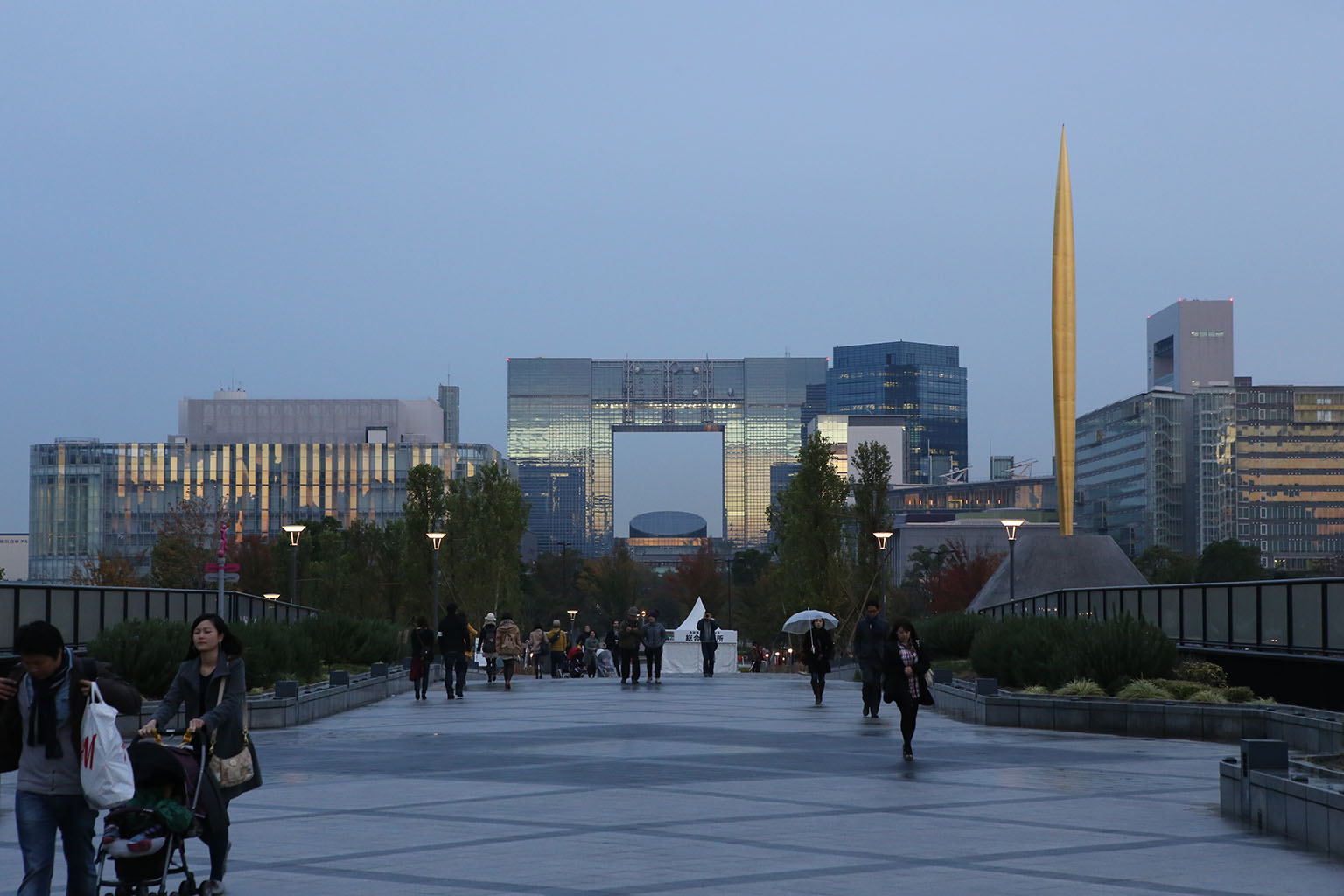
Odiaba island is a large, artificial island in Tokyo bay.  Starting as a military defensive base in the 1800’s, it grew dramatically as a port hub in the 1900’s. In the 90’s it got targeted during the the Japanese real estate boom as a commercial and ‘future showcase’ development area.  The mayor of Tokyo began a major development plan for the island called Tokyo Teleport Town and was designed to showcase futuristic living.  It had residential and commercial development for about 100,000 people.  However, the mayor’s successor halted the plan in 1995 as the Japanese asset bubble popped after a great number of the lots were still vacant and the area underpopulated.  Unfortunately, over 1 trillion yen (~$10 billion USD) had been poured into it by that point.  Many of the special companies that developed the island quickly went bankrupt as Japan went through their ‘lost decade‘ during the late 90’s as the overvalued asset bubble unwound.  Since then, it’s languished – and it shows.

It has absolutely enormous buildings in a large-scale city-planning style.   Capturing the scale of this complex is very difficult due to the huge buildings and the gigantic open spaces between them. The whole place feels like a bit like those images of Chinese ghost cities but with odd futuristic buildings that look nearly empty and few people walking around.  It was actually kinda creepy.

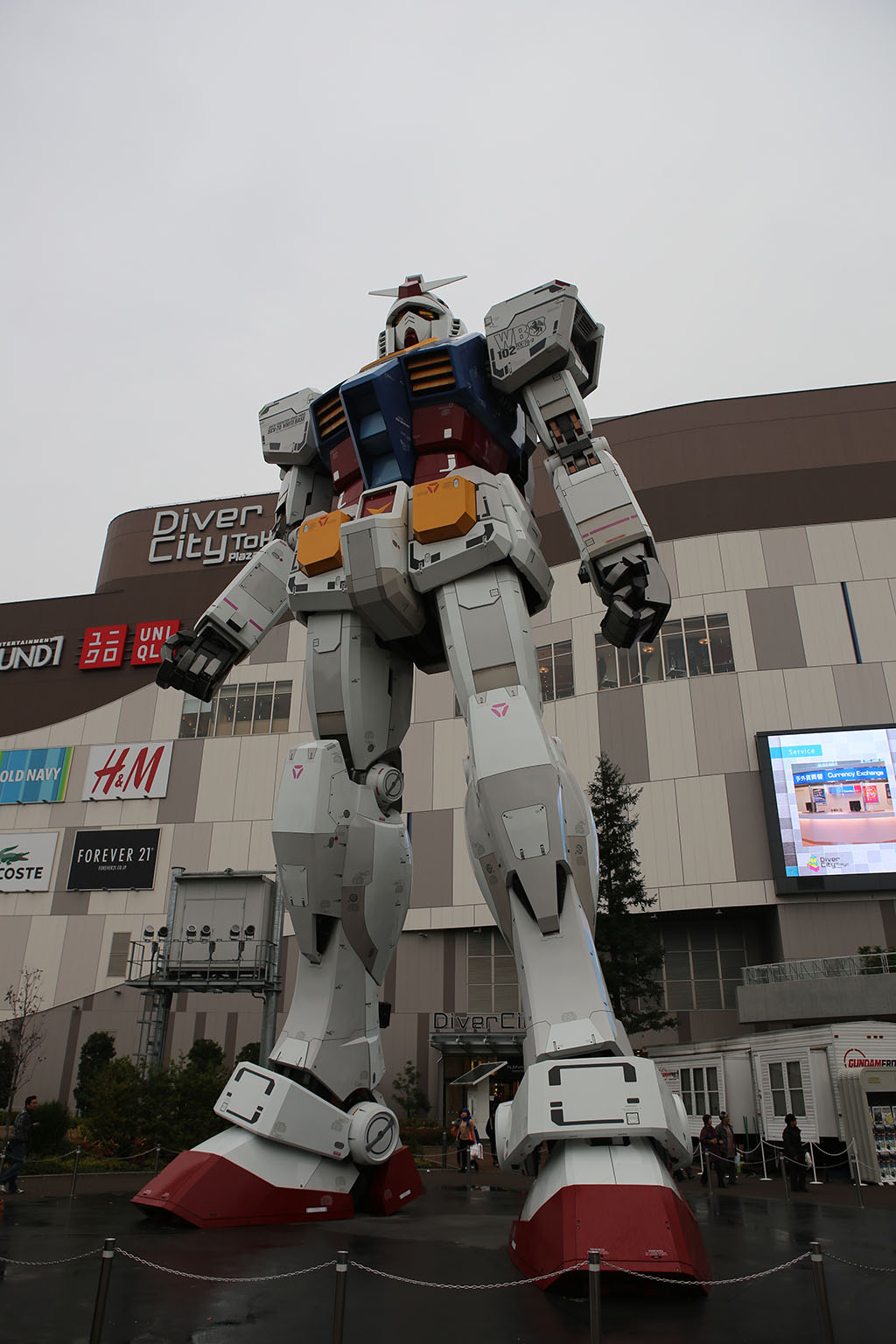
I could easily have spent a day walking around the humongous city/island.  The buildings were nearly miles apart.  But I was looking for Diver City.   Diver City is a large and very nice modern mall.  I found it just a short walk off the rail line.  It’s about 5 floors of shops – and reminded me very much of any modern mall you’d see in the US.  Almost all the same stores were there too: Old Navy, H&M, Diesel, American Eagle, etc.  The food court also had a lot of mall-style chains like McDonalds, Starbucks along with lots of local chains I didn’t recognize.  They had some higher-end shops and gourmet chocolate stores as well.  So, overall, on the flashier end of mall stylings.  But this wasn’t what I was looking for.  I was quickly trying to find a certain recent addition before the afternoon show.
IMG_8161  IMG_8165

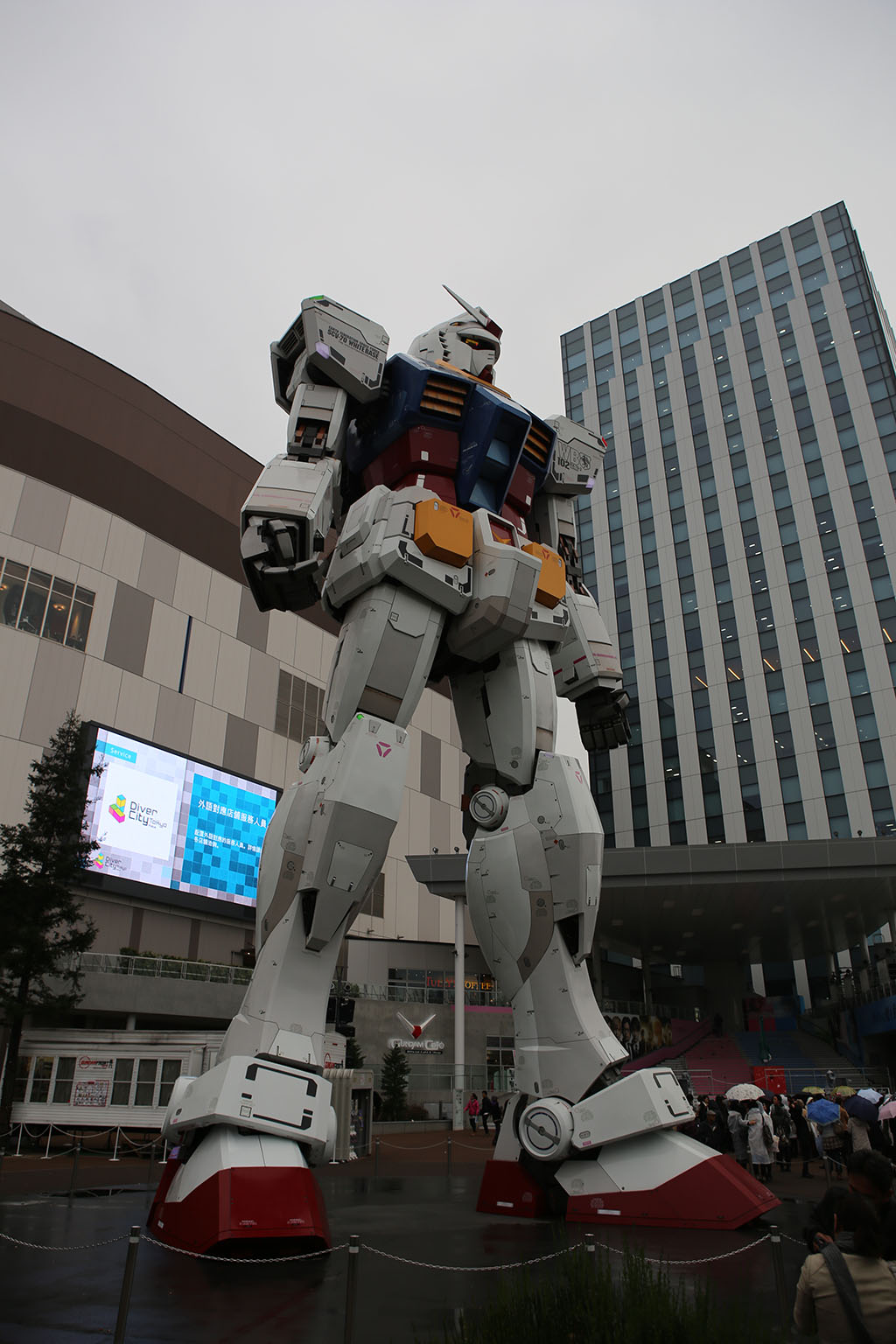
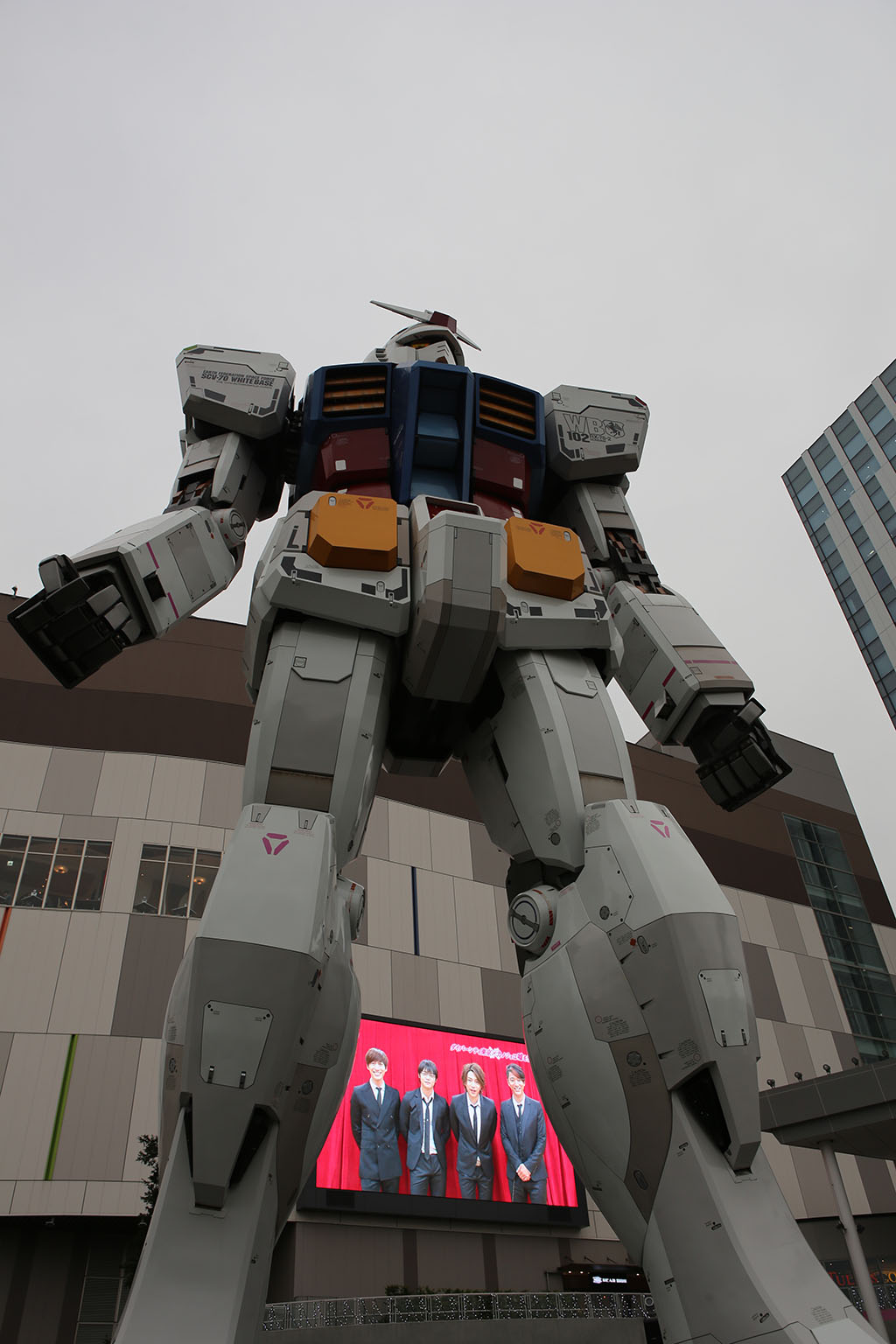
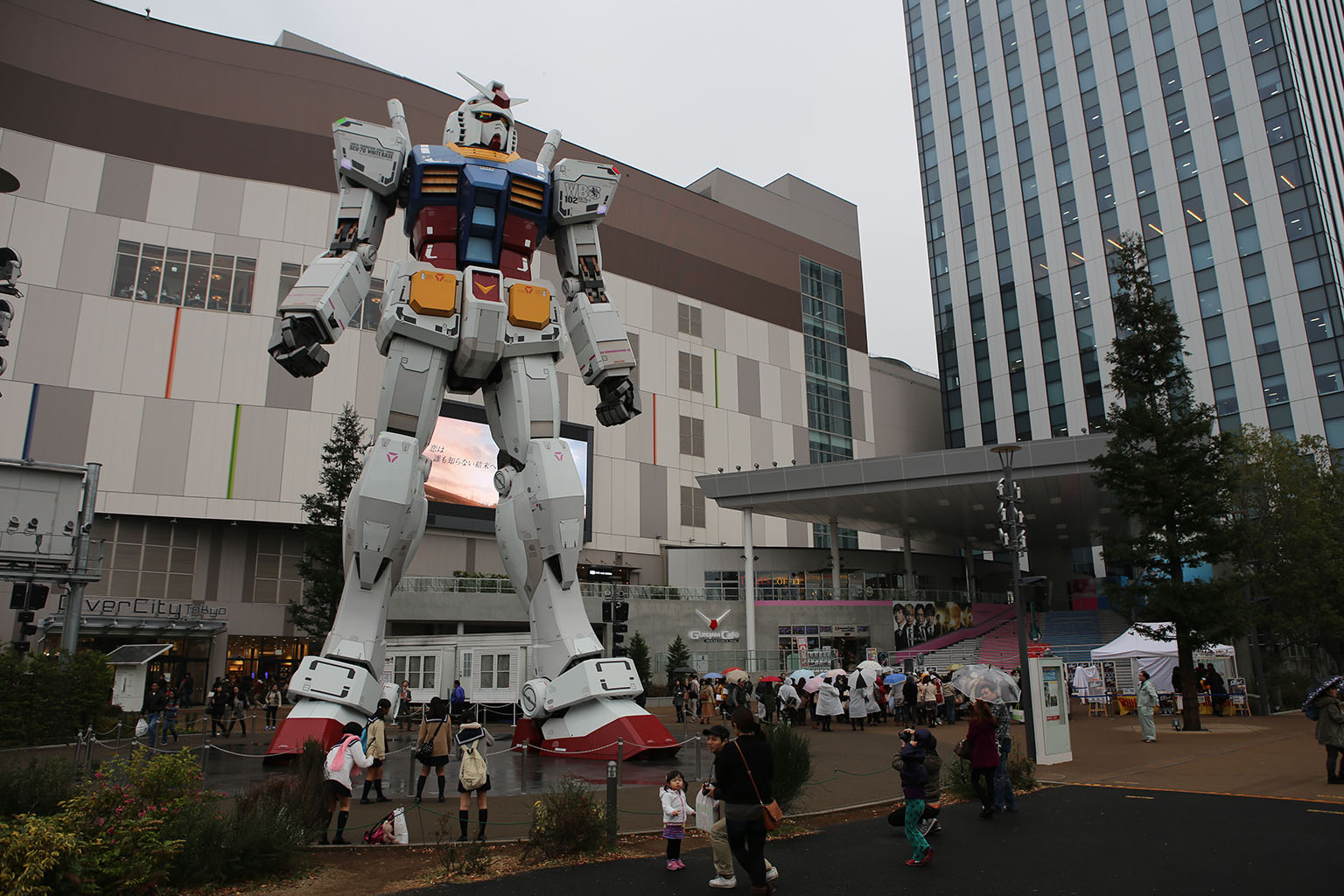
I head out the door of the food court and – bang!  There it is – the Giant 60 foot tall RX-78 Gundam.  This giant robot/statue/installation was originally built by Bandai in Odaiba’s Shiokaze park to mark the 30th anniversary of the massively popular Mobile Suit Gundam franchise.  It was first constructed and unveiled in July 2009, and made a big splash with fans.  It was so popular that in March 2010, they rebuilt it with a light saber.  Since then, it found it’s more permanent home at Diver City.  They have daily shows where lights, smoke, music, pour from the robot as it comes to life.  The daytime shows look just like this:

The night-time shows have lights and video accompanying them. I had a few minutes before the afternoon show, so I looked around the foot of the giant statue.

 

IMG_8170 IMG_8176 IMG_8182 IMG_8186   IMG_8168

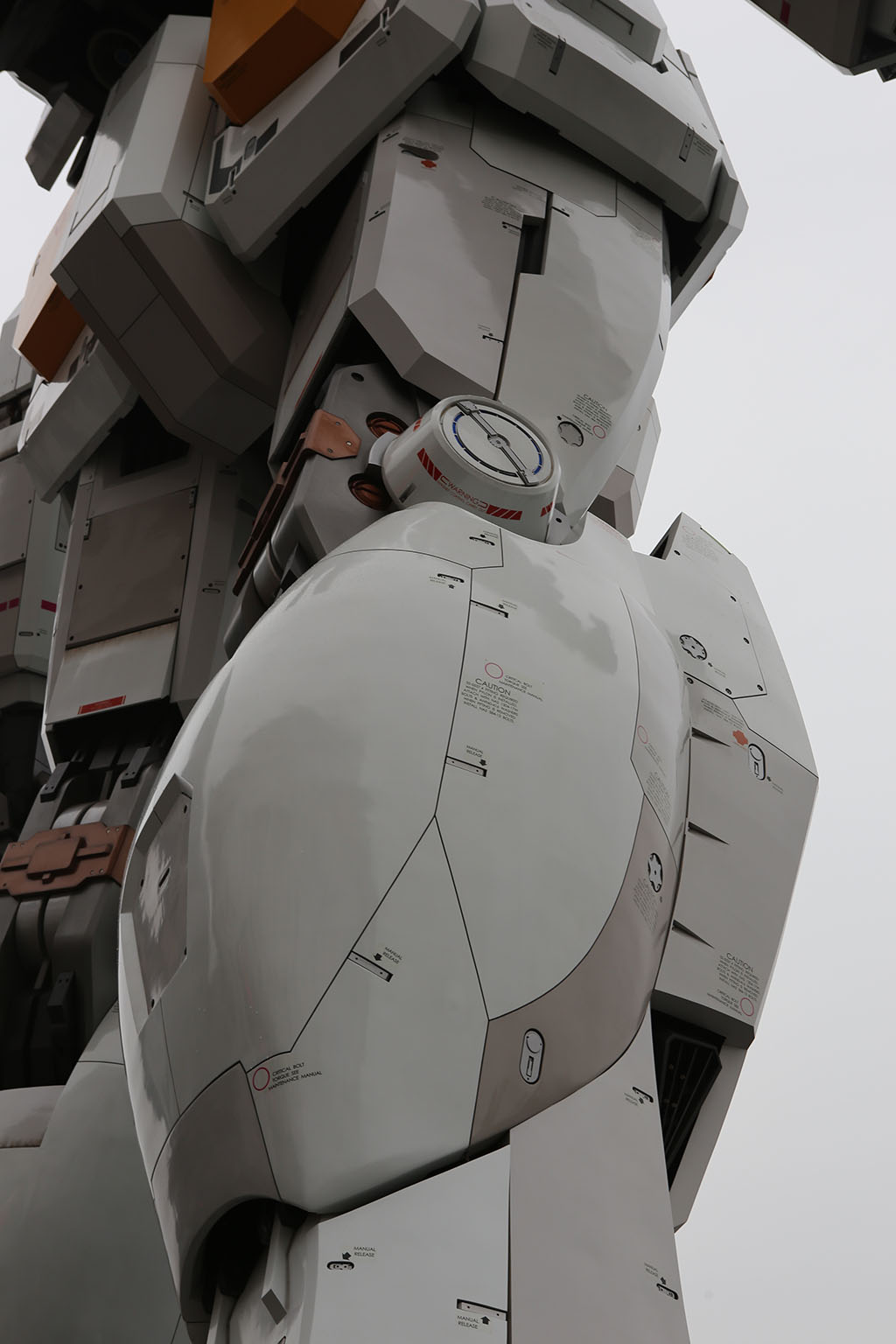
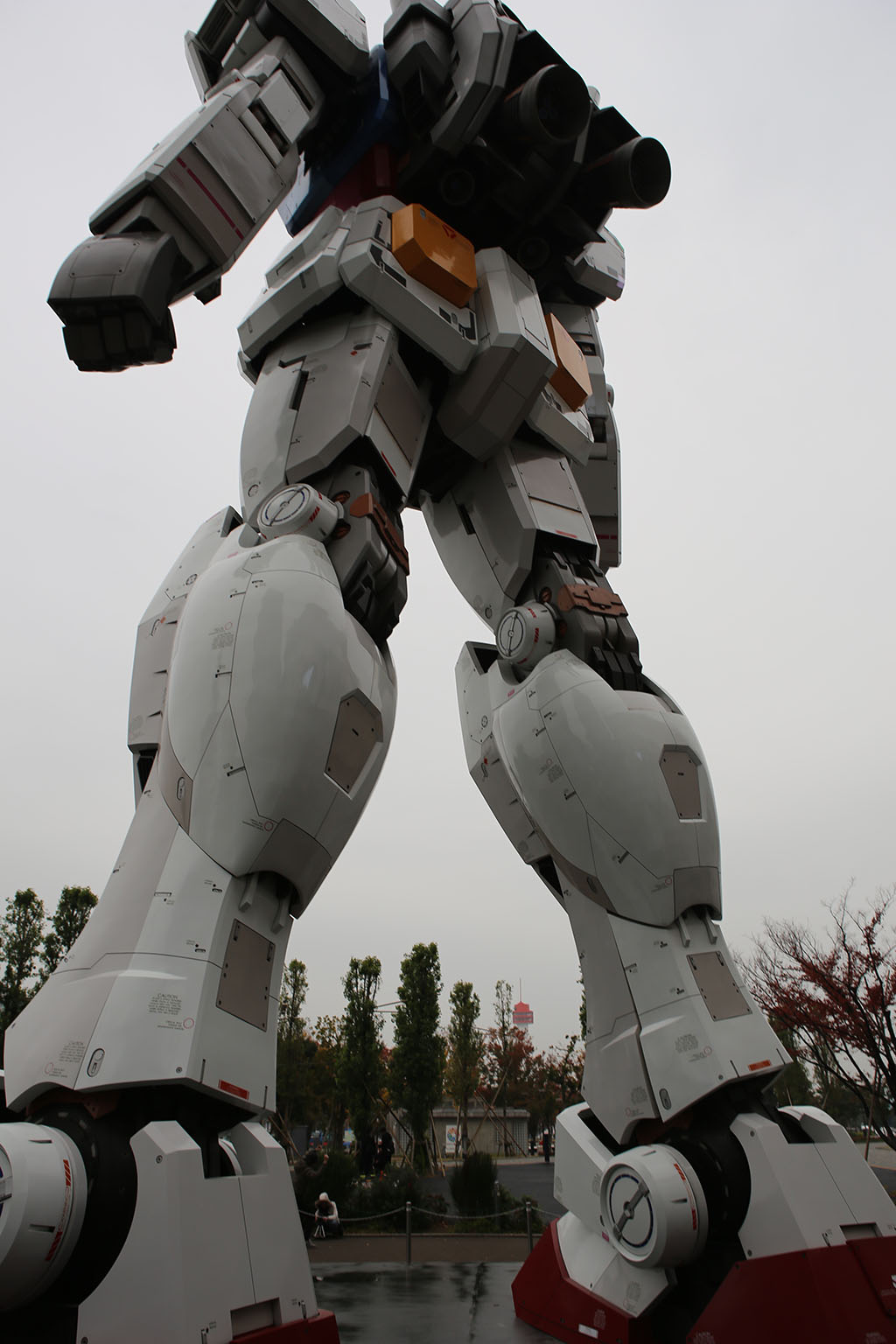
The detail was just fantastic.  Usually, with things this big, the closer you look the shoddier it is up close.  You look in between the joints and see hollow forms.  The section edges/connectors are actually just paint on a solid plastic form/etc.  Not with this thing – it was fantastically detailed even inside the less-visible areas.  Some serious love and care went into this statue.  Amazing amounts of detail were everywhere on it.

It was kind of interesting, because just to the right of the Gundam, was a small stage with HORDES of teen girls waiting in the sprinkling rain.  I couldn’t quite figure out what was going on until the Gundam show finished.  All of a sudden, the girls start yelling as a 4-teen boy band popped out of their tent and started singing on the makeshift stage.  It was kinda surreal to watch all these young ladies singing along with this 4-guy boy band next to a giant Gundam.  I went over to the Gundam’s temporary shelter area where they had a store selling a lot of their current Gundam line toys.


IMG_8214  IMG_8215

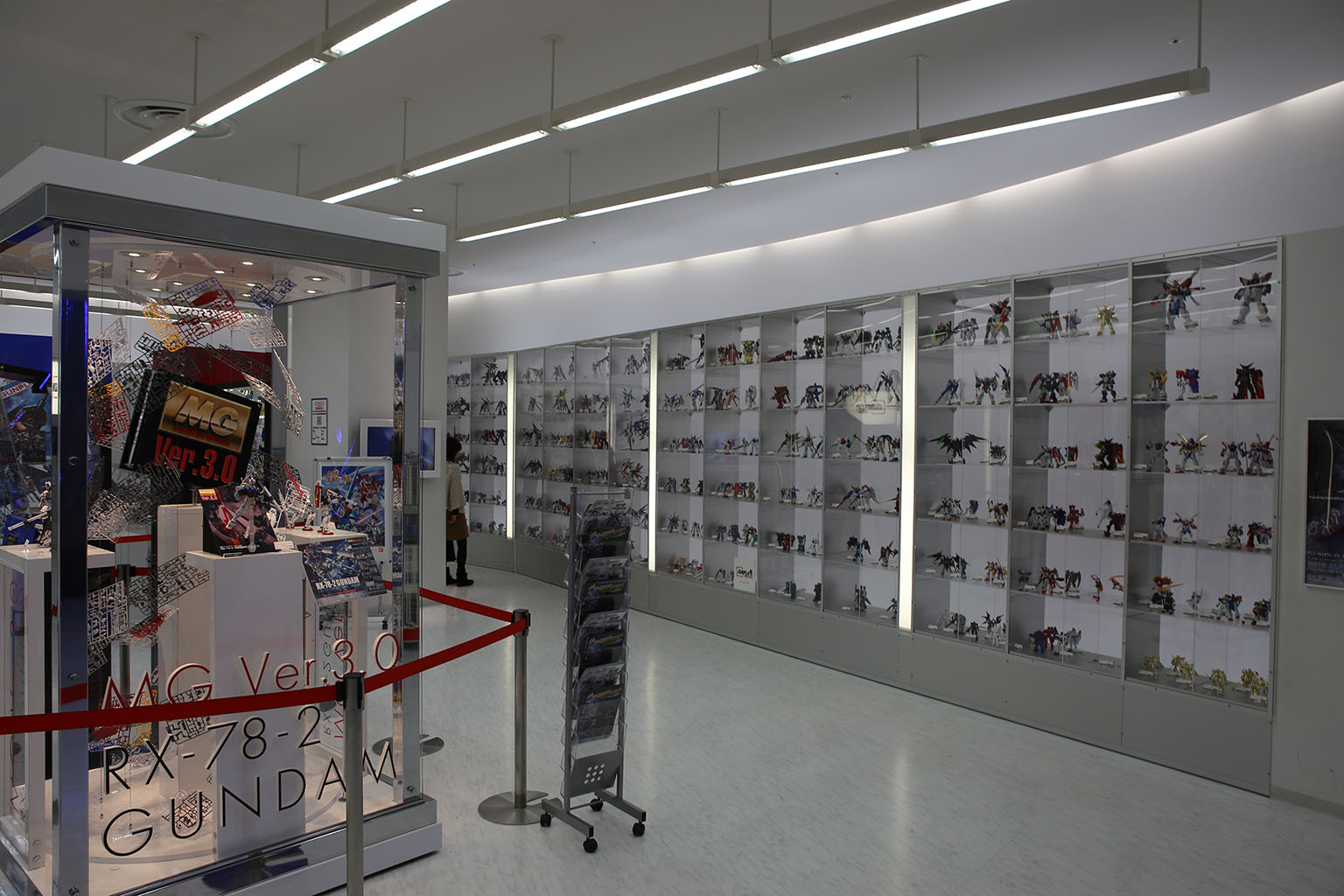
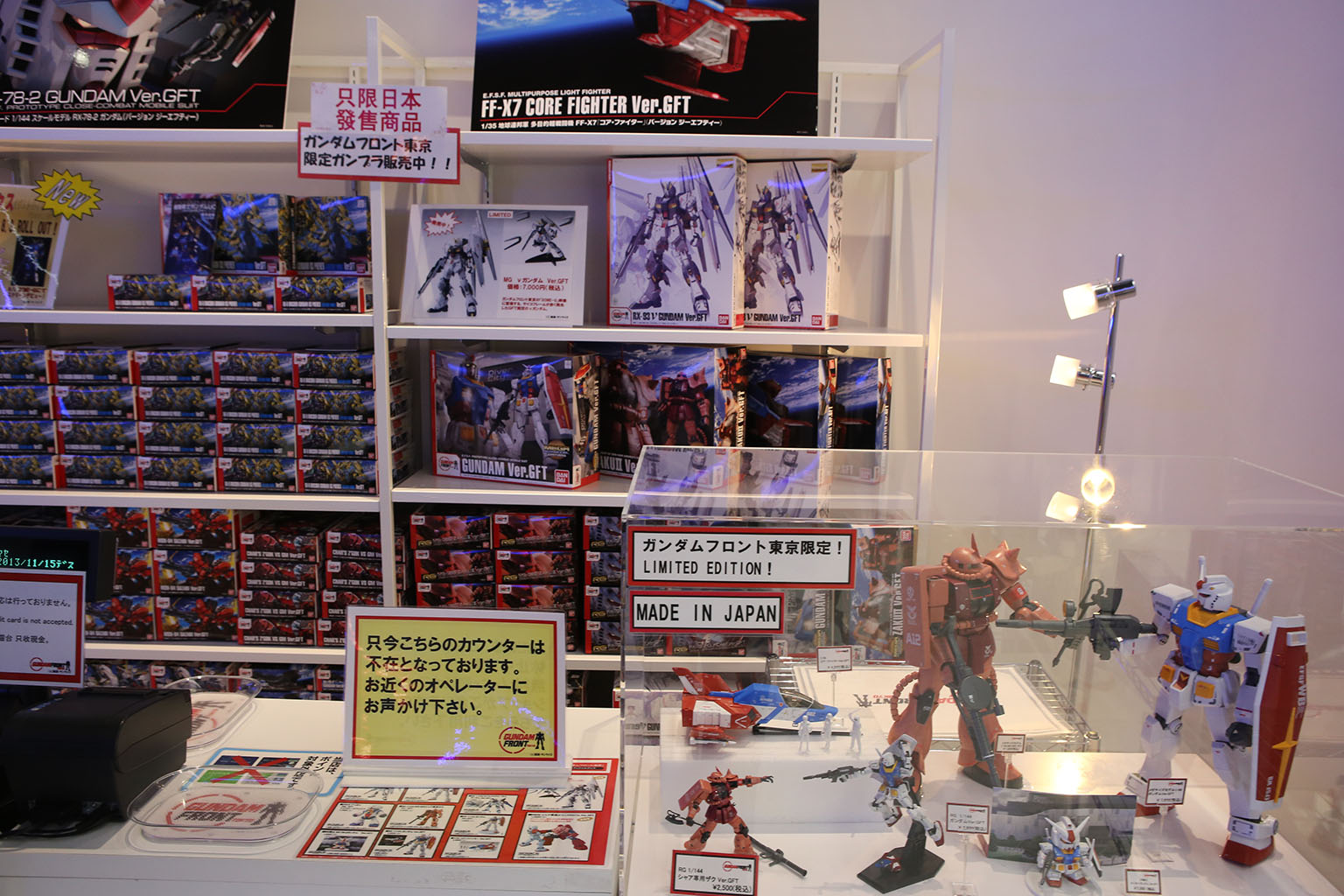
But that’s not all that’s Gundam at Diver City.  They have a whole museum area inside the mall on the top floor/north end called Gundam Front.   Gundam Front is a store/showcase/museum for the Gundam series.

IMG_8192 IMG_8193 IMG_8196 IMG_8200 IMG_8204 IMG_8208

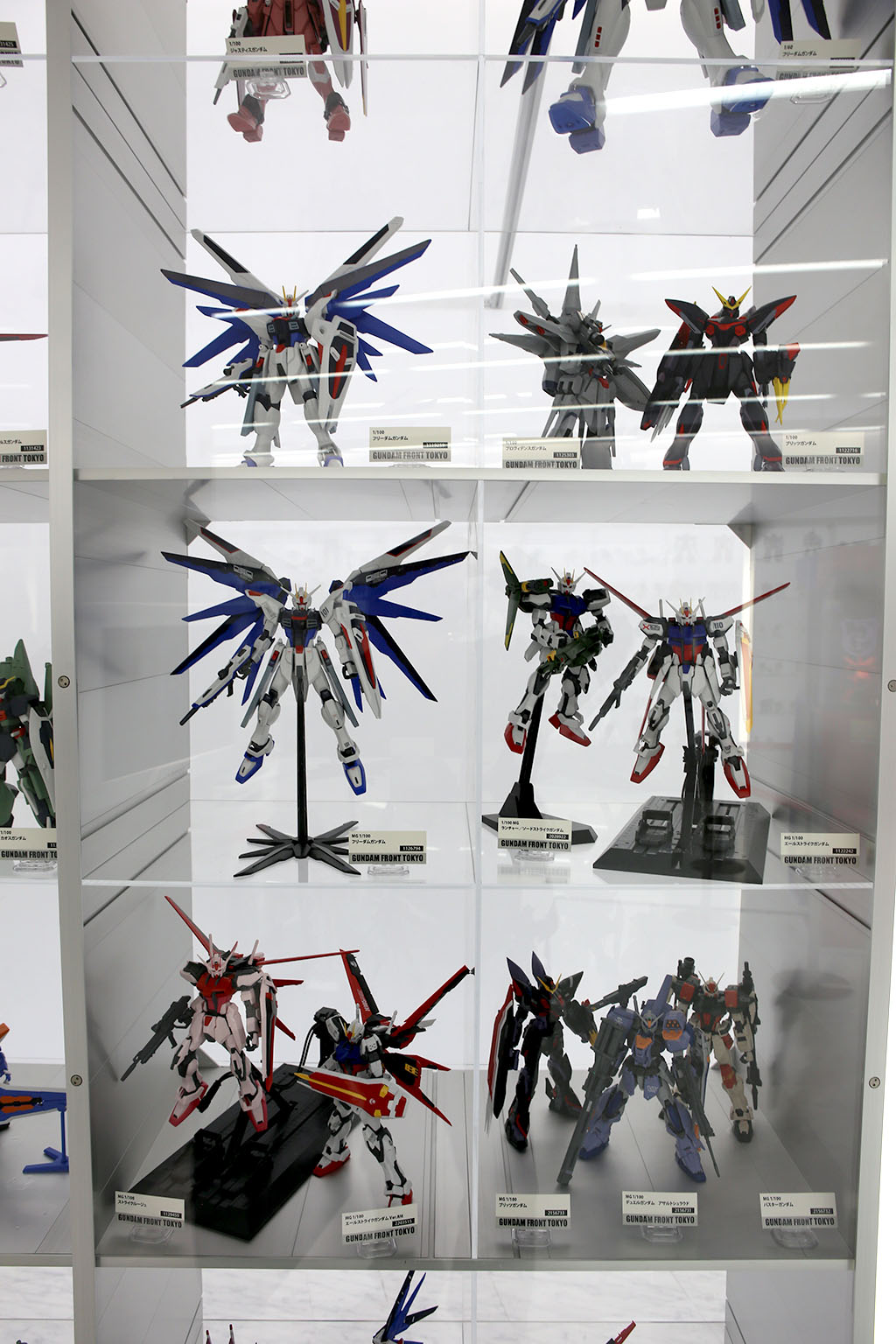
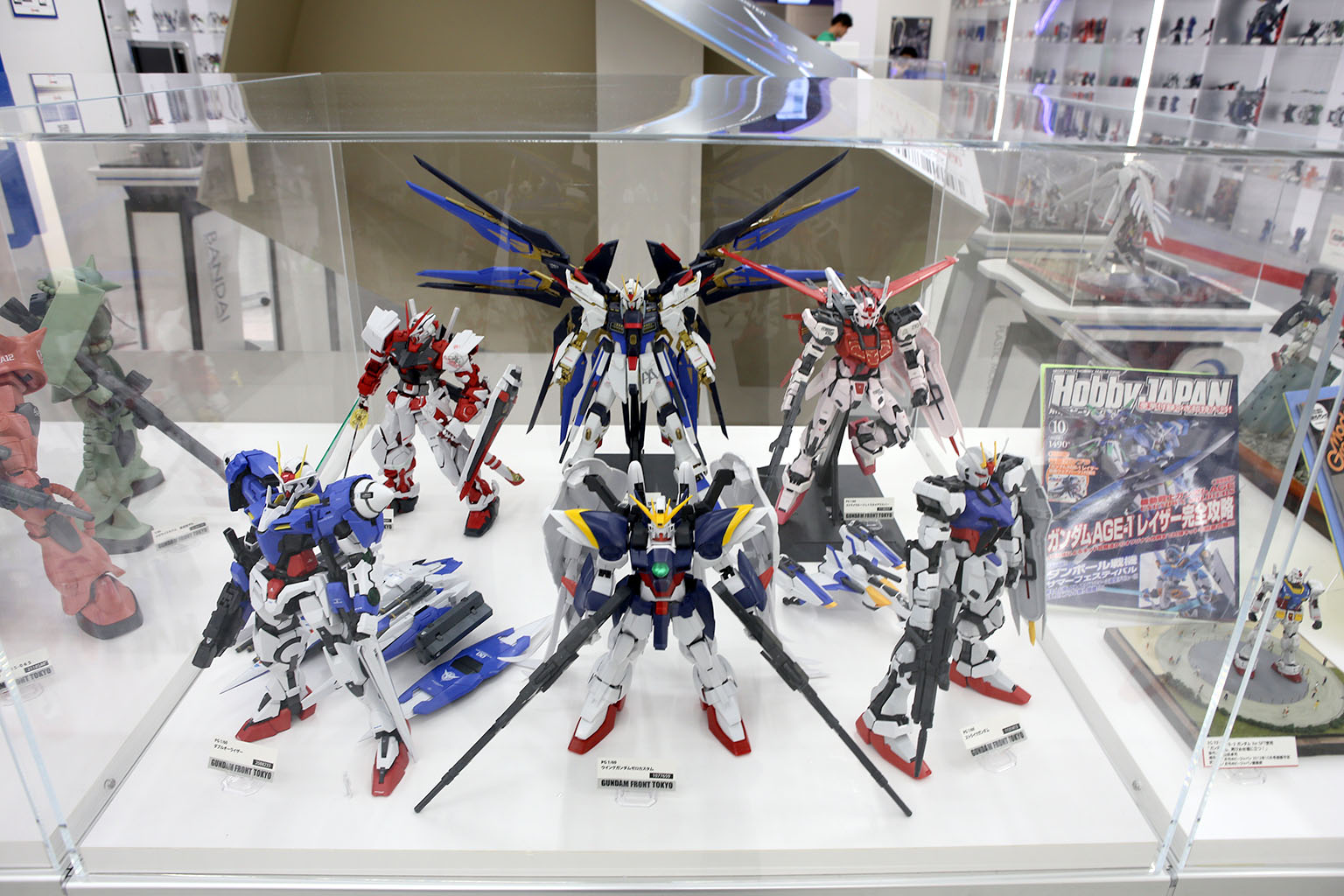
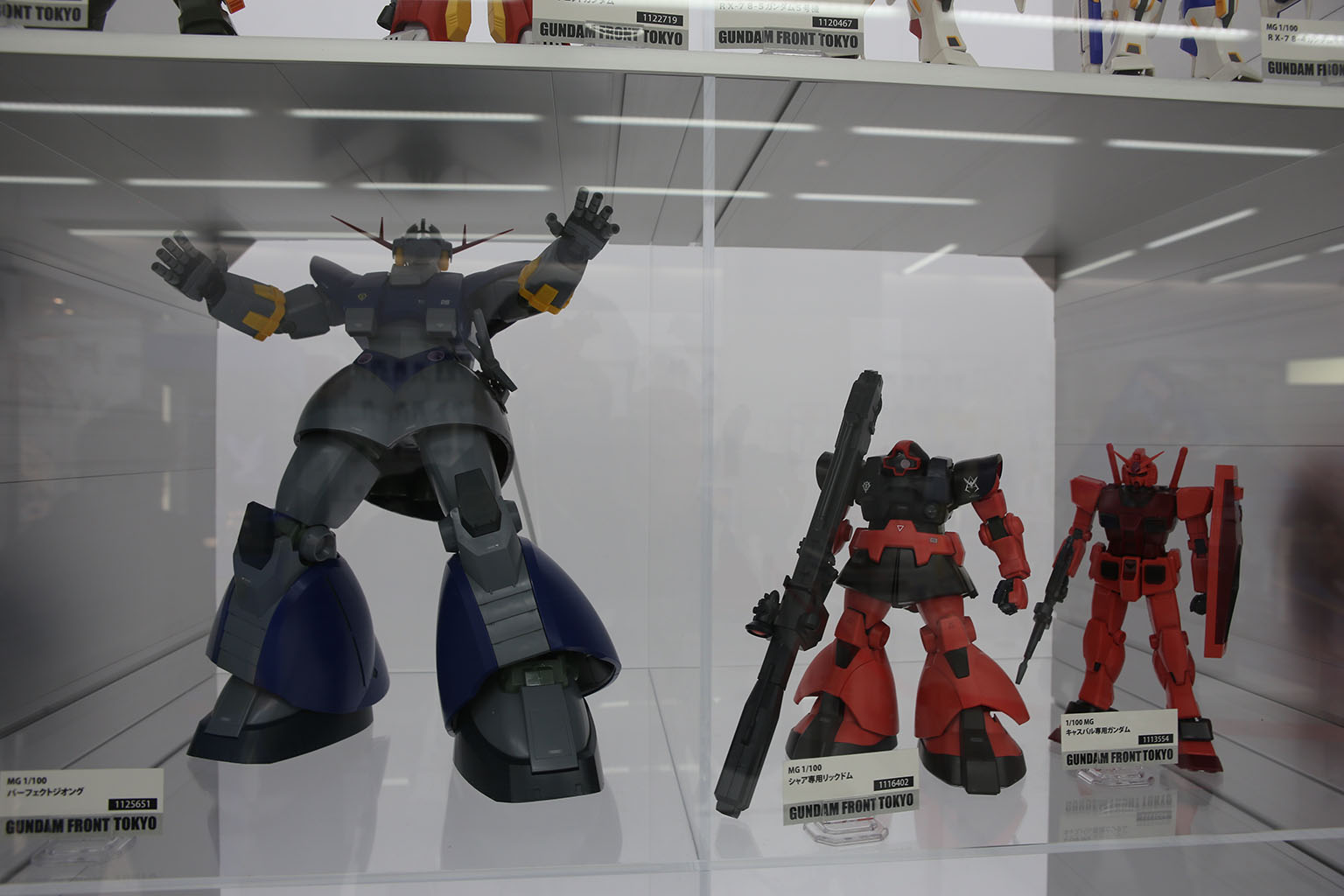
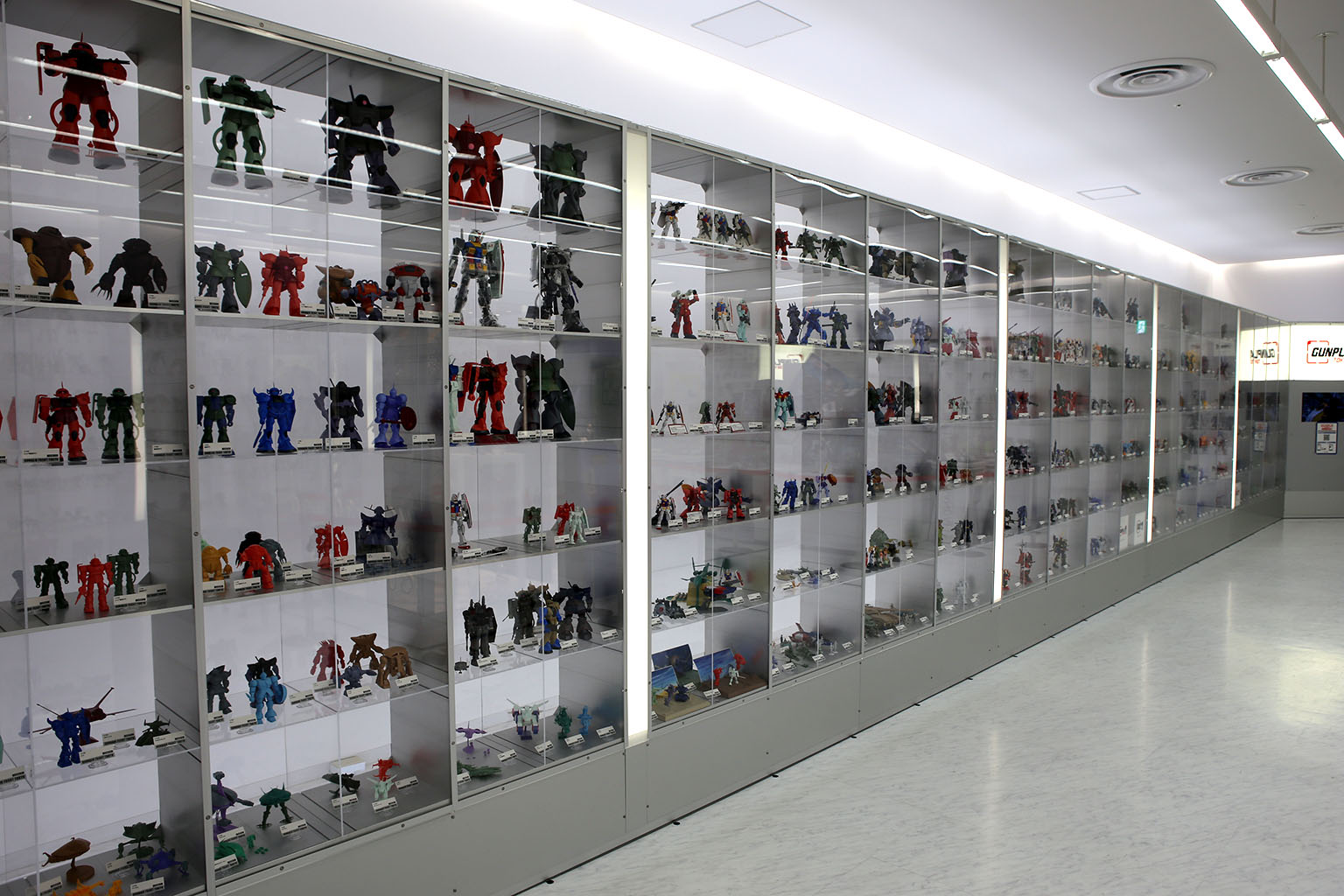
On your left as you enter is a museum are with just about all the Gundam toys ever made.  Two giant rows with special display cases in the middle.  You can see how they’ve evolved from very simple beginning to massive and complex models as time went on.  They went through a lot of different style changes too.  But it was pretty amazing to say the least.  One could easily geek out of the whole line.

IMG_8210

But it wasn’t all just toys.  They had a shop with clothing too.  I found the prices to be pretty amazingly high, but probably not an issue for true fans.  There was also a whole pay area to Gundam Front with life and scale-model sized Gundam suits along with many of their more famous enemies as well.  I decide not to pay the money to go in – and I believe they had assigned time slots as well.  I enjoy a good robot as much as the next guy – but I don’t think I was ‘hard Otaku’ enough to warrant it.

I grabbed a bite to eat at the food court and walked around the high-end shops of the mall a bit to get a feel for things.  I especially enjoyed the gourmet chocolate shops that had all kinds of interesting brands and styles. Strange styles of Pokey and candies I’ve never heard of before.  But, nothing too noteworthy as this mall was much like other malls, so I called it a day.

As I left, however, I was treated to one last gift from Tokyo.  Sunset.

IMG_8364 IMG_8386

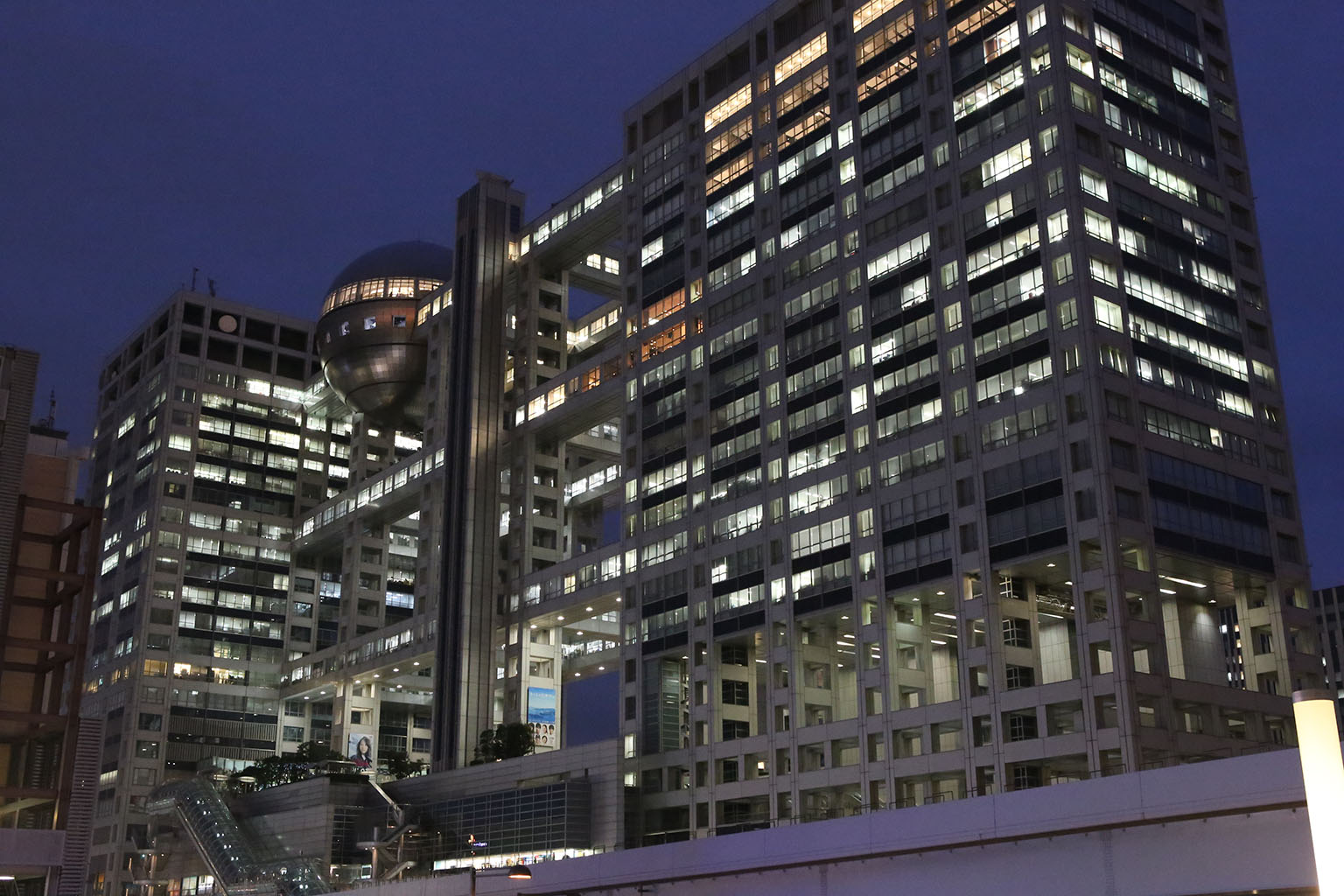
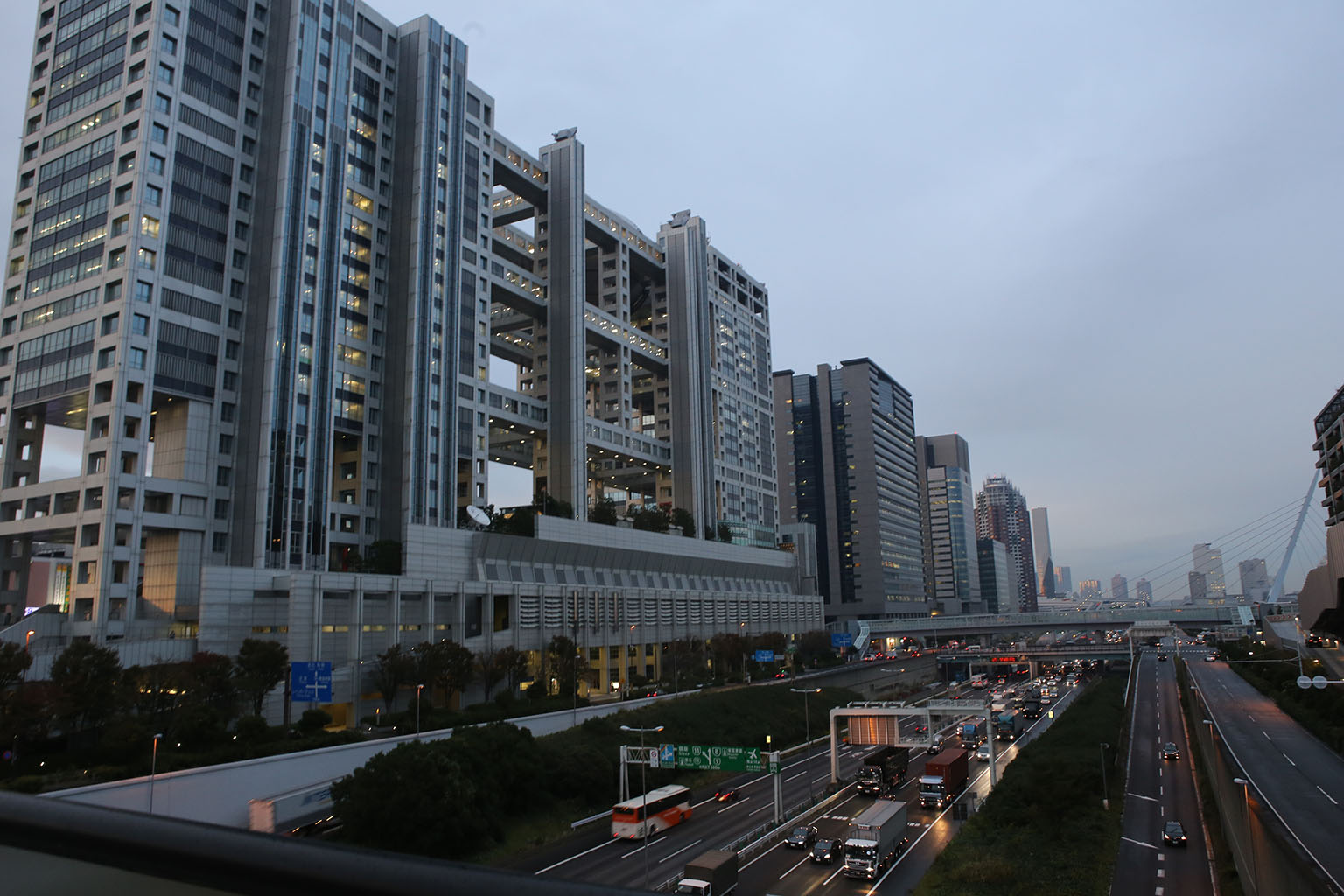
Being fall, sunset comes early.  The buildings on the way over to the train station already had their lights start coming on.  This particular building was intriguing, it reminded me of some kind of cross between a Sierpinski carpet (in this case a Sierpinski cube).  As I rounded the building, I was greeted by a few sights simultaneously.
IMG_8375b

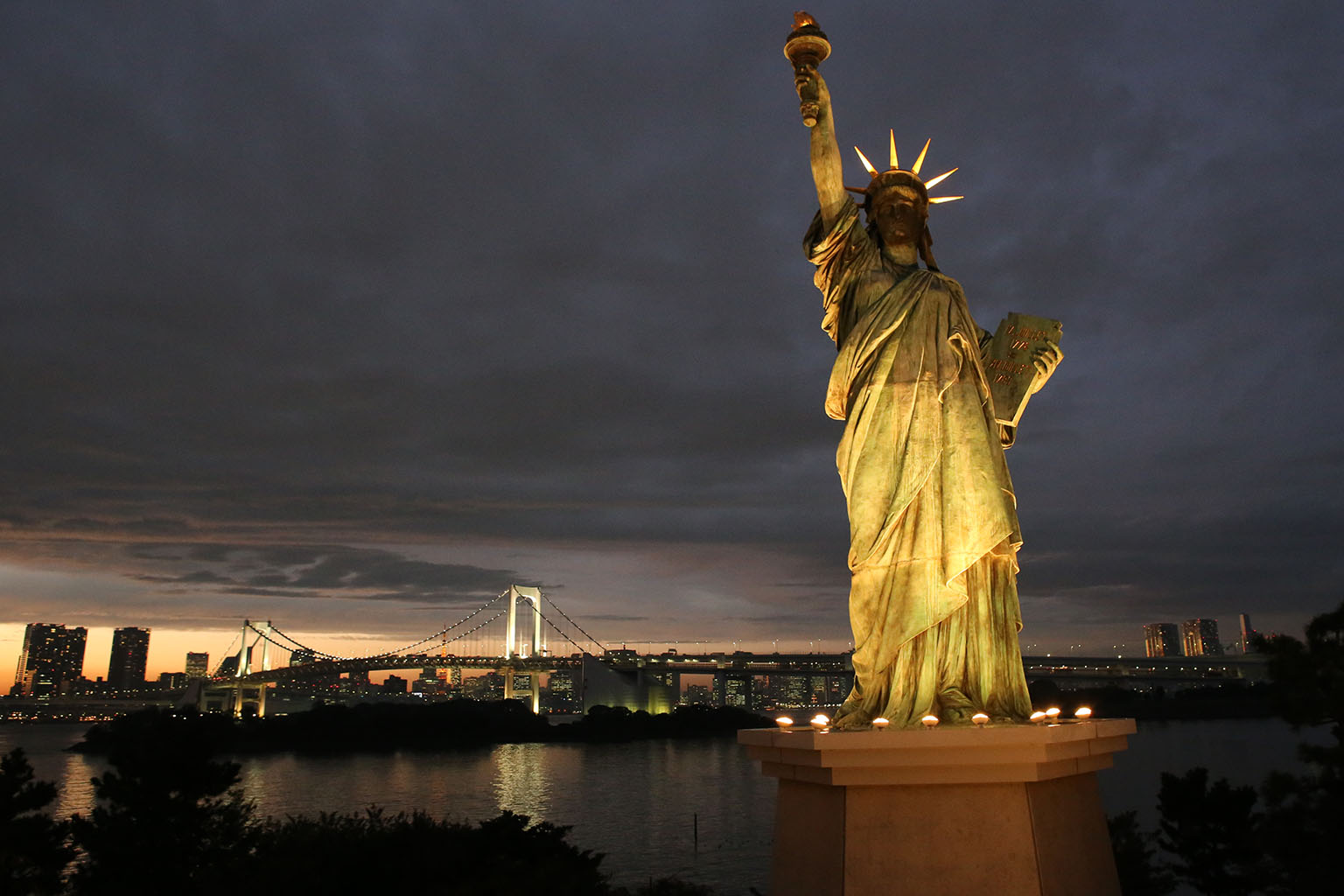
First off – the Statue of Liberty!?!  I had no idea there were so many Statues of Liberty around the world – let alone one in Japan.  This version was only about 30-40 feet tall, but there it was.  There was also a small area set up with a large Christmas wreath to stand in for folks to get their picture in front of the statue.
While taking this shot, a group of orange robed Buddist monks came up and started snapping shots too.  Kind of surreal to have the Statue of Liberty against the Tokyo skyline, a couple of Buddists monks in their orange regalia with cameras, English Christmas music playing with local tourists getting shots standing in a giant Christmas wreath.  My, what globalization has wrought.

IMG_8413s

Next amazing sight, the Rainbow bridge across Tokyo bay.  This night it was lit up white, but has been rainbow colored in other times.  However, it was very beautiful.

IMG_8310

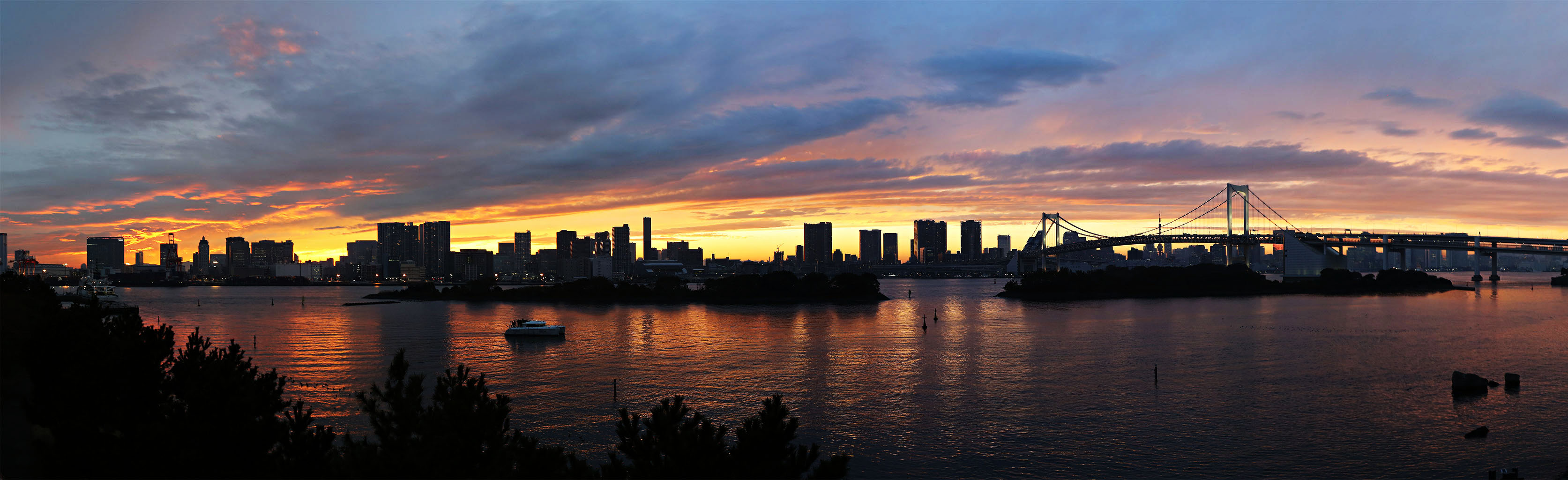
Finally, the sunset itself.  Wow – firey! Amazing colors as the setting sun found its way over the horizon.  I sat and enjoyed the setting, shifting colors.  So much so that I decided to take a nice wide panorama.  It came out beautifully.
IMG_8283sb-

As I just sat and watched, I realized that I hadn’t stopped running and seeing things since I got there.  I think when we travel that we often get too wrapped up in the process of traveling itself, seeing things, doing things, being on a schedule.  We often don’t make space in our schedules, nor place ourselves in the right places, to enjoy moments like this.  To smell the ocean breeze blowing across a bay.  Watch the sunset go down.  To see the changing colors of the sky.  Watch the lights slowly coming on in the buildings as the city moves into evening.

Life is a beautiful thing – and all too fleeting to spend it wrapped up in constant doing.  It’s in the quiet moments that you actual realize what life is about and see just how amazing and precious are the things you’ve been holding in your hands all along.
 

Japan Day 4 – Friends and interviewers

Japan Day 4 – Friends and interviewers

I awaken in the morning still feeling the light effects of the Fugu.  I decide to rest in a bit since it’s been a couple of big days.  I watch some TV shows that I brought over on my laptop and also get my Netflix working by using the awesome Firefox plugin called MediaHint.  It’s nice to be able to have a taste of home after a few days in a completely different country.  I’ll admit one thing I watched was Adventure Time.

IMG_1946

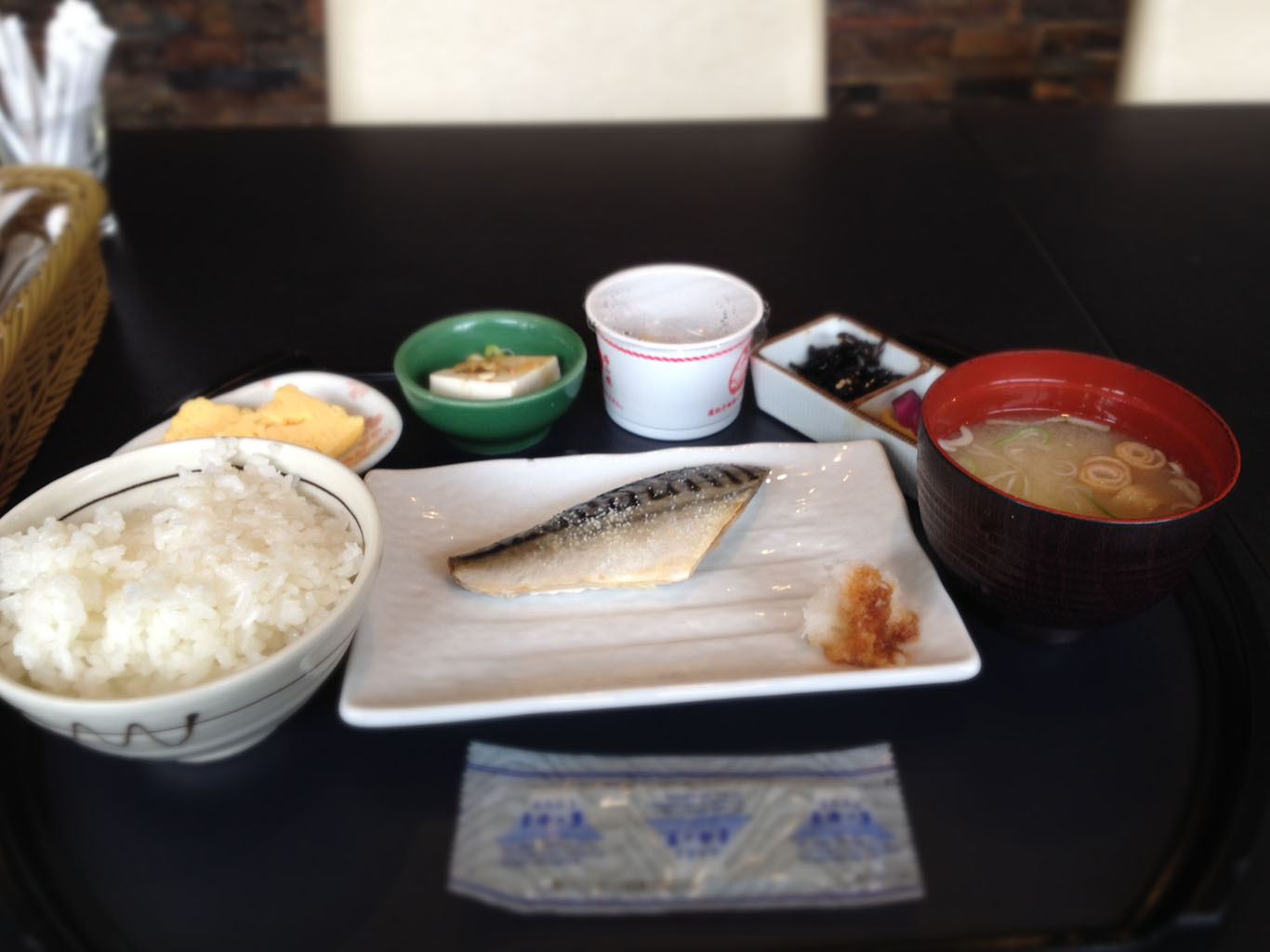
Still a bit disconcerted from the odd fugu feelings, I head down for breakfast at the hotel restaurant.  I get the traditional Japanese breakfast, and am then off to get my first big errand done – a shipping box and packing materials.

I run over to Tokyu Hands, a pretty remarkable and famous do-it-yourself department and crafts store.  I pick up a large box, and then run into these folks as I’m on my way out:

IMG_2098

They’re some kind of news/interview folks from some show called ‘Zip!’ TV.  My guess was it was kind of like the local cable-access channel.  They asked me if they could interview me about my purchase at Tokyu Hands.  After tentative agreement, signing a waver, and getting a tip or two from their translator – the camera guy switched on.  They asked me a lot of questions about my box.  What I bought it for, what I was going to send home. They had a young 20’s-ish kid from Vancouver, BC doing their translation and he admitted he kind of fell into the gig of translator for them.  Anyway, it was kind of awkward to admit that most of what I was sending home was Otaku stuff: some models, a few action figures, a DVD or two, and a nice tea set and some pottery.  Yes, pottery and tea set – that’s what I was sending home – and didn’t mention the otaku stuff.  My goodness, I guess I now know what it’s like to be Bill Murray in Lost in Translation!  But onwards, I had a meeting to get to!

IMG_1956  IMG_1957
At about 11 o’clock, I run over to the Shibuya Hikarie building to meet up with some friends-of-a-friend.  What a fabulous building.  It sits right behind the Shibuya station and is connected to it.  But the connection was described as “Hikarie is part of Shibuya station the way a tree is part of your house when it falls on it.”  Love it.

Before we went to lunch, however, one of the guys I was about to meet was super-helpful and we ran over to the post office.  He helped me get my box of otaku wares shipped – so thanks Howard!  I still have yet to see it about a month later, but they did tell me that sending it via surface ship could take 2-3 months.  No hurry thankfully.  We had a great lunch and we chatted about much geekery.  Great success.  Thanks Tanya for setting us up.

But after lunch, it was time to get to touring again!   On my way back to the hotel, I take a little different route, and what do I find?  A pet store!

IMG_1961 IMG_1959 IMG_1965 IMG_1963

So, how much does a cat in Japan cost?  89,000 yen is roughly $900.  How much is the little black and white doggie in the window?  139,000 yen is about $1400.  The little black pug was even more at almost $1700 USD.  They were all adorable little animals – but it definitely showed that pets were a terribly expensive luxury item.  If you see a person with a pet of any kind – they likely spent almost a $1000 on even an average looking animal.

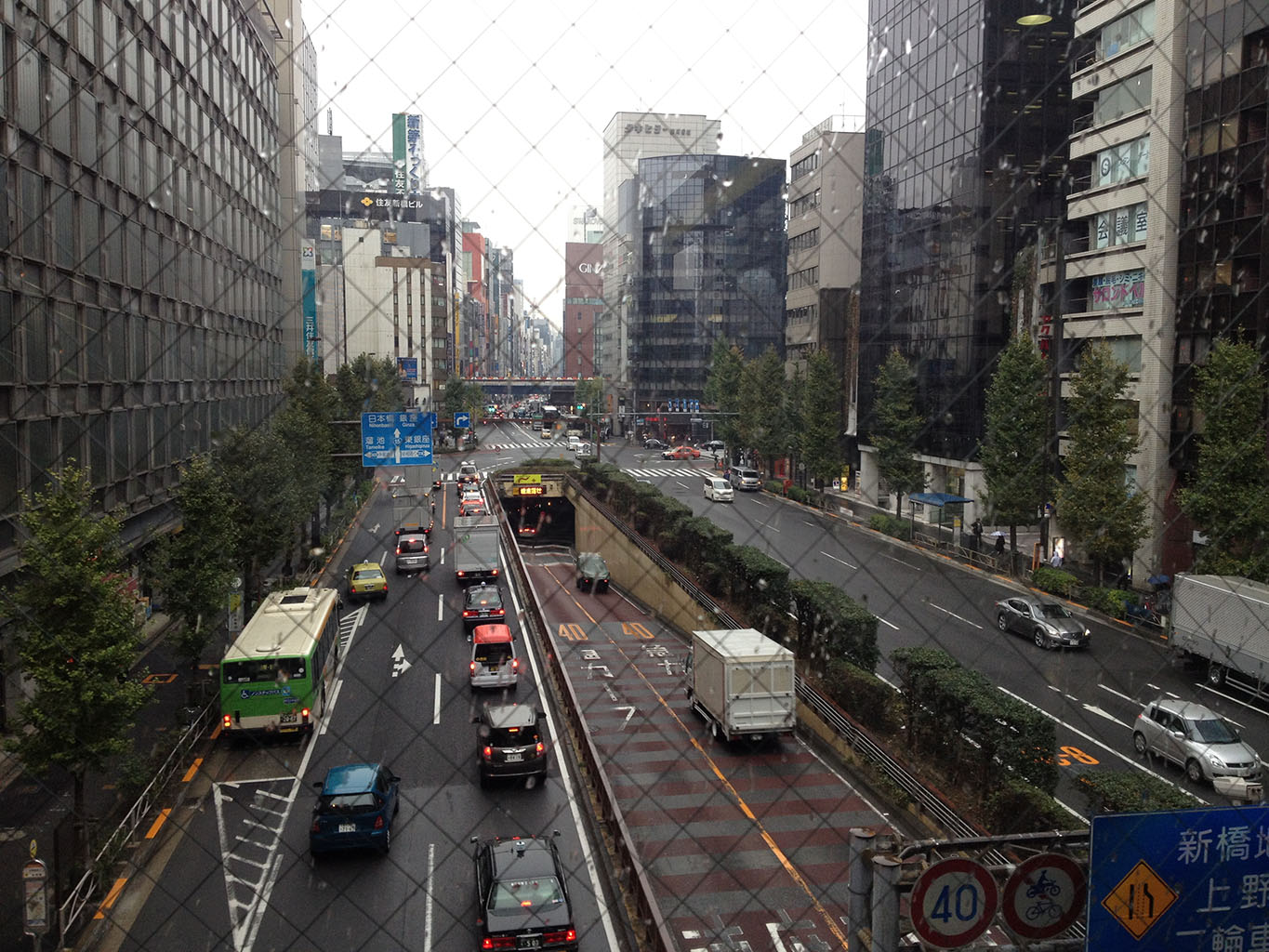
But onward.  I was going to take a trip through the heart of downtown Tokyo, and visit something I was very keen to see.  It involved, however, an interesting train ride out to Odaiba island in Tokyo bay.


IMG_1969 IMG_1971 IMG_1977

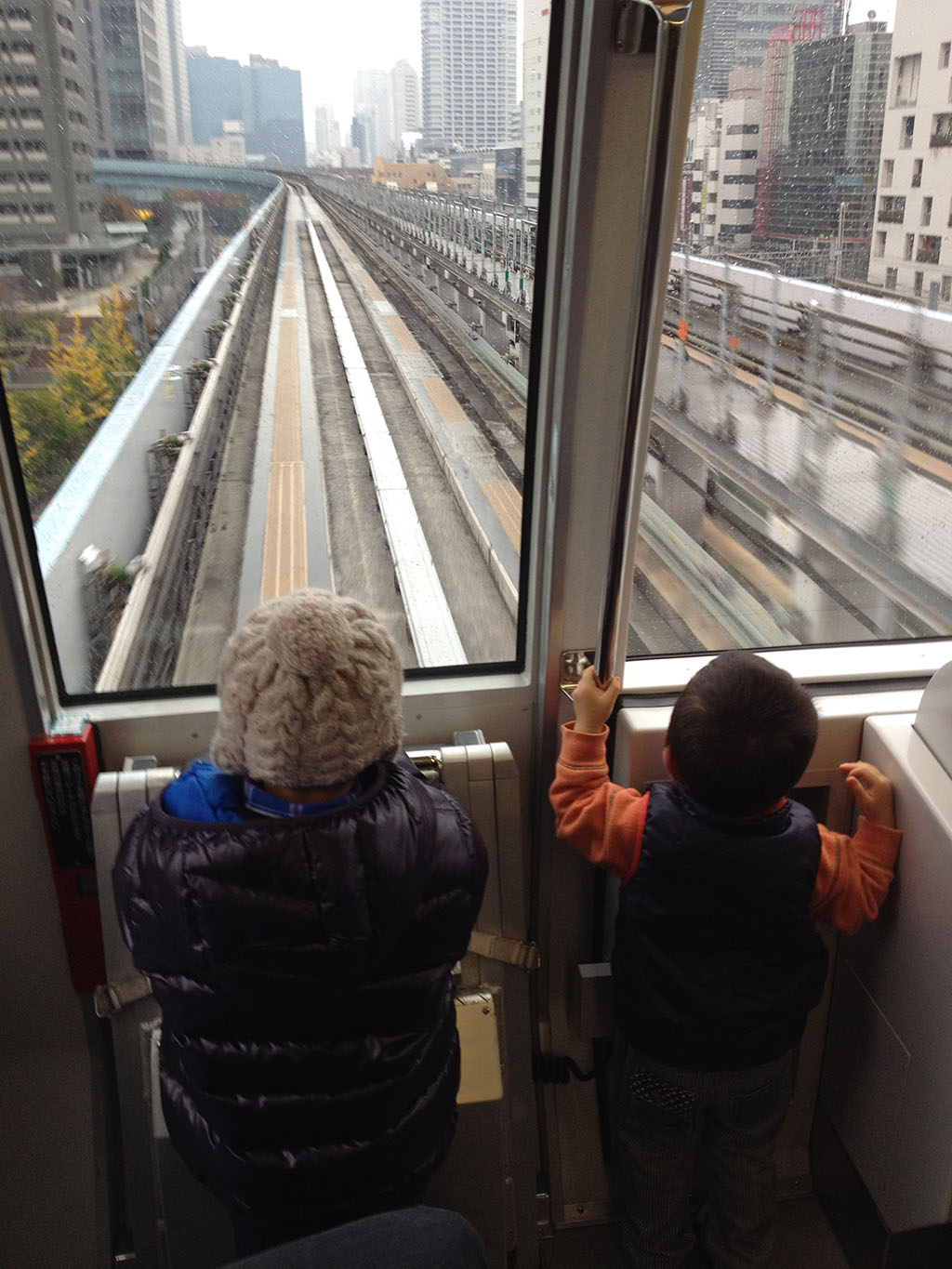
I take the subway all the way to the waterfront, and then switch to the Odiaba loop rail.  It’s much like airport trains you see in that it’s really a train with car wheels that runs on a monorail track.  It goes over the Rainbow bridge to the island itself.

IMG_1991  Windows8StartScreenandLockScreenBackgroundPhotos-BlurredCityCityscapeBridgeSubwayTunnelakaEmerge6

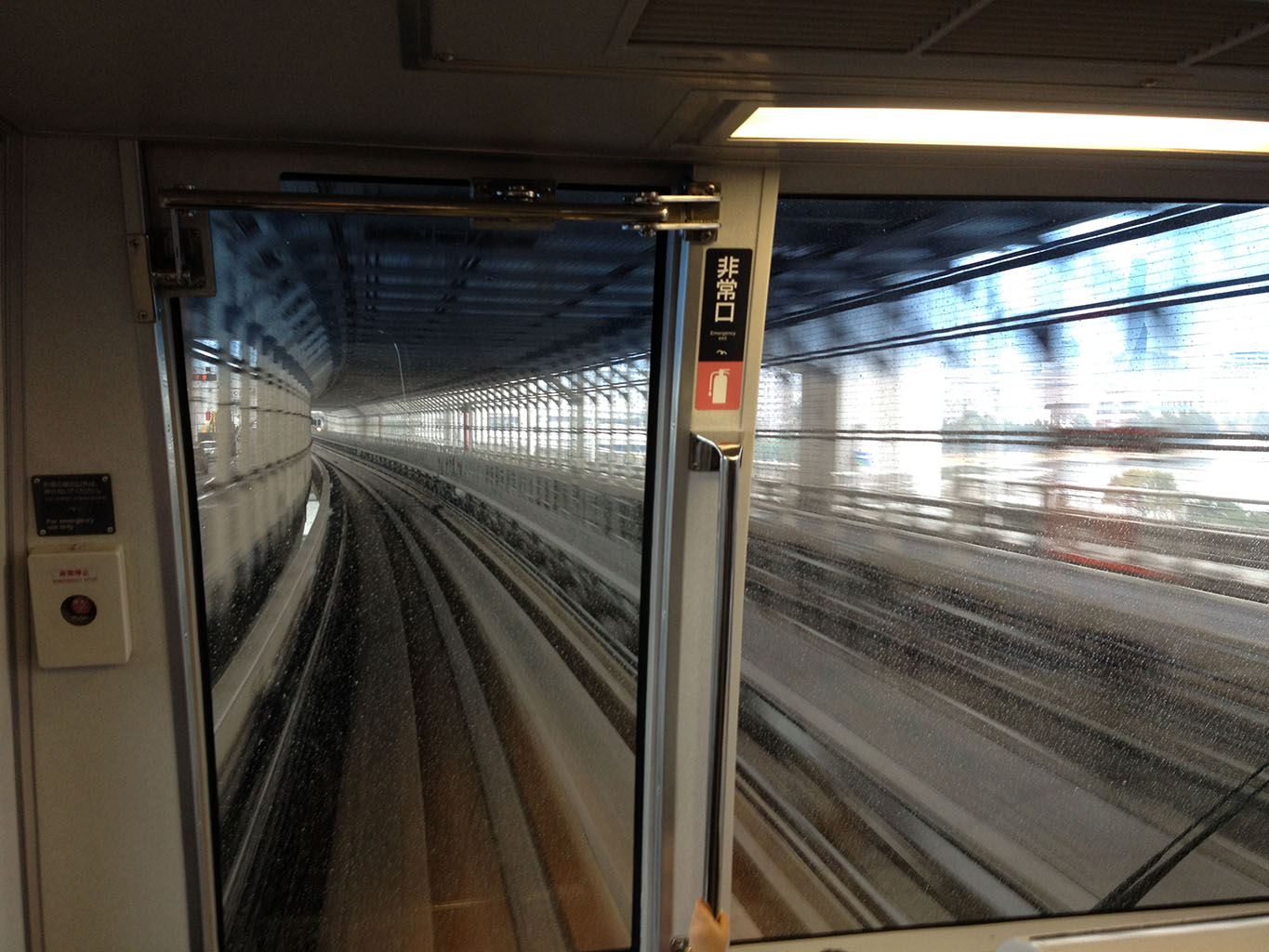
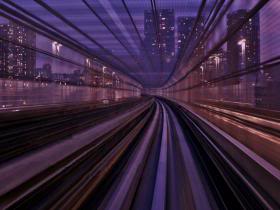
Does this picture look familiar?  For those using Windows 8 – it should.  The left shot is the exact same train line as the one on the Windows 8 desktop.  In fact, it is the same rail line, just taken in the opposite direction off the bridge heading back into Tokyo.  I thought of setting up my tripod/camera, but the train was full and so I just hand-held it.  Nifty.

Anyway, I arrive at Odaiba island – and go looking for what I came to find…


Japan Day 3 – Fugu me!

Japan Day 3 – Fugu me!

I take the train from the arcade in Kawasaki back up to Shibuya for one last adventure of the day.  I stop by my hotel and pick up all my medical information and insurance cards and put them in my wallet.  Why?  Because they might just save my life.  But we’ll get to that in a minute.

IMG_1927

A local Tokyo friend of a friend recommended a chain called Toro Fugu for being very highly respected (and highly priced) place to eat fugu.  When your life literally could be on the line, I figured it was best not to go for the cheapest route and go with an established location.

IMG_1930

The fugu in this restaurant are prepared to order – and this is the tank of fish that greets you as you enter.

IMG_1931

I am shown to my own private traditional dining area and start working out what to order.  They end up getting one of the chefs who spoke a bit of English to come by and we chat briefly about a few options.  I opt for the fugu sashimi platter, a bowl of fugu spine soup.  Both of which come highly recommended as great first dishes – and the ‘safest’ of the fugu dishes to try.  At this point, part of me started considering the wisdom of ordering potentially deadly food when I don’t even speak the language…

Before we go on, a little bit about fugu.  Fugu, or pufferfish, is one of the most celebrated and notorious dishes in Japanese cuisine. It is a dangerously poisonous fish that requires extremely careful preparation.  Mistakes in preparation are often fatal.  Its preparation is strictly controlled by law in Japan.  Only chefs who have qualified through rigorous multi-year training programs are allowed to deal with the fish for public consumption.  Apparently only about 30% of chefs pass the first time they take the certification test.  For reference, only 17 restaurants in the United States are legally cleared by the FDA to serve fugu and it was illegal up until only a few years ago.  Even with that, all domestic US restaurants have the fish properly cleaned and prepared in Japan before being flown over.

So how many people do get poisoned?  In Japan from 1996 to 2006, between 34 and 64 victims a year end up hospitalized from fugu poisoning and anywhere from 0 to 6 persons die each year.  The majority of these poisonings, however, involved fishermen eating their own catch.  Many cases also involve folks who eat the internal organs such as the liver and ovaries, which are considered delicacies, but are also the most poisonous.  Bandō Mitsugorō VIII, a famous kabuki actor, deliberately ordered four fugu livers to feel the rush and claimed to be immune. He died seven hours later.  So, I’d say the danger is very real.

What is the story with the poison?  It’s called tetrodotoxin (TTX).  Tetrodotoxin is a potent neurotoxin which shuts down electrical signals in the nerves.  Lethal doses are usually 8μg / kg of body weight.  So a 170lb person would be killed by the miniscule amount of 0.62 milligrams.  This is 1200 times more deadly than cyanide.  On average, a single fish has enough poison to kill 13 people.  Further, the potency is not affected by cooking so it doesn’t matter how much you did or didn’t cook it.

What are the symptoms?  In light (or heavy doses), one usually immediately feels a bit of burning in the mouth or lips as soon as they eat it.  This passes and they start feeling numbness in their extremities (fingers/toes/nose/etc) and a light airy feeling in their chest  This is actually the feeling most people that eat fugu strive for.  Many restaurants allow a miniscule amount of the toxin to remain on their portions so that diners get that feeling.  One scientist, who had been bitten by a snake with neurotoxic venom, described it as the kind of peaceful light-headed feeling that people are supposed to get in the last few moments before they drown. That, combined with a tingling body, is the experience many desire and expect from their fugu dining experience.

More than that amount and…well… it becomes not pleasant quickly.  There are many harrowing stories of folks who have been poisoned.   The lightness progresses to dizziness, exhaustion, headache, and gradual loss of muscle control.  More severe doses cause nausea and difficulty breathing as the poison works itself inward to core organs.  Ultimately, loss of all muscle control results.  This includes the respiratory system.  Breathing then stops and asphyxiation follows – which is the ultimate cause of death from tetrodotoxin.  Since the neurotoxin does not cross the brain-blood barrier, victims are fully conscious while their bodies shut down.  Some have described it as sinking feeling, or being ‘entombed’ in your own paralyzed body.  Near fatal poisonings often put people in a coma, sometimes even a waking coma.  The time from consumption to collapse can be anywhere from a 4 hours to only minutes.  There is no known antidote and treatment consists of emptying the stomach, feeding them active charcoal to bind the toxin, and putting the victim on life support until the poison wears off while keeping their fingers crossed.

It’s probably best I didn’t know all of this before I ate it.

IMG_1933
IMG_1934

Shortly, my order arrives.  The sashimi is sliced razor thin – as I had read.   You could literally see through it.  I say a little prayer, and take a bite of my first (and hopefully not last) piece.

Fugu is a white fish, and as such, does not have a heavy fishy taste.  In fact, it’s quite light.  It almost has a smoked taste to it.  Closest I could think of is a cross between yellowtail and cod.  The texture, however, is unique.  It’s somewhat rubbery like octopus; but lumpy – not smooth.  The lumpier spots were rubbery and the bits between were soft and yellow-tail like.  Overall, it was very good flavor – but not a knock your socks off experience (IMHO).

The spine soup was also very good.  The long, white strips are fugu skin and spines.  This was mixed with radishes and other bitey-flavored strong vegetable cuttings in a light vinegar soup.  Again, the fugu bits were very mild flavored and a bit chewy.  Mixed with the radishes and other strong vegetables – it made a great combination of flavors.

A final round came – the fried fugu.  This turned out to be a bit much for me as the fish came STILL TWITCHING.

The charcoal grill was great and cooking up the pieces was really awesome.
I will however, say I did not finish my fried fugu.  In truth, I was starting to feel a bit strange.  While eating the bowl of spines, I did get a little burn on my lips.  It was the same kind of burn that hot BBQ sauce would leave on your lips.  This passed within a minute or two, but I did in fact notice my fingertips get a tingly sensation to them and my chest felt ‘airy’ and light.  I found it to be a disconcerting feeling.  I decided a plate of fugu sashimi and a bowl of spines and skin was enough tempting of fate and called it a night.  On my way home, I did feel the ‘light/airy’ feeling that is associated with eating fugu.  Personally, I wasn’t really digging it.  You felt your body acting a bit strange.  For me, I felt my fingertips be a bit numb, then it would move to a light/airy feeling in my chest, then my legs, then repeated the cycle.  I never got the nausea or dizziness of the next stages – which according to what I read – means I got a very well prepared dish of fugu.

I monitoring how I felt for a solid 4 hours while reading and watching tv until I felt like things were not moving on to stronger stages, then tentatively went to bed.  When I awoke in the morning, I could certainly feel the same shifting around of the feelings – but much less so.  Still, the feeling stuck with me until about noon of that day when I got some good walking in and ate a great lunch.

So what did I learn?  Was it worth it?

I would say yes – for the pure experience factor and only if you go to very high-end, well respected places.  Fugu is simultaneously a nationally celebrated and notorious dish.  It’s consistently rated at the top of the most dangerous foods to eat.  Even the Simpsons had an episode about it.  To say you’ve done it does put you in a small crowd.

Is it worth the risk for the flavor of the dish?  No, I can’t say it is.  While good, it’s not markedly better than most other kinds of sashimi I’ve had.  It does have a unique texture and a really pleasant, delicate taste (again, closest I can think of is a chewy yellowtail).  But I had much more enjoyment from the ultra-fresh sushi I enjoyed at Tsujiki.

Would I do it again – almost certainly not.  After the odd feelings I had for nearly 24 hours afterwards, it certainly isn’t something I would like to repeat.  I found that part to be more disconcerting than invigorating.  Not having control over what your body is doing is not something I enjoy – but could understand why some would.  For me, I tempted fate once and came out fine.  I apparently got a very well  prepared dish of fugu, got a taste of tetrodotoxin, and lived – but it’s not a flavor I think is worth tempting fate twice for.

Update Nov 2023

Here’s a great scientific summary of about tetrodotoxin and pufferfish by The Octopus Lady on youtube.

Japan Day 3 – Kowloon Walled City inspired arcade

Japan Day 3 – Kowloon Walled City inspired arcade

(Update Oct 2021: Kowloon Walled City is no more, and sadly as of Oct 2019, the Kawasaki Warehouse is no more either. After getting a bucket of hits today, I fixed a lot of old WordPress formatting that didn’t age well, cleaned up my travel grammar issues, and expanded a few bits. Enjoy!)

After my awesome visit Tsukiji fish market, it was time to head south of Tokyo to Kawasaki and visit something I’ve long wanted to see: Kawasaki Warehouse.

Perhaps you’ve heard of Kowloon Walled City? Kowloon Walled City, located in Hong Kong China, was an amazing urban jungle of 350 buildings, almost all between 10 and 14 stories high, and populated by 33,000 people on an unbelievably tiny 6.5 acre plot of ground. This came about when the plot became disputed land after it was released to Britain in the late 1800’s. It existed in a lawless state as its governance remained in dispute. This disputed territory quickly was occupied by those seeking an escape. The people that lived there and the city they built has become stuff of legends.

Kowloon has been the subject of a famous book (now out of print and copies sell for over $400, though reprints are now available) and inspiration for many works of art (like these scenes from the Ghost in the Shell movie):

So, I jumped at the chance to visit the arcade that was supposedly inspired by the cityAmusement Game Park Kawasaki Warehouse is located in Kawasaki just a half hour train ride south of Tokyo.

I took the 30 minute train ride down to Kawasaki Station and then a 5 minute walk south-east of the train station (past a little shopping plaza with a really cool color cycling staircase)

I walk about half a kilometer to the arcade address: 3-7 Nisshinchō, Kawasaki Ward, Kawasaki, Kanagawa 210-0024, Japan.

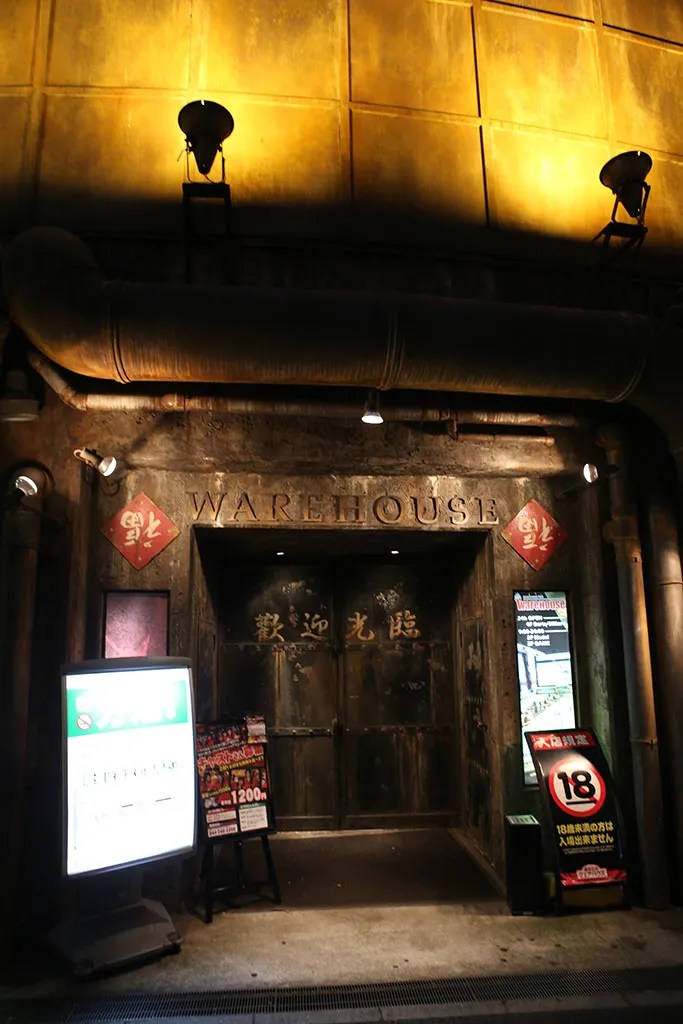
And there it was nestled between some innocuous looking business towers:

This thing was impressive! The closer you got – the more amazing it looked.  The front door itself was an amazing piece of art. 

The doors opened automatically with a whoosh of air as you entered – like a sci-fi movie. Once through the faux-iron outer doors, it revealed a red lit airlock within.

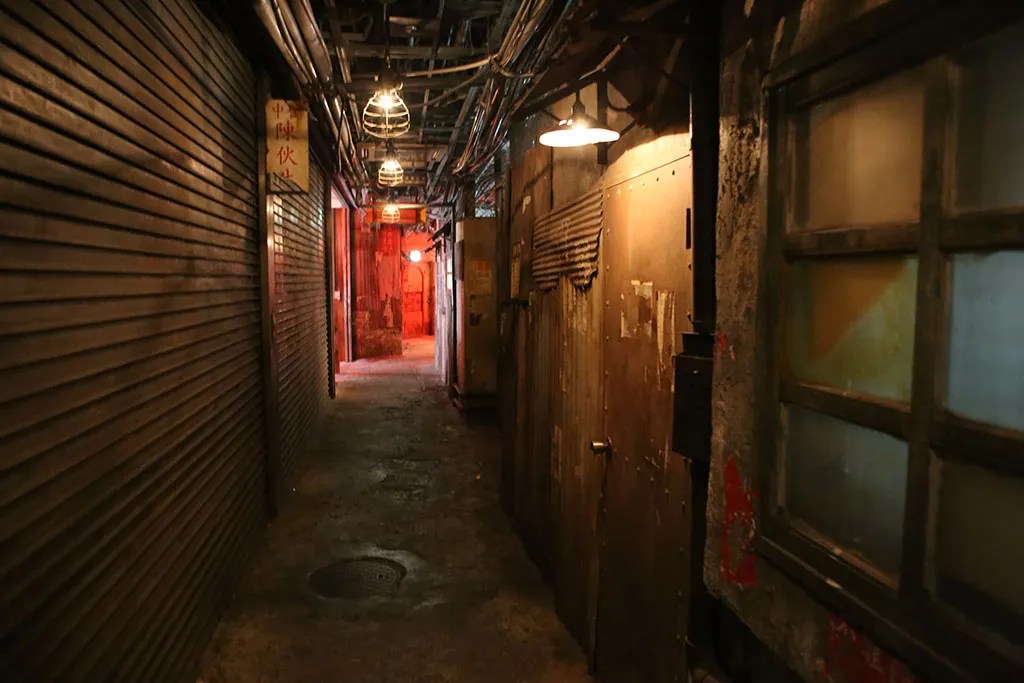
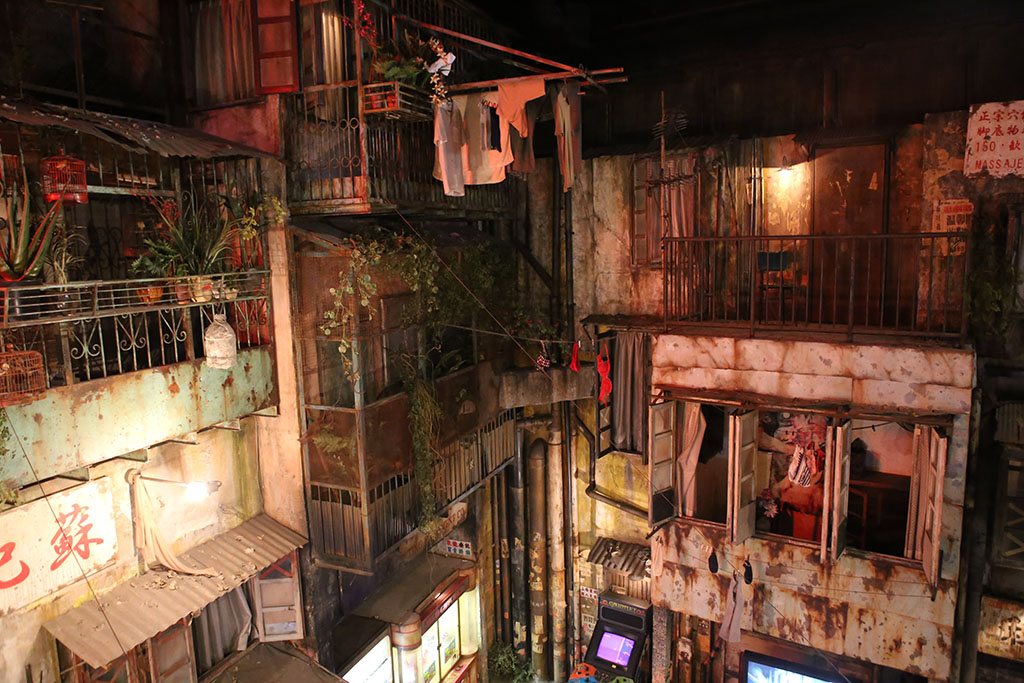
Next you found yourself in a long hallway that mimics walking down one of Kowloon’s narrow city streets. The attention to detail was astounding. You could hear muted street sounds all around you. As you walk past the doors/windows you overheard noises and voices behind the walls. It sounded like bits and pieces of conversations. Often you could look through the windows and see little scenes and apartments. It was all really well done with lots of great details. But the real treat awaited upstairs – which you reached via a cool elevator.

Wow!  You come up either the elevator or escalator and are greeted by this amazing sight. A very intricate re-creation of a Kowloon street area awaited – with signs, graffiti, food vendors, and dingy vending machines. But this place isn’t a museum – it’s an arcade!  5 floors of it in fact.

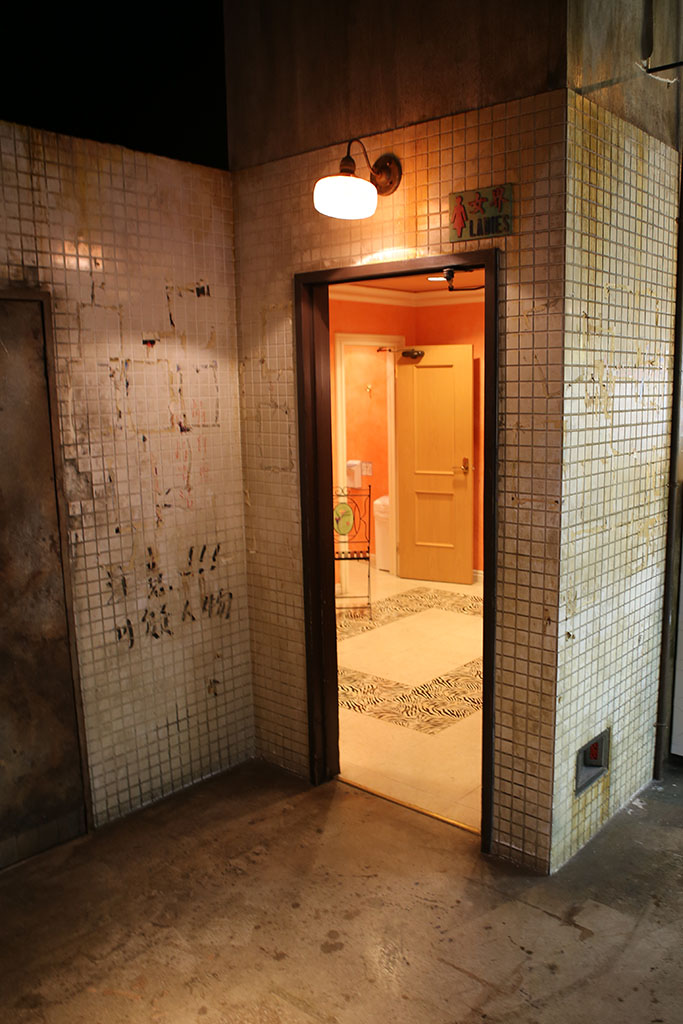
The first three floors of the arcade were Kowloon themed – even to the bathrooms.  Well, the men’s bathrooms anyway – the women’s were very nice (at least from what I could see from the hallway. Thankfully the arcade was almost empty mid-day on a weekday so I could snap this shot of the open door). The dinginess is all faux – it’s painted grime. It was like being on a Blade Runner movie set.

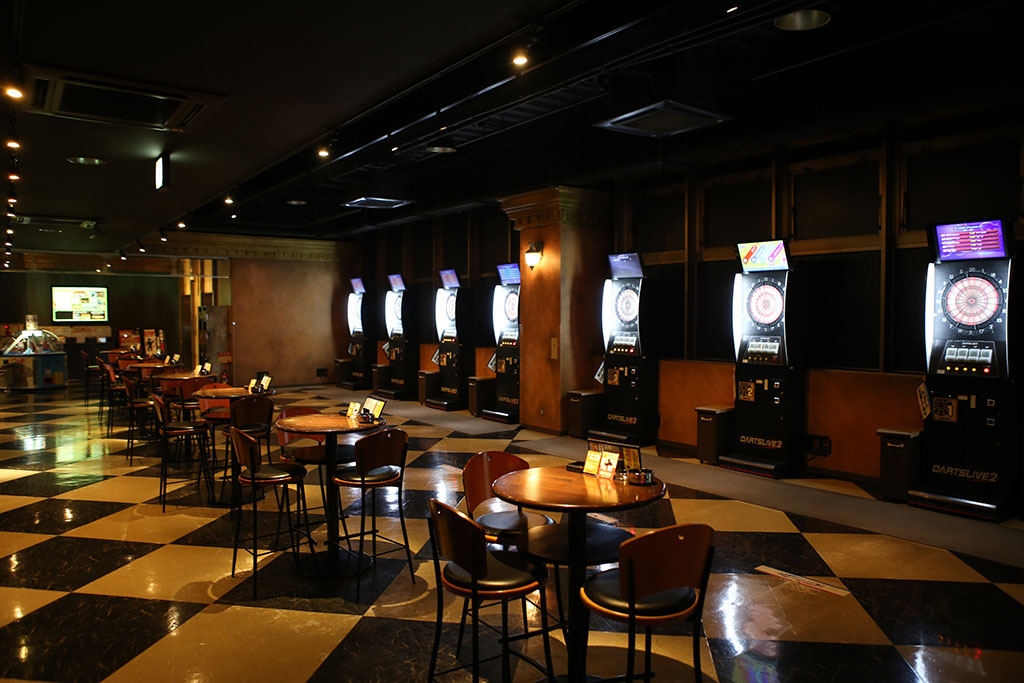
The other floors were also themed. There was a floor done up like Greek/Roman architecture. Yet another that looked kind of like a smoky leather/hardwood bar. There were also lots of different floors of games. The first arcade level, like many Japanese arcades, were claw prize machines. The second level was pachinko and coin pusher machines of all sorts – and some strange, gigantic video horse-racing games. The third level was the traditional video arcade machines you’d expect. The fourth level was a field of pool tables, ping-pong, and dart boards being used by some very serious looking characters. The fifth floor was some kind of private club area – so I couldn’t go in to check it out – but it looked a little swanky.

The second floor’s arcade games, however, were very impressive. Many I had never seen before.

Here was a guy killing this game called Jubeat. You had to hit the squares that lit up with special icons in sequences as the music played. The icons changed color quickly after they appeared, and I think you had to hit in time with the beat to give you perfect/good/missed scored points.

The above game is called BeatMania. It’s a fast-paced rhythm game you play on a very realistic DJ mixing panel. Some of the better players I saw were going at amazing rates – this was probably the *slowest* I saw someone playing it.

This game is called Gunslinger Stratos. It looked a lot like a standard rail shooter game but with dual-wielded pistols. The graphics were really well done, but the real kick was the physical guns. On various parts of the handguns (sides/top/front/etc.), they had little alignment rails with attracting magnets in them. While you played, you could you could physically ‘hook’ the two guns together in different configurations: side by side, one on top the other, etc. and get different power shots/effects.

These things have apparently been getting really hot in Japan – Namco P.O.D. (Panoramic Optical Display) systems. Right now, this one is set for Kidō Senshi Gundam: Senjō no Kizuna – Mobile Suit Gundam: Bonds of the Battlefield. You actually sit inside this cockpit and are surrounded by displays. They’re apparently networked and you can play people across the country – or in the same arcade. If in the same arcade, you apparently even get in-cockpit voice chat.  But at like 500¥ per play (approximately $5 USD), it comes with a steep price tag.

After a lot of arcade enjoyment, I went back over to the Kowloon themed area from the upper floor and took some more shots. It was impressive and hard to capture the 360 experience.  

(2021 Update: I found this VR view from the upper balcony:)

Finally, one of the most impressive things was the back entrance to the arcade via the parking lot of all things.

If you enter through the garage, you see this cool looking door…

but when it opens…and WHAT????

You get a cool little room with water pouring from dragon heads into this green-lit pool. You have to walk across the rocks with rusty pipe handrail while funky ambient music plays.

Here’s a video of the effect.

This was a fantastic arcade, but after the fun of a few rounds of games, it was time to head back up to Tokyo for one last adventure for the day…

Japan Day 3 – Tsujiki fish market and knife shopping

Japan Day 3 – Tsujiki fish market and knife shopping

IMG_1832

Got up moderately early as I continued to overcome my jet lag and went over to Shibuya station.  I got a better picture of famous Hachikō statue.  Then it was off to the Tsukiji fish market.

IMG_1839 IMG_7900

Tsukiji is arguably one of the most amazing fish markets in the world.  Every day, fishermen bring their nightly catches to the market.  Madness ensues during the unloading and nearly instant auctions for the fresh catch of the day.  They are usually well in swing at 4am sharp – so one has to arrive very, very early.  I had several friends who braved the early morning madness.  While they said it was a great experience, they didn’t know if it was really worth getting up that early for it.  So, taking their advice and hoping for a nice full day instead of getting up insanely early then needing a rest mid-day, I went a bit later at 9am.


IMG_1841

Upon arrival, I decided to get some food.  And why not have what is arguably some of the best sushi in the world?  Here’s a picture of the lines outside Daiwa Sushi and Sushi Dai – two of the most famous and probably best restaurants in the market.  These two sushi shops are a father and son pair next door to each other.  Sushi Dai is the father’s shop on the right and often has a 2-3 hour wait from the time they open at ~6am till 1pm when the close.  I opted for the son’s shop Daiwa Sushi on the left and waited about 30-45 min before I got a seat.  I had a nice chat with two Korean journalism students who were working abroad in Japan.

IMG_1844 IMG_1847

You take a seat at the very small sushi bar.  It only seats about 12 people and the cooks are hard at work.  I decide to take their 10 piece ‘set-menu’ option with the chef’s choices of the day.  At about $35, it was also a pretty darn good deal too.  I place my order and sip on my tea.

IMG_1849 IMG_1850 IMG_1852 IMG_1854

The sushi arrives as you eat.  As you eat up your first round, without even asking, the super-friendly sushi chefs simply leans over and delivers the next few pieces.  I start working my way through the chef’s choices.

Does it live up to the hype?  Yes!  You can tell this sushi is of another level all together.  Since these fish were swimming in the ocean only 12 hours before, you simply cannot get much more fresh – and it shows.  The tuna is particularly extraordinary as it pretty much melts on your tongue and barely requires you chew.  Tuna (and other fresh fish) that has been stored or sits around tends to pick up more and more of a rubbery texture and looses it’s flavor as it sits/is stored.  This had none of that and was of a very different melt-in-your-mouth texture. Each of the pieces was absolutely fantastic.  In fact, I just kept ordering until I couldn’t have another bite.  It was the best $45-$50 of sushi I’ve ever eaten.

While I most certainly had the best sushi I’ve ever had, I will admit that claims of near-religious experiences eating it are a bit over-blown.  Would I go again if I went to Tokyo – absolutely and without hesitation!  Would I recommend everyone who likes sushi to go to Tsujiki and try one of these two place – absolutely!  Is it a near must-do for anyone going to Tokyo that likes sushi?  Yep.  But let’s just not get too carried away.  Go do it, and experience some of the best sushi in the world; but don’t let the hype over-blow it for you. 🙂

IMG_7874  IMG_7872

Upon finishing my food – you find that you enter in the front and exit out the back.  As you walk back past the washing station, you pay a hurried lady in the back and find yourself in the alley in the stacks of preparatory materials.  I make my way back around front, and find that the line for Sushi Dai has barely moved.  Seems to be I made at least partially the right choice if the difference between the two is marginal.

IMG_7881  IMG_1858

But this isn’t the only eatery in the Tsujiki area.  There are rows and rows of places serving sushi, yakitori and all other manner of food.  All of these places would blow your average eatery away in the states.  So if you’re pressed for time and can’t wait for Sushi Dai or Daiwa Sushi – definitely try one of these others out and you’ll probably get a 90% experience as well.

IMG_7916 IMG_7923 IMG_7925 IMG_7930 IMG_7931 IMG_7934 IMG_7935 IMG_7941

But don’t stop there!  Keep going through the rows and rows of shops just north of Tsujiki.  Shops sell things that just came from the fish hauls/sales a few hours earlier.  You’ll see just about every bounty from the sea there – fish, mussels, octopus, tuna, etc.  You’ll also see all manner of farm vegetables along with nuts, fruits, and all kinds of things I wasn’t sure about.  It’s absolutely worth a walk through and wish I’d actually spent more time there.


IMG_1855

But the shops weren’t all fish and food.  There were also pottery salesmen as well.  I picked up a number of very cheap dishes and had them packed well.  We’ll see if they survived a ship back to the United States when they arrive here.


IMG_1861

Here’s another amazing find.  Masamoto knives is hidden among the stalls.  Unfortunately, they were sold out of a great number of their knives when I went, but I picked up a beautiful 9.5″ specimin for ….well… a good bit of money.  But you are getting just as much of a piece of art as you are a working tool.  I am anxiously awaiting it’s arrival as I had it shipped back to myself.  10″ knives aren’t the most clever things to bring in your carry-on luggage.

But this was just the morning adventures!  On to part 2…


Japan Day 2 – Akihabara – Part 3

Japan Day 2 – Akihabara – Part 3

IMG_8069  IMG_8080

Next set of stops were all along the main street of Akihabara. Shops till you drop.  Seriously – I spent almost a whole day here and felt like I didn’t even scratch the surface properly.

IMG_8102

Since I don’t read Japanese, I started culling the manga stores – thought I did drop into one or two just to see how amazing they were.  Yep – floor to ceiling, wall to wall.  I think it would take a lifetime just to read what was in one of these stores.

IMG_1730  IMG_1732

Onwards.  Store after store.  You would certainly find interesting things – like R/C Toilet seats and pretty bunny hockey masks.

IMG_8074  IMG_8075 IMG_8066   IMG_1751

There were plenty of new/used DVD/Blu-ray stores and found a few amazing gems.  OMG – almost bought these.  They had a few copies of the limited edition Blu-ray Cowboy Bebop series that had never been released in the US.  Yeah, and the price really is 18,900 yen – or about $190.  They also had Macross Plus and Gunbuster! on blu-ray – also never released in the US.  Ugh – it was so painful to see all these great anime series and not be able to justify the price.  I also had to remind myself these were mostly region coded for Japan and they were usually subtitled in Japanese and Chinese only.  Still, I did pick up a copy of Only Yesterday on blu-ray.  I had to mail it back to myself, so we’ll see how that works out when it gets here.

Other shops sold new and used console games.  Nothing too new there, except for the fact many had a whole floor was dedicated to PC dating simulators.  These are fairly popular with women.  These games usually depict scenarios of high school or other situations in which you interact with other characters getting points for getting on dates with the right characters and performing dating tasks.  It was actually amazing to see that there were literally HUNDREDS of these games.  The fact many stores had a whole floor to them was surprising.  Guess it’s a genre of PC gaming I never knew was so popular in Japan.

Unfortunately, I couldn’t put any pics of that up, because the other half of the most stores that had the dating simulators held Eroge games.  Often they were mixed on same floor.  (Eroge games are near, to fully, pornographic).

IMG_8094

After wandering down the main street and killing hours of wide-eyed wonder, I started returning to my starting point via the next block over.  This was less flashy, but no less awesome.  There was a larger cross-section of stores.  But up first is one of the first must-hit of the stores.


IMG_1739

This black obelisk is Mandarake and well known must-hit spot.  They have over 7 floors of geekery.  The shop is primarily known for collectable and rare toys, but also have anime, manga, collectable card series, and movies.

IMG_1741 IMG_1743 IMG_1749IMG_1760

How about these?  Original boxed Star Wars and Transformers toys.  Original Akira promotional kits, etc.  If you have a fond childhood toy memory – they have one of them there somewhere.  It was amazing – but do have to admit some of the prices weren’t the best.  You can find slightly better prices on eBay or Yahoo Japan auctions for more common items, but they do have some one of a kind and extremely rare items that likely will never be found anywhere else.

Another thing you’ll notice right away is that the used items are in absolutely amazing condition.  The Japanese grade used items and an item needs to be exactly as good as new to get an A grade.  Amazingly enough, things that would qualify as A grade here probably wouldn’t even hit a B in Japan.  You rarely even see a C – people simply don’t want them. Collectors here take amazing care of their items.  If you want absolutely pristine collectables – Japan is the place to go.

IMG_1733 IMG_1734

I walked a bit further down the street and low-and-behold, a PC shop!  I had passed several small computer parts stores along the way, but this was different.   This was more of a glitzy retail store that had fancy, fully-built PC’s.  This is somewhat surprising considering the fact many consider PC gaming in Japan to be a nitch marketG-Tune, however, is apparently a growing brand in Japan as I had seen ads for them several other places during my travels as well.

IMG_1735 IMG_1736

They had fully spec’ed out systems that were clearly well-thought out configurations.  They were clearly focusing on the gamer market with these rigs.  For about $1200, you got a fully loaded PC with a slick looking case/keyboard/mouse.  While a bit high, the prices were in the range of what one would expect for a higher-end ‘premium’ line like this.
Interestingly enough, despite the fact the Japanese are notorious about adopting the latest technology – almost none of the systems had Windows 8 on them.  They came with Windows 7 by default, with an option to buy Windows 8.  May people have panned Windows 8 a terrible desktop OS, and apparently the Japanese gamer’s market agrees.


IMG_8109 IMG_8110

Next down the road is the amazing Super Potato.  Down this innocent looking hallway is a gateway to amazing things.

IMG_1806IMG_1797IMG_1809 IMG_1799 IMG_1801 IMG_1803

Floor after floor of amazing retro gaming goods.  If one is careful, they can find some amazing items, deals, and take them back to the US.  I found an original copy of Rez for Dreamcast for $20.  You need to be a bit careful because Super Potato has become a little more known to the tourist crowd so the prices aren’t necessarily the best. Still, amazing stuff.


IMG_8103  IMG_8106
You also run across interesting things like this.  This guy’s bike was done up pink Anime style.

IMG_8112

Next major hit down the road was an unexpected gem – Kotobukiya.

IMG_7672 IMG_7670

IMG_7671

The first floor had some pretty standard Anime stuff – cutesy dolls, emoticon chocolates/candies, and man-shaped sleeping pillows….er…what?

IMG_8114 IMG_8117 IMG_8118   IMG_1775


The second floor was amazing models and kits.  Kotobukiya apparently has a whole line of it’s own model kits (order-able overseas by the way).  I have to admit these were pretty amazing.

IMG_8127

They also had this life-sized Danbo from the Yatsuba series.


IMG_1771 IMG_1772

The third floor got a little weirder with dolls.  One sub-genre of Otaku culture is dolls.  This floor had clothes, mannequins, wigs, and everything you’d need to make hyper-realistic dolls.  While I recognized the craftsmanship, the dolls themselves kinda creeped me out.


By now, it was getting dark, and I reluctantly headed back towards the train station with sore feet from a day of beating the pavement.  But wait, what’s this?
IMG_7673 IMG_7688 IMG_7678 IMG_7683 IMG_7679 IMG_7681

On my way back, I found some of the very old roots of Akihabara’s past: actual electronics. Down a very narrow opening between two buildings, and directly under the train lines, I found this little maze of electronics dealers. Store after tiny store – most specializing in something very specific. Vacuum tubes, capacitors, resistors, switches, surveillance cameras, multi-band radios, led lights. You name it – it was there somewhere (well, I didn’t see any Nixie tubes, but they were probably there somewhere).


IMG_7694  IMG_8140

Finally, before hitting the train, I decide to stop by two famous eateries of Akihabara. AKB48 and the Gundam Cafe. AKB48 is a cafe dedicated to the girl-band by the same name. This throng of fans was waiting outside for their dinnertime opening. I however, was interested in the Gundam cafe.

IMG_7703 IMG_7707

When I, I was told drinks were on, but food service hadn’t started yet.  In about 10 minutes it would, however.  This was fine by me as I grabbed one of their signature Gundam drinks and found a table to rest my weary bones.

IMG_7705

This one was themed after a particular gundam wing that I forgot. It was very good and refreshing after that day of walking.


IMG_7708  IMG_1812

As I’m sitting there, it suddenly hits the dinner hour and this happens. The lighting in the whole place turns blue, and I can now order some food. I got a bowl of classic Gundam aka White Mobile Suit.Notice the shaped noodles?  Crazy.

I also meet an interesting local guy who I had a great friendly conversation with. Turns out he works on his own video encoding system and was taking a break while his machines crunched on a batch of video processing. We talked of the differences between being ‘hard’ or ‘soft’ Otaku and the different kinds of Otaku. He was a little older, and was ‘hard Otaku’ on Ultraman, Thunderbirds, and geekery of that era. I said I was more of a soft anime Otaku fan and we talked about some series we both liked. Very enjoyable dinner and we traded making paper cranes for each other. Turns out, I seem to make them very differently than the way Japanese do. Interesting.

After that, I’m completely shot. I head back to my hotel and wonder over the hoards of things I saw – knowing that I’m likely going to have to come back some day…

Japan Day 2 – Akihabara Part 2

Japan Day 2 – Akihabara Part 2

IMG_8044  IMG_8056

Right off the bat from the station, you enter into the madness and spectacle of Akihabara – which is even more impressive at night when all the lights are going and the streets filled with people after working hours.


IMG_8052 IMG_8054

One of the first shops you’ll run into outside the station is actually a unique Japanese phenomenon: showcase rental shops.  These shops simply provide locked display cases full of private owner’s collections.  This particular one is called AStop.  It had been an electronics store, but was slowly going out of business.  When the owner put some of his toys out for sale, they sold for far more than he imagined.  Then he had a brainstorm.  Why not have display cases people could rent and sell their own things?  For about $20-60/mo you can rent your own locked display box and sell, or even just boldly display, your own collections.  The owners simply put price stickers on all the items in the cabinet and the staff are in charge of getting items out and handling the transactions for you.  The box contents change all the time based on who is renting the boxes and what they are selling or displaying – so these are often very busy places with people checking them out quite often.  You’ll see these boxes all over Japan and they are really neat ways to see people’s obsessions.

Next up was one of the biggest things I wanted to try when coming to Japan.  Their arcades!

IMG_8056  IMG_7667

Sega and Taito are will be some of the bigger arcade centers you find in Akihabara, but they all follow a similar pattern.  They are multiple floors with usually the first 1-3 floors being crane style games.  You can win everything from plastic fish to helmets to keychains to tiny stuffed animals.  If it can fit in the box, then there’s probably one somewhere.  I was honestly surprised how many there were as these things are notoriously hard to win.

The next floors are full of what would be considered more standard arcade machines.  But I was looking for one in particular.

And here it is!  Cho Chabudai Gaeshi – or the infamous table flipping game.  Chabudai are the small traditional tea tables you see in almost every Japanes home.  Chabudai gaeshi is the term that describes the act of violently upending a chabudai as an expression of anger, frustration, and disapproval.  It was an action that is attributed to very old-fashioned Japanese fathers but considered about the most rude and family unity destroying thing that one could do.  This game is a spoof of that.  There were a number of different scenarios but this was my favorite.  A nagging wife, a daughter that does nothing but talk on her phone at the dinner table, and son who just ignores everyone.  Well, he’s fed up!  And in this video, I get first place on the machine!  Success! (╯°□°)╯︵ ┻━┻

Sangokushi Taisen arcade card game.  This was fascinating to watch.  The machine had a large play field that allowed you to play it with a combination of a real-time strategy, boss fighting, and card game elements.  The machine feeds out cards periodically from the center dispensary.  The player then takes the cards and places them on the board which has different regions on the playfield marked out for different actions.  Some are attack cards, other defense and other effects.  At the macro level, it looks like a realtime army vs army game.  As the armies collide, the heroes of each smaller phalanx duke it out in a boss-style battle.  The player then takes the cards and moves them to the appropriate attack/defense/inactive states on the board which appears to sense where they are and applies the effects the times the player puts them there.  As play progresses, more cards are dispensed.  Quite fascinating overall.

Border Break – An interesting and usually busy FPS mech-battle multiplayer game.  Each person controls a mech and several of the machines are usually linked together.  You would see lots of groups of young people taking turns playing each other.  It’s very fast-paced and appeared to have a number of different fighting modes such as everyone-on-everyone and team vs team modes.  The graphics were the best of any mech fighting game I’d ever seen, the action was fast-paced and looked quite fun.

MaiMai – touch-screen based rhythm game.  This was terribly popular with female players, and I personally found it quite addicting and entertaining.  The game consists of touch buttons on the outside ring that you hit as each moving shape reaches the outer ring on the correct beat.  The screen itself is also a touch screen and some of the more complex moves involve swiping from one button across the face of the game to another button.  It was quite fun and the music was actually quite good and catchy J-pop.  Anter perk is you get a lot of play out of a single coin.  You get up to 3 songs as long as you pass each one.  If you do well enough (A rating or better on each), you get a bonus 4th track.  There also appeared to be a score saving/continuing/profile system that allowed you to get strange perks and continue your ascension to higher levels (and more unlocked songs?).  I have no doubt this was one of the more popular games at the moment and was in just about every arcade I went and at least one was always being played.

Bishi Bashi – this game was just complete hilarious, random nonsense.  You battle your way head-to-head with up to 2 friends performing ridiculous tasks like this toilet sitting mini-game.  The levels go up narrated by a game-show like host and each level you pass has a different, and more ridiculous task to perform.  Great fun even to watch.

But onward – there’s a lot more Akihabara!

Japan Day 2 – Akihabara – Part 1

Japan Day 2 – Akihabara – Part 1

I wake up on my first full day in Japan a bit less groggy from the night before – but the jet-lag is certainly there.  What to see first?  Well, it wasn’t much of a choice for me – off to Akihabara!  Akihabara is the world-famous electronics, gaming, and anime district.  It got it’s start after WW 2 as a home electronics, radio, and post-war black market section of town.  It’s most recently turned into a cultural mecca for Otaku pursuits such as gaming, anime, manga, and toys.

IMG_1669

Despite being still pretty beat up from the travel, I got started early.  A bit too early in fact.  When I figured out the city rail system (using my trusty new Japanese enabled phone) I found myself there and almost all the shops were closed.  Most of them didn’t open till 10am.  But I walked around as I killed the last 30 minutes before they opened and grabbed a bite of breakfast to eat.  At 10am, everything started to open.

normal_akihabara_IMG_6888     IMG_1667

First to open was famed Yodobashi Camera.  The name is a misnomer, because it’s a HUGE store with all things electronics: tv’s, computers, cameras, DVD/CD’s, video gaming, bikes, toys, PC’s, networking equipment, washing machines, etc.  In short, it had everything.  If you want a peak into what Japanese electronics and home goods look like – this is a great way to see them. I actually needed a few things I forgot: a LAN cable since the wireless in my hotel room was terrible and a mini tripod since my cheap $9 little one didn’t survive the trip very well (or, pretty much not at all).

IMG_1674  IMG_1680  IMG_1675

I checked out a ton of different departments – computers, cameras, DVD’s and CD’s, home appliances, toys, TV’s, etc.  I finally got to computer components for my LAN cable.  I browsed the PC parts section for fun.  I was surprised to find prices for computer components were very similar to what you’d find on Newegg (within 5% or so). For a retail store in downtown Tokyo, I was pretty impressed.  Not only that – but they had a GREAT selection of everything they had as well.  They didn’t just have ethernet cables, they have every length from 1′ to 50′.  Flat-style, round-style, every color, different levels of connector quality, every color in the rainbow, CAT 3 through CAT not-even-out-in-the-US.  They had that kind of selection for everything: cameras, TV’s, electronics, etc.  In fact, I found a multifunction internal USB 3.0 + card reader that was WAY better than any I’d seen in the states.  So I bought it for only $20 when I knew similar to even lesser models were going for $50 in the US.

One of the more interesting points that I noticed is that Blu-ray movies were terribly expensive in Japan.  While a DVD version of a more recent movie might run you 2,000 Yen ($20), the Blu-ray version might run 6,500 Yen or more ($65).  Here in the states the blu-ray version might only be an extra $10 more.

I blew a good hour and a half in Yodobashi then head back out to the rest of Akihabara.

Next stop: gachapon!

IMG_1729  IMG_7661  IMG_7658

Gachapon are fun little toys distributed in plastic balls from vending machines.  The word gachapon is Japanese onomatopoeia made up of two sounds: “gacha” for the sound of turning of a crank on a toy vending machine, and “pon” for the sound of the toy capsule dropping into the receptacle. It is used to describe both the machines themselves and the toys obtained from them.
Gachapon Kaikan is probably the largest and most well known of these in Akihabara.  It has well over 400 machines carrying toys of all types.  You bring (or change) in a ton of 100Yen (~$1 usd) coins and get to work.  You’ll find all kinds of toys here – from fake tiny plastic food, realistic looking animals, anime characters such as Evangelion, and some completely what-the-heck-is-this stuff.  You simply plunk in your coins and start cranking.  Prices range from 100Yen to 500Yen per machine with the majority in the 200-400Yen range ($2-$4USD).  So, it’s not for the cheap of heart.  I think I blew about $20-30 here but it was an absolute blast. Far, far better quality than the toys you get from the grocery store machines in the states when I was a kid.
For those with less adventuresome spirits but a collectors heart – there is also the option to go to the front counter and buy a bag that contains all the toys for a small premium above the per-unit price.  For those wishing to get a whole set without getting 5 of the same thing – this is cool.  There are also some rental display cases here from people selling their extras as well.

But onward – more Akihabara to explore!

Japan – using your cell phone

Japan – using your cell phone

So, one of the biggest useful tools when in a strange place is being able to use your cel phone.  Looking up maps, bus, and train schedules saves you oodles of headaches, frustration, and lost time you could spend exploring and enjoying your trip.  But using a cel phone abroad is also full of horror stories.  People arriving back home with $1000 bills for roaming charges.

So, off to the forums to read about it.  Turns out my current carrier AT&T offers an international 300MB plan for $60 and 600MB plan for $120.  That felt a bit steep for me as a friend who went for a week said that 300MB was barely enough for 7 days.  So, I started digging around on traveling forums and found a variety of companies.

Googling tends to pop up lots of different companies with many options.  Some will rent you a whole phone for your trip. Some rent SIM cards that replace your current one.  Others rent wireless hubs which you can tether your cel phone and/or PC and other devices.  Depending on what you need and how long your trip is, there are lots of options.  If you are staying a long time (month+) and want to actually get a Japanese phone plan, you usually need to show a vista that indicates you have at least 90 days of stay left before they’ll let you get one so you don’t leave the country with their phone.

The tricky part about these companies is that half of them look like scams – and others are full of fine print.  Softbank comes up top on many searches for renting sim cards for your phone in Japan.  Seems like a good deal, $1/day minimum, 0.31 cents/packet with a $15/day max that then covers unlimited data.  Sounds pretty good.  Um, but a packet is 128 bytes so you hit the $15 max in 620,000 bytes, or about the size of one jpg image.  In other words, you’re probably going to pay $15/day if you even turn it on.  A 10 day stay will then run you $150 – which is worse than the plan from AT&T.

Instead, I dug around on the forums and found these guys: eConnect.  These guys offer 1gb of data for a flat 4100 yen (or about $40).  What you are doing is renting/buying a SIM to replace the one in your phone.  They also have phone/text plans, as well as separate WIFI hubs for those with bigger needs/more devices.  I opted for the $40 data only SIM plan since I didn’t need to make phone calls and could send emails instead of texts.  The offered SIM and micro-SIM cards.  Since I had an iPhone 4S – standard SIM worked for me.

I took the gamble for $40 and bought the plan.  I opted to have it mailed to my hotel and imagine my joy that upon arrival at my hotel a package was waiting for me.  How cool to be handed an envelope and be told ‘A package arrived for you sir’ in front of others checking in.  🙂

But there’s a little work to do with the kit.  So here’s the procedure:

  1. Unlock your phone.  If you can’t unlock your phone, the SIM option is off the table for you.  My iPhone was just out of the 2 year contract period on my AT&T account, so I chatted with their support and they sent me to a link to submit an unlock request.  Wow – they use every excuse under the sun to avoid unlocking it.  I sent in the unlock request, and was told it might take them 1-3 days to respond.  Fortunately, it was more like 4 hours.  I got an email stating it had been processed for unlocking, but that I needed to wait 24 more hours before running the procedure.  I wait 24 hours, run the procedure (which requires resetting your iPhone to factory defaults for one), and then verify it is unlocked using the IMEI website (despite it’s completely scam-y appearance).  Long story short, give yourself 3-5 days to get your phone unlocked to be safe.  Don’t leave this till last minute in case their are difficulties.IMG_1632  IMG_1633
  2. Get your package.  The kit is just a small mailing envelope with instructions and the card.  eConnect lets you either pick up the package at their airport kiosk or have it delivered to your hotel.  If you opt for airport kiosk pickup, be sure that the kiosk will be open when you arrive!  Many are only open 8am-8pm and so forth.  Be sure to account for flight delays or you’ll find yourself going back out to the airport the next day.  I opted for the hotel route and it was waiting for me when I arrived.  It takes them about a week of lead-time to get it delivered via normal mail, so again, don’t do this the day you plan to leave.IMG_1618  IMG_1635
  3. Insert the new sim – I was a little surprised to find what looked like a credit card inside the package.  But you snap out the sim from the card mounting and it is in fact a normal SIM card size.  Popping out an iPhone 4S SIM is fairly easy and you can find youtube videos for just about every major phone if you look, but I did need a pointy tool for mine.  Turns out a paperclip works fine – but there wasn’t one to be found in my hotel room.  I actually brought my own paperclip pre-bent for this purpose. I highly recommend you make sure you can get your sim in/out before you leave.  The first time I tried to get my SIM card out, it was very stiff and I had to initially pop it free with a an actual tool.  You don’t want to arrive there and find you need a tool you don’t have.
    It’s at this point that you can convert a regular SIM card to a microSIM if you need to do the surgery.  eConnect actually offers microSIM’s, but not all carriers do.  I talked to one fellow on my trip who actually brought his own scissors and file and successfully managed it for his Android phone when his Australia-friendly plan only offered regular SIM’s.  I didn’t have to do this part since mine used a standard SIM card.
    IMG_1636
  4. Set up the network password – So, I put the old SIM into the included zip-lock bag for safekeeping (you are going to need it when you get back home!), and turned the phone on.  Success!  But you do have one final step.  You need to go to the carrier settings and set the APN username and password.  The instructions included were very straightforward and easy to follow.  I entered the data and waited.
    It did take a little bit for the phone to register itself with the network the first time.   Probably a good 5 minutes.  In fact, if I turned the phone to airplane mode during the day to avoid using up data, it usually took about 1-2 solid minutes before it would pop back onto the network.  But soon enough in the upper left corner I saw not my old AT&T logo but  NTT DOCOMO.  I never got any signal strength bars but it did work fine. Coverage was great all across the country where I traveled – even out in the remoter areas in the mountains around Takayama.
  5. Enjoy!  I was very conservative with my phone use at the beginning.  I would turn the phone to airplane mode when not using it.  I also only looked up train schedules and maps.  In this mode, I used only a few dozen megabytes per day – anywhere from 10-30mb.  Later, as I got closer to the end of my trip, I even did a little bit of facebooking, left it on more during the day, etc.  Those days I got closer to about 100mb/day.  In all, 1GB for a 14 day trip was just about right.  I ended up using about 700MB of my 1GB by the end.
  6. Shipping the SIM back (not required in my case).  Some companies require you to actually ship the SIM card back to them when you’re done.  eConnect didn’t and that’s one less hassle to deal with on your leaving day.

Overall, using eConnect was a great experience and I’d totally use them again.  If you’re going to use over 1GB of data, they actually recommend you buy multiple SIM cards and use them back-to-back.  eConnect SIM cards are only good for 30 days from first use.  So, they are use-it-or-lose-it deals.  Hence another good reason to just buy multiple cards and just insert more as you use them up.

Man, I really wish it were this easy and cheap in the US.  Just another example of the terrible phone companies we have here when you see how amazingly easy and cheap it is in other countries.


Japan Day 1 – Tokyo

Japan Day 1 – Tokyo

Writing this all in post-script fashion since I’m already back.  Was going to try and keep a journal as I traveled, but turned out I kept so on the move that I decided to capture with photos then write up in hindsight.

The flight over was a bit longer than needed but as uneventful as a 14 hour flight around the world is expected to be. 🙂   I used miles to fund the entire flight; but in order to save miles, I ended up having to backtrack to Denver.  So, I flew 2 hours the wrong direction so I could then fly 2 additional hours in the right direction (towards Japan).  I don’t recommend it, but for the amount of miles it saved me (over 30,000), it was worth it to me.

IMG_1587

I flew out on a Monday morning at 6am, which by experience, I knew could be a terrible madhouse at PDX considering the usual morning business travelers trying to get places.  So to save time, after web checkin on Sunday I had some time and had a leisurely 20 minute drive out to the airport to do the passport check in and picked up tickets.  International flights require you to hit the desk to show your passport – even if it was just one of the automated kiosks.  I wanted to avoid even that hassle – and figured if nobody was in line when I got to the airport, I’d short term park it, check it out, and do it/not do it based on the line at the counter.

When I arrived, there was absolutely nobody in line and I actually worked out some really nice seats (not available online) with the bored counter lady.  I asked about the power outlets on my planes and also stopped for a bite to eat by the Ikea and headed home.  Total of 45 minutes for me.  And sure enough – the next morning was general mayhem at the PDX airport.  Thank goodness I didn’t need to wait in the hour-long line for check-in.

IMG_1590

First stop – Denver.

IMG_1597  IMG_1595

Arriving in Denver, I find the weather extremely nice and sunny.  It’s there that I get to view my Japan-bound chariot: the new Boeing 787 Dreamliner.  For being such a large plane, it looks smaller than I expected on the outside because of the smaller dual-engine design.  But onward we board.

IMG_1603

On-board, you immediately can tell you’re not on the 30 year old plane that exists in most of the US fleet.  This thing is spacious and new.  It even smells new.  After riding in many older US planes, you forget that that all the handles, bins, fittings, and knobs are supposed to be tight and neat. Most of the interior lights are LED’s and there are lots of little colored accent LEDs that make everything look really sharp.  The seats (except for first class) are in a 3-3-3 arrangement across each row and 3 front-to-back sections.  Only about a dozen first class little beds/cubbies up front, the cattle-car section in the back, and the extra legroom section in the middle.  Even in the ‘cheap seats’ it feels much, much roomier than older planes.  The extra legroom area is just the same as the cheap seats except the extra space front-to-back between each row.  Every single seat has a TV on the back of it, but more importantly, a USB outlet.  You can charge and use your usb devices right off the seat.  I think there was also some way to get an app to interact with your TV as well but didn’t try that.  Further – under the middle seat of each set of 3 seats were AC outlets.  These power outlet features alone makes them worth the price of the ride when cooped up for 8-12 hours on your average trans-Pacific flight.  I’ll definitely be checking to see if I can get on a 787 from here on out.

Each touch-screen TV was pretty standard and I was a bit disappointed that the menu system was about the same as the old versions on other planes.  This could have used a facelift.  But each had it’s own selection of well over 50 movies, easily a couple dozen TV series and shows, music channels, and even a dozen or so audiobooks.  Movies were the latest: Superman, both Star Trek’s, all 3 Ironman’s, etc.  TV shows were also pretty new. However, they did have a ‘classics’ channel which consisted of black and whites, but also Ghostbusters.  Ugh- am I so old now that 80’s movies are now ‘classics’?

IMG_1607

Another notable change is the electromechanical smart-glass windows.  These things were crazy-futuristic.  The above picture is what they looked like in a regular cabin with the outside bright daylight.  Most of the windows at their darkest setting and one in normal transparent mode.

I didn’t sit by the window, but here’s exactly how they worked after watching my row-mate play with his:


And then I settle in to fly for about 12 hours.  I had pretty good luck staying asleep most of the time.

IMG_1608 IMG_1614

Arrival!

We finally arrive in Narita about 12 hours after leaving Denver.  I’m feeling pretty beat up from the long flight – but better than usual for such a trip.  Perhaps it’s because the 787’s keeps air pressure at the equivalent of 6,000ft instead of the usual 8,000ft pressure level.  They use much better gaseous filtration systems and the humidity is kept at 15% instead of the usual 4%.  Boeing says its studies with Oklahoma State indicates this greatly increases passenger comfort, and I must agree it did feel better compared to my trip to New Zealand a few years back.

IMG_1618  IMG_1624  IMG_1626  IMG_1627 

Upon arriving at Narita, I stop for a moment to survey my surroundings and get over my grogginess.  It’s only about 6:30pm, but already dark.  First order of business is get money from an ATM and to convert my JR Rail pass voucher for a real ticket (amazing deal btw – look into it if you’re going to travel Japan.  However, it must be bought and delivered to your outside of Japan address BEFORE you get there).

I find an ATM station, and that’s when the rumors about the 7-11 ATM’s not taking Mastercard is proven true.  In Japan, the go-to place for foreigners to get cash used to simply be to find a 7-11 convenience store.  ATM’s are not as super-plentiful as they are here in the states, but every 7-11 has a selection of one or two of them.  Since Japan has 7-11’s on just about every other street corner, they’ve become kind of the defacto ATM centers.  However, back in April of 2013, 7-11’s of Japan apparently had some issue working out fees with Mastercard – and so their ATM’s stopped taking their cards.  If you try using a Mastercard, you’ll get a  disappointing ‘Unavailable at this time’ message. But don’t hold your breath or try another ATM – it never worked the whole time.  Good thing I brought 2 different cards.  But at the airport, they also had other bank-centered machines that did take Mastercard – so I used those.

Next, I locate the JR travel center and got me rail pass voucher replaced for a real rail pass.  I then got directions on how to get to Shibuya station from the really helpful desk clerk.  Unfortunately, the train ride from Narita to downtown Tokyo is just over an hour directly (more if you needed transfers!).  One will almost always opt for the rail route as it’s only a few bucks but cab rides will run you in the neighborhood of $200 USD on last reports I read.  This is obviously a bit painful after having been on a plane for 12 hours and realizing you have another hour before reaching your bed.  But, turns out the express train actually goes right to Shibuya station and off I go.

IMG_1631

A little over an hour later, I find my hotel just a block or so south of Shibuya station and am all settled in.  I particularly liked the mattress bed on the floor.  And yes, the toilets are super-futuristic with heating, several bidet features, and even speakers that make long, loud ‘courtesy’ flushing noises.  One bathroom I found also had a ‘powerful deodorizer’ button that made me wonder what would happen if you pushed it. 🙂  I also picked up my new Japanese phone SIM card from the front desk where it had been delivered – but I’ll put that in another post.

I dump my stuff off, get my phone working, and decide to walk around the Shibuya area to kick off the grogginess of the flight.

IMG_1649  IMG_1652

Shibuya is known for three things.  First, and most locally famous, is it’s center of high-end fashion stores.  The whole district was busy with lots of fashion-conscious young people like this every single night of the week.  Secondly, it has the famous ‘scramble crossing‘ that is lit up like Times Square and shows up in just about every movie that finds itself in Tokyo.  Finally is a statue to the famous dog Hachiko.  The story of the faithful dog Hachiko is worth a read and his story is known around the country.  I definitely wanted to visit the statue to whom so much fame had been poured and an exit of the train station in Shibuya is named.

IMG_1644  IMG_1640

But I am hungry!  I had heard about this sushi track place that was known for it’s unique Shinkansen (bullet-train) like sushi bar.  Since I was in no shape nor awareness for a full sit-down meal, I decided to give it a go.  After a bit of looking around based on the internet directions, I located Uobei – Genki Sushi Co (Genki is Japanese for ‘energetic’) about a block behind the famous Shibuya 109 building (the name ‘109’ is Japanese actually a funny wordplay since ’10’ is ‘‘ and 9 ‘kyū‘ as in Tōkyū).  At first, Uobei looks like a normal sushi track, except there are no plates of food moving on the tracks.

IMG_1639

Instead, you are directed to a spot and look at your touch-screen display.  You then order up to 3 items at a time, from the menu, and press the ‘order’ button.  You sip your tea and a tiny bit later this happens:

Super cool!  You just keep ordering and it’s about 125¥ a plate, or at the time of this writing, just over $1 usd.  After you take your food off the rail tray, you simply pressed a little button and back the tray went to the kitchen so others could get their orders (everyone in your row shared the same 3 tracks).  The sushi came ridiculously fast – within 60 or so seconds of ordering in most cases.  The sushi itself was very good (much better than the average US sushi track place) and had a lot of local businessmen and 20-somethings eating there.  For a hungry traveler looking to get some food in them before heading to bed, this absolutely hit the spot.  I sat next to 3 guys from Australia and we swapped a few fun stories but quickly headed back to the hotel where I had a well-deserved shower and off to sleep.  Tomorrow: Akihabara!