Moving your browser cache to a ramdrive

Moving your browser cache to a ramdrive

So, memory is dirt cheap right now. Crazy considering the prices just 2 years ago. I started with 8GB in my machine, then upped it to 16GB.  The reality has been, sadly, that I haven’t really seen a speedup or perf improvement from that extra ram as I rarely seem to use over even 8gb of memory.  Think my max has been 12GB so far.  It’s not really wasted as Windows 7 Prefetch is populating it with programs in the background – but that’s not super- interesting now that I have an SSD drive.  However, I do want to save my SSD from lots of browser cache writes.  What if I told you that you could do that, speed up your browsing by about 20% AND keeping you more secure. How?  By moving the browsers cache to a ramdrive.

Benefits:

  • Speed – reports are anywhere from 20%-100% speedups
  • Privacy – When you shut down and the ramdrive goes away – your entire browsing cache and cookies are irrevocably erased unless you persist/restore it from a regular drive.  No tracking cookies or other nasty junk is left around.  No need to ‘safe delete’ files.
  • Security – I’ve also already seen where this method caught a pop-up virus because when I rebooted and the app tried to install itself during the bootup cycle, the payload that was in the cache was gone and I caught the installer’s error message.
  • As long as you’re mostly hibernating/waking and not rebooting, the cache stays active and in memory.
  • Free and automatic once set up with about 5 easy steps
  • Some browsers are building this method into the browser itself
  • If you want to persist the cache between reboots – you can with a simple checkbox select.

Downsides:

  • Unless you persist/restore the ramdrive to a regular drive, you have to rebuild the cache each time you reboot.  First browsing on a page requires the reload of all the data.
  • Could potentially slow down your entire system if you are running short of memory
  •  Requires an initial setup

So, how do you do it?  The detailed instructions are on the linked websites below, but I’ll summarize here in case those instructions go away.  This is for firefox, but works for all other browsers too.

  1. Download DataRam Ramdisk and install it.  Amazing little ramdrive program that works on x32 and x64 Windows systems all the way up and through Windows 7. Great GUI frontend, does everything you expect, super stable, restarts on boot automatically.
  2. Open the Ramdisk configuration utility after install:
    1. Select the Settings tab
      1. Set the size to anything from 500-1500mb
      2. Set the file system type to Fat32
      3. Check the Disk Label checkbox and make sure the drive name is ‘RAMDisk’
    2. Select the Load and Save tab (optional step if you want the cache to persist between boots)
      1. If you want the browser cache stored and reloaded when you shut down the machine, select ‘Save disk image on shutdown’ and ‘Load disk image on Startup’.  Make sure they point to the same image file.
      2. I don’t do either of these as I want my cache to go away.  Loading/Saving the state will also increase both your bootup and shutdown times.
  3. Open Firefox
    1. Type ‘about:config’ (no quotes) in the address bar
    2. Hit the ‘I’ll be careful’ button
    3. Right click – select New -> String
    4. Type ‘browser.cache.disk.parent_directory’ into the box and press OK
    5. Type the path of your BrowserCache directory using the drive letter of the Ramdrive i.e. ‘R:BrowserCache’
    6. Close all open Firefox tabs and windows
    7. Reopen Firefox, open any webpage, and see if there is a new directory called BrowserCache on your ramdrive.
  4. Fix the drive letter on reboot.  Ramdisk has an annoying feature.  On reboot, it’ll assign the Ramdrive whatever random drive letter is available.  Obviously, this breaks the cache directory assignment in Firefox.  You’d need to update Firefox each reboot to point to the right drive.  Totally unacceptable.  DataRam’s Ramdisk doesn’t allow you to specify the drive letter of the ramdisk.  Totally unacceptable.  But – you can get around this by having a script move the drive letter during bootup.
    1. Copy the below code, then use notepad or other text editor to save it in a file called C:RamdiskRename.bat
    2. Press Win + R (or find “Run” on start menu), a “Run” dialog will appear. Enter “gpedit.msc” and select the “gpedit” in Programs list.
    3. In the left pane, click “Local Computer Policy” -> “Windows Settings” -> “Scripts(Startup/Shutdown)”  then on the right side, click “Startup”
    4. In the pop-up dialog, On the “Scripts” tab, click “Add…” and add the “C:RamdiskRename.bat” to the list. Click “OK” to finish.

Thats it!  To test it, reboot your machine, and you should see the ramdisk always at R.  When you open the browser for the first time after a reboot, you should see the cache directory appear in that drive. Using the Chromium benchmarking tool, the original author found that page load times were reduced by around 20%.  Shutting down and restarting the browser is also a lot quicker.

Links:
http://downloadsquad.switched.com/2010/11/10/how-to-move-the-firefox-or-chrome-cache-to-a-ram-disk-and-speed/
http://www.zomeoff.com/fixing-the-drive-letter-for-your-ramdisk-a-simple-solution-to-dataram-ramdisk/

RamdiskRename.bat:
@echo off
:: Settings
SET _ramdisklabel=RAMDISK
SET _ramdiskletter=R:

:: Get ramdisk disk number in diskpart
echo list volume > %systemdrive%ListDrives.tmp
diskpart /s %systemdrive%ListDrives.tmp > %systemdrive%DriveList.tmp
FOR /F "tokens=2-4" %%a IN ('type %systemdrive%DriveList.tmp') DO @IF /I "%%c"=="%_ramdisklabel%" @set _ramdisknum=%%a

:: Create drive change script
echo. > %systemdrive%ChangeDrive.tmp
if DEFINED _ramdisknum (
echo select volume %_ramdisknum% >> %systemdrive%ChangeDrive.tmp
echo assign letter=%_ramdiskletter% >> %systemdrive%ChangeDrive.tmp
)

:: Run diskpart using the new script file
diskpart /s %systemdrive%ChangeDrive.tmp

:: Delete the script files
del /q /f %systemdrive%ListDrives.tmp
del /q /f %systemdrive%ChangeDrive.tmp
del /q /f %systemdrive%DriveList.tmp

exit /b 0

Quantum of Solice – A collection of short Bond stories by Ian Fleming

Quantum of Solice – A collection of short Bond stories by Ian Fleming

Short story collection

This new collection of nine short stories written by Ian Fleming is actually a collection of two separate short story books: For Your Eyes Only, and Octopussy And The Living Daylights.

I won’t go over every story since there are 9, but there are some real gems in this collection of great stories.  Some of my favorites are:

  • For Your Eyes Only – some friends of M’s in Jamaica are killed when they refuse to sell their land to a nefarious man.  Bond tracks the man and when he’s arriving at their remote mountain hideout – he encounters the daughter (Judy) of the slain friends on her way to kill Hammerstein herself with a bow.  The action of the shootout is great and Judy is a well-done character.
  • Quantum of Solice – This really unique story told to Bond over a dinner conversation about a young, beautiful air hostess is one of my favorites.  She falls in love with a pedestrian public servant and marries him in Bermuda.  Their poor pairing (she likes the social life, he is very un-social) soon leads to her having a open affair with a popular and rich young man on the island. After the husband has a breakdown and is sent away for a while, he returns and emotionally divorces her while still maintaining a relationship publicly.  He heaps cold injuries on her and finally divorces her after his assignment ends – leaving her with a mountain of debt.  The ending takes an awesome twist and is a great study of human character and the power of un-healed emotional hurts.
  • Octopussy – Another unique story told mostly in flashback.   It tells the story of a retired English agent who worked intelligence during WW2.  After the war, he kills a German who knows of secret hidden gold.  He convinces the German officer to show him the hiding place, kills the man, steals the gold, and then retires to a tropical paradise to live ‘happily ever after’.  Bond tracks him down and when Bond lets him have a few hours to think out how he should turn himself in, the man goes for one last swim…
  • Property of a lady – not terribly unique, but does tell the story of good double-agent espionage.  A woman is sent a fabulous Faberge egg in payment for her spy services over the years.  The English secret service have known of her double-agency and have been using her to feed false information back to Russia for some time.  They don’t want to lose her as a great feed of false information to the Russians, but Bond deduces that the Russians will send her handler to the auction to drive up the minimum price enough to cover her services, and they’ll likely discover who this man is.  Bond arrives at the auction, and the adventure begins…

All the stories are good for sure.  Again, not rocket science and not to be delved too deeply in – but great little action short stories.  Again, another great collection of Bond tales and worth the read.  I rate them a solid A-.  Highly recommend.

Moonraker – Ian Fleming

Moonraker – Ian Fleming

Next up on my James Bond audio-book while you drive to work kick: Moonraker

This is Ian Fleming’s 3rd bond book – and considered by many to be one of his best.  It really introduces a number of the re-current character traits and story lines of a Bond novel – and it is a good little story to boot.  In the movie version, we saw Hugo Drax bent on destroying the world via taking a chosen population to space and then gassing the entire world’s population as a bid to ‘restart’ the world.  The book version, as usual with Flemming novels, differs from the movie. But as Bond adaptations go – it’s pretty darn close.

In our story, Hugo Drax is a rich and results-oriented industrialist in charge of an important government contract: the Moonraker project.  Moonraker is a new missile designed to protect Britain by making it capable of dropping warheads on enemy targets around it’s sector of the globe.  The post-WW2/pre-cold war themes are thick in this story line and a great insight into the fears of Fleming’s times.  However, Drax and his scientists on the project are a very mysterious lot with very shadowy backgrounds; but are in charge as they are the only people capable of developing such a technological marvel.

The story starts with us introduced to Bond’s gambling prowess at the high-society, high-stakes gambling club Blades at which M is a member.  Drax has been trouncing people at cards and has raised M’s suspicions of cheating.  Bond is sent in to uncover the methods behind Drax’s winning streak and then brutally turns the tables on him.  Fleming’s description of Drax’s character flaws with its near phrenological, and psychological and character ‘analysis’ is down-right entertaining.  You can hear how a person’s fiber was judged in post-war England – which is thick with derogatory national, racial, and appearance-based evaluations.

After the trouncing by Bond, there is the mysterious death of the Moonraker project’s government overseer just days before the very public test launch meant to show the world Britain’s new might.  Bond is brought in to investigate and make sure nothing interferes with a successful, test-firing of the Moonraker rocket.  He then uncovers the sinister background of the scientists and Drax, as well as their diabolical plan.  As the seconds before the Moonraker is test shot, Bond must find a way to stop their plot and save England.

The plot is solid and simple, the villain overblown, the evil plot gigantic, and the story keeps right on going through the minor plot holes and improbabilities.  Drax makes the first of the now-boilerplate great evil-genius monologs.  In short, it’s everything James Bond story is meant to be and I was loving it.

I give this a solid A- since it’s a great, fast and entertaining read.  It introduces us to many of Bond’s character traits and the action he’s well known for.  Highly recommend.

Live and Let Die – Ian Fleming

Live and Let Die – Ian Fleming

Next up on my listen-while-you-commute: Live and Let Die by Ian Fleming

Live and Let Die is Ian Fleming’s second novel, which came out pretty quickly after Casino Royal.  This story has a very different tone with Bond traveling to America to battle the nefarious black gangster Mr. Big.

The story starts with someone smuggling and selling large quantities of gold coins in Harlem.  The coins are from old Caribbean pirate treasure long thought lost.  M sends Bond to America where he hooks up CIA agent Felix Leiter to find out who is selling the coins.  Their path soon crosses the gigantic Haitian Mr Big who is behind the coins.  He works for SMERSH and uses voodoo to maintain his control over his minions.  During Bond’s first encounter, he meets Mr Big’s captive fortune-telling girlfriend Solitaire.  He escapes, saves Solitaire, and they head to Florida to follow up on a lead to the source of the smuggling route.  The story then gets thick with Felix being attacked by sharks and Bond heading to Jamaica to search out the source and get revenge for Felix as well as rescue the now-captive Solitaire.  Bond swims through shark infested waters to the island source, is captured, and is nearly killed as Mr Big attempts to drag Solitaire and Bond across the reefs.

It’s a great little story, but certainly different than Fleming’s earlier offerings.  Fleming’s impressions of America via Bond’s observations are humorous and derogatory at times.  His comments about American cars, food, and Florida’s aging retirement population are particularly entertaining/harsh.  It is a good insight into how certain American cultural aspects appear to our foreign friends.  There is plenty of racism in Flemming’s writing about Mr. Big’s and his African American gangsters.  Fleming’s 50’s-era sentiments certainly show.

Despite the sexism/racism/dated descriptions (that likely wouldn’t have been given a second thought in Fleming’s day) it’s a pretty entertaining story.  It contains a caricature-like portrait of America but plenty of action and suspense.  Bond’s seduction of Solitaire is also a strong storyline. This book also introduces a recurrent Bond theme of tropical destinations and shark-infested underwater adventures.  The final scene of Bond being tied behind Mr. Big’s boat and dragged through shark infested waters was used almost exactly in the movie version.

In the end, it was a pretty decent story.  Nothing spectacular, but is much like a fun carnival ride.  Lots of sound and action, but not a ton of substance.  I give it a B.  Recommend.

Mt St Helen’s Mother’s Day climb

Mt St Helen’s Mother’s Day climb

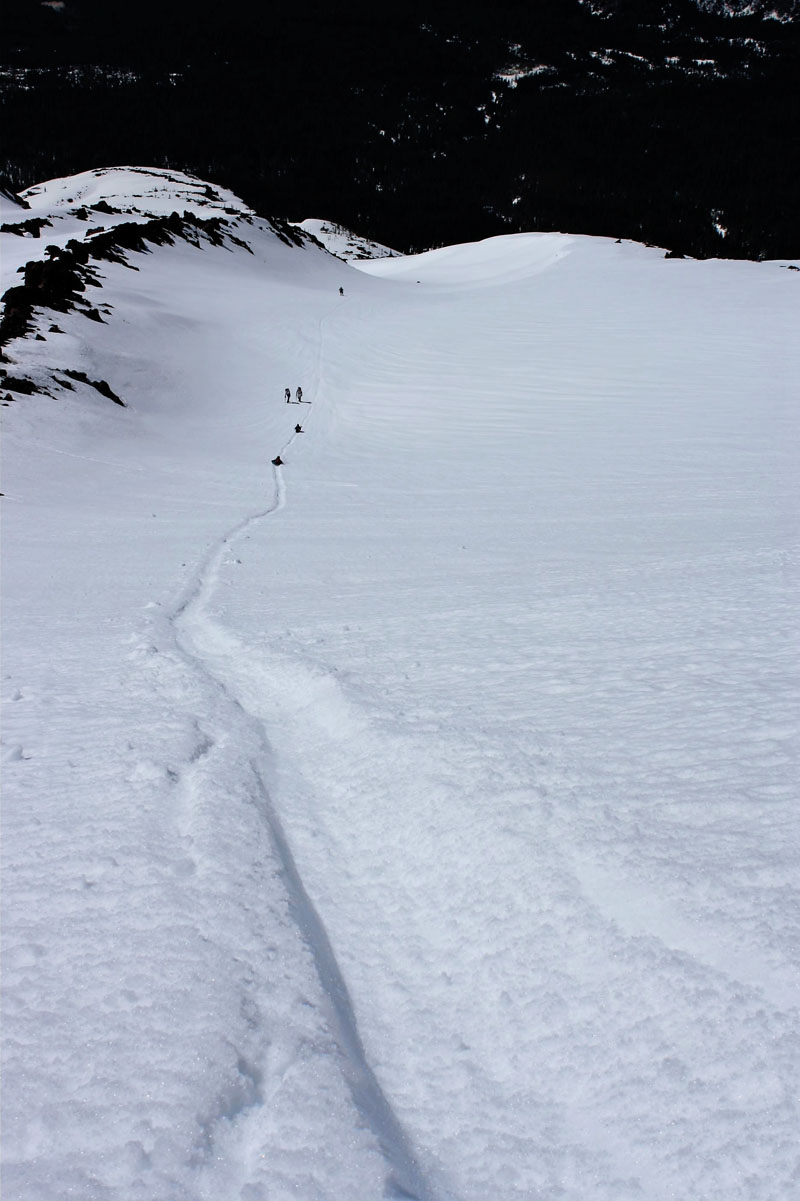
I tried to climb Mt St Helens on Mother’s day last year after graduating from BCEP – but the weather had other plans (winter snowstorm + lightning!) and we had to cancel.  This year it couldn’t have been more opposite.  Temps were predicted to be warm.  No, strike that, downright HOT.  So warm in fact, that there was a wet-slab avalanche danger warning issued for the entire cascade range and they were even taking the unheard of step of offering refunds on climbing permits.  This made me apprehensive, but our excellent climb leaders who’d had a lot of experience with these conditions and St Helens felt our particular route up Monitor Ridge should be very safe.

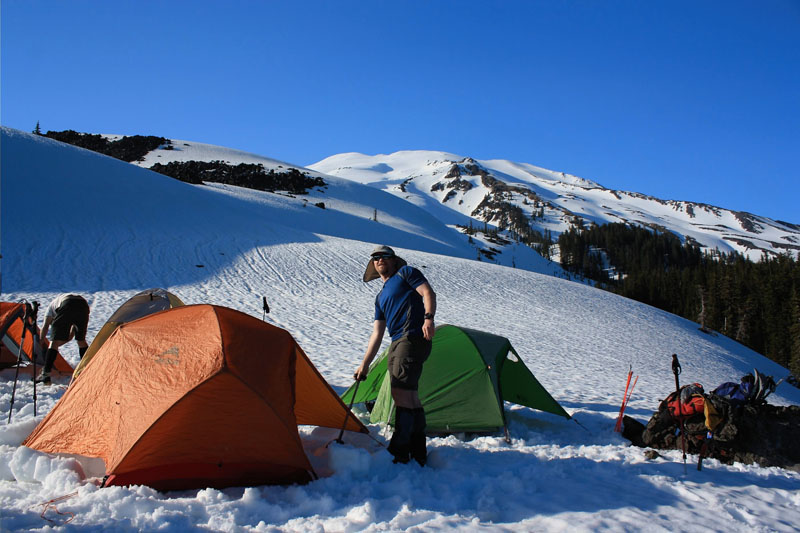
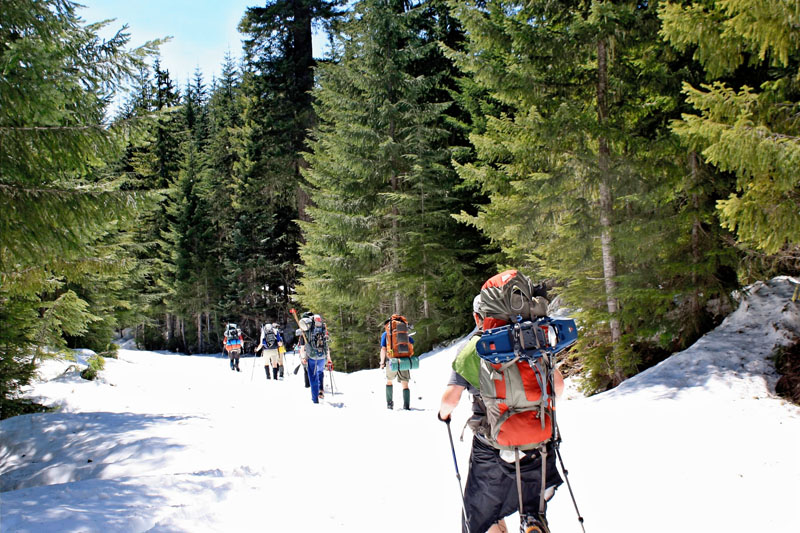
We started our 2-day adventure on Saturday afternoon from the Cougar Snopark located on the south side of Mt St Helens.  After a couple thousand feet of gain and ~4 miles of sweaty snow hiking with full camping packs, we reached the tree line and set up camp for the night.  It was blindingly sunny the whole time and getting roasted by the sun was a real danger.  I was taking a bath of multi-spectrum SPF 50 every hour and still got plenty of sun.  The heat made for interesting conditions.  The warm air temp kept me sweaty hiking in a T-shirt and shorts; while the snow was soft and made for slower going.  We brought snowshoes to keep from post-holing.  But as the sun went down, the temps started dropping fast.  After finding a beautiful spot to camp at the foot of Monitor ridge above the tree-line, we quickly melted snow for water and had dinner then I hit the sack early.  (I am now in love with the MSR Reactor stove – I’m selling my old stove to buy one of these).


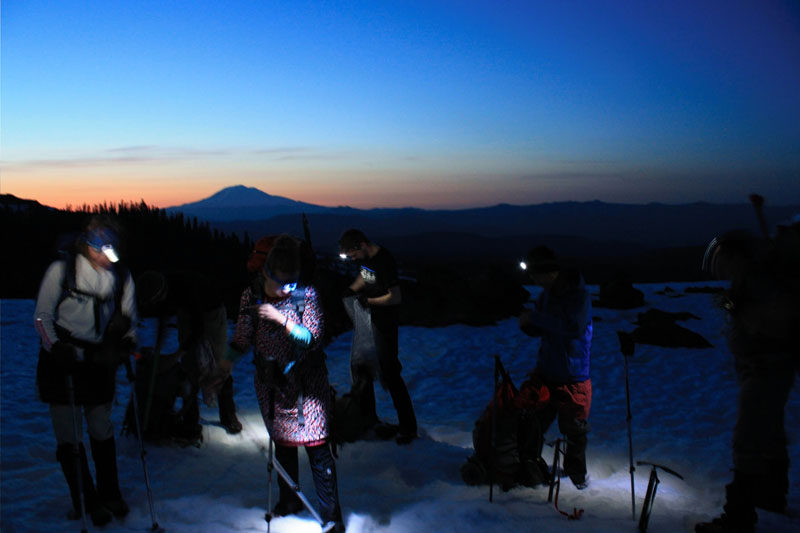
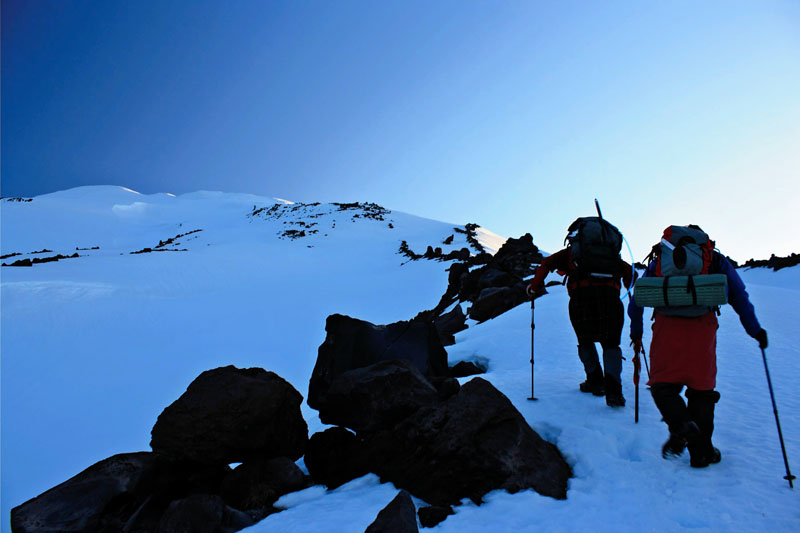
After a few hours of sleep, we awoke at 3:45am to get ready for our climb.  We whipped together our gear, got some food in us, and checked conditions.  The temps were cold but after gathering gear I was shedding layers like crazy.  It was warm – still in the upper 30’s lower 40’s by my guess.  I had hoped for freezing temps since that helps freeze the snow and make for safer climbing – but it was not to be.  A little after 4:30am we switched on our headlamps and started up the Monitor ridge route.  I know the warm temps and high avy danger warnings kept me apprehensive all morning as we started up the steep pitches.  We climbed up, through, and around the rocks of Monitor ridge, taking short breaks every hour for a bite and drinking.  The idea being that by staying on the ridge top and out of the snow fields – we would be much safer.

We made steady progress of about a 1,000 ft of elevation every hour; and the route was only moderately steep.  I would certainly say it was easier than Mt Hood.The sun began to glow over the horizon and we feasted on a beautiful sunrise about half the way up.  The snow was fairly well consolidated, and easy to walk on with crampons.  As we reached to summit, however, the sun was full-on shining and the snow quickly softening.  But by then, we had already reached our goal, the summit rim, at around 9:30am.


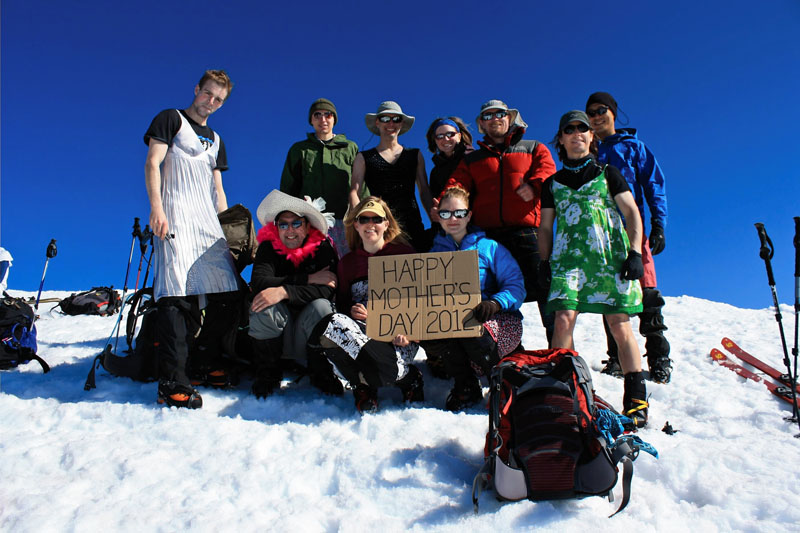
Upon reaching the summit, we posed for the obligatory summit shots and took a breather.  This became more fun because a great number of people there were sporting all manner of ladies dresses, hats, etc.  We posed for our shot and quickly re-clad.  Even though it was already in the 50’s, the mild wind was enough to keep our jackets on.  We had some lunch, took some photos, enjoyed the scenery and enjoyed the show.  We were some of the first few groups there, and a huge line of people were steadily streaming to the summit. The costumes and goof-balls that showed up were certainly entertaining.


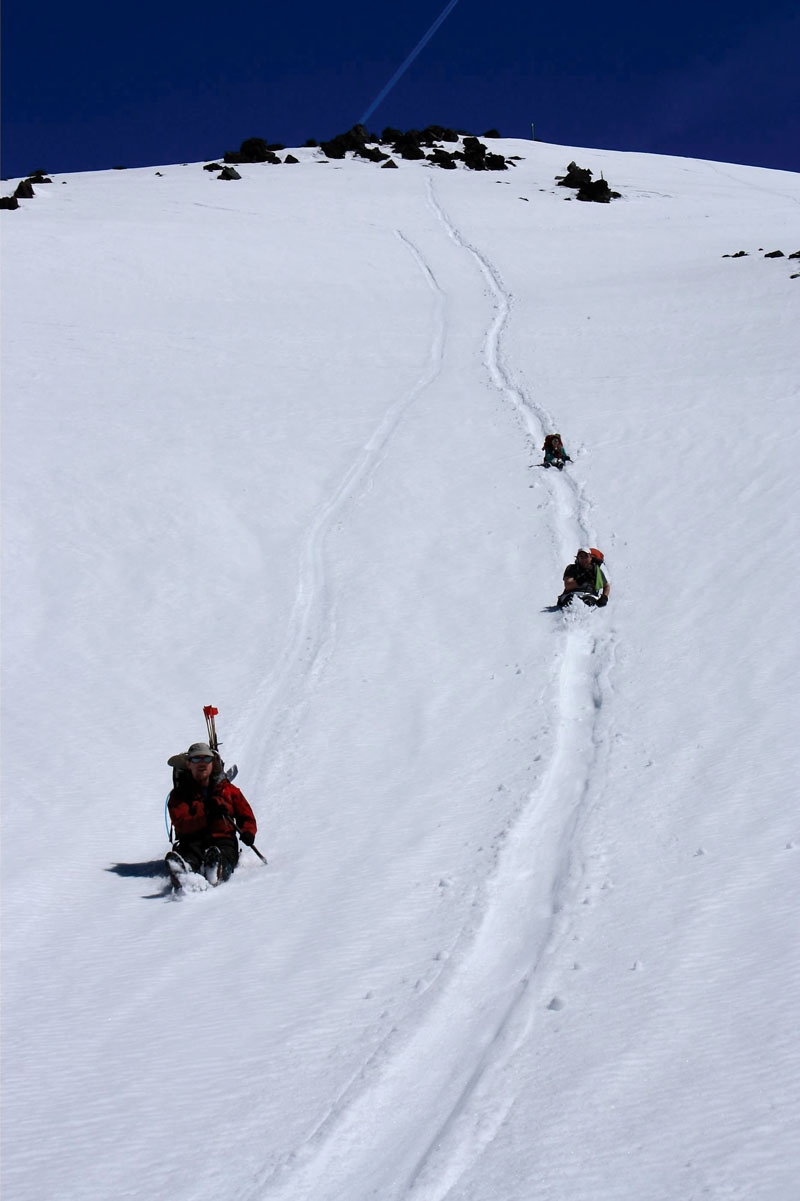
Then the best part – the return trip. About a third of the people coming up skied or snowboarded down.  We did not have such accoutrements (but man – I would have LOVED to had my snowboard judging by the amazing carving folks were doing!), so we opted for glissading.  The snow had softened dramatically by this point under the glaring sun, so we glissaded huge sections back to our campsite.  Honestly, some of the most fun I’ve had in a long time.  Absolutely amazing conditions.  I did see some slab cracks forming at the tops of some ridges – and it certainly made me pause – but our leaders believed them benign and we skirted them.  Still, I was keenly aware of those avy warnings that I’d been reading.  The advantage of the glissading was actually that we spent much less time in the ‘danger zones’ by zipping around them instead of spending extra time hiking them.  We reached camp in a blindingly fast 2 hours.  We packed up then hiked back to our cars.  We were all quite beat by the time we reached the vehicles – but it all went swimmingly.  What a great experience!


I would have wished for far less avy danger and certainly wouldn’t have attempted this without 2 very experienced team leaders.  I also escaped getting sunburned – but did get a really nice sun rash.   Even two days after the trip, the second I get into the sun my skin starts to prickle.  This after taking baths in SPF 50 every hour for two straight days.  A testament to how bright it was.  Good thing I work an inside desk job so I can give my skin a rest. 🙂

Jiro Dreams of Sushi

Jiro Dreams of Sushi

Watched Jiro Dreams of Sushi last night during the $5 cheap showings at Living Room Theaters.  Pretty darn good movie and enjoyable to watch.

Synopsis:
Jiro Dreams of Sushi is the story of 85 year-old Jiro Ono, considered by many to be the world’s greatest sushi chef. He is the proprietor of Sukiyabashi Jiro, a 10-seat, sushi-only restaurant located in a Tokyo subway station. Despite its humble location, it is the first restaurant of its kind to be awarded a prestigious 3 star Michelin review. Sushi lovers from around the globe make repeated pilgrimage, calling months in advance and shelling out top dollar for a coveted seat at Jiro’s sushi bar.  

My take:
A fascinating tale.  A few interesting tidbits that come out:

  • Jiro left (an apparently unhappy home) at age 9 and started working in a sushi restaurant.  He was told by his parents that he could not come back if he left.  He never went back and has made sushi ever since.  He is now 85.
  • You must book at least a month in advance for a seat (either lunch or dinner).  Some book up to a year in advance.
  • There are only 10 seats in Sukiyabashi Jiro, and the bathroom is actually outside the restaurant.
  • It was the first sushi restaurant ever to get a 3-star Michelin award.
  • A seat with the standard course sushi set starts at 30,000 yen (~$370 USD by Apr 2012 rates)
  • You get ~15 pieces of sushi in 20 minutes for that price.  That breaks down to $26/piece, or $18.50/minute.
  • Apprentices work at least 10 years in training before he’ll let them make actually make sushi.
  • He found experts in each type of fish and rice he uses and only buys the best from them.
  • He worked long hours so much that he rarely saw his children awake.  When he had actually had a day off and slept in, his own children came running to their mother in the morning exclaiming there was a strange man sleeping on the couch.  They didn’t recognize him.

Jiro is a great living example of the Japanese style of striving for perfection, or Shokunin.  The best definition for Shokunin I could find was:

“The Japanese word shokunin is defined by both Japanese and Japanese-English dictionaries as ‘craftsman’ or ‘artisan,’ but such a literal description does not fully express the deeper meaning. The Japanese apprentice is taught that shokunin means not only having technical skills, but also implies an attitude and social consciousness. … The shokunin has a social obligation to work his/her best for the general welfare of the people. This obligation is both spiritual and material, in that no matter what it is, the shokunin’s responsibility is to fulfill the requirement.” – Tasio Odate

You can see the delight in his eyes and peace of heart he has achieved.  Here’s a great quote from Jiro that sums him up:

“All I want to do is make sushi.  I do the same thing over and over, improving bit by bit.  There is always a yearning to achieve more.  I’ll continue to climb, trying to reach the top…but no one knows where the top is.  Even at my age, after decades of work, I don’t think I’ve achieved perfection.  But I feel ecstatic all day.  I love making sushi.  That is the spirit of Shokunin.  When to quit?  The job you’ve worked so hard for?  I’ve never once hated this job.  I fell in love with my work and gave my life to it.  Even though I’m 85, I don’t feel like retiring.  That’s how I feel.”

It’s the story of a life seeking perfection.  A giving of your life to a higher purpose than yourself. It’s success, not as we do it today using flashy-showy marketing and constant shifting to chase after the latest/greatest new thing, but by real technical accomplishment and finely honed skill in your craft earned from a lifetime of practice and experimentation.  His philosophy consists of several key elements:

  • A life-long desire to always improve.
  • Repetition that strives to get a little bit more perfect each time.
  • Dedication of long hours and years to your practice

This reminds me of a talk given by a fellow at the Game Developer’s Conference.  He said that success was not found when you strive for recognition, publication, awards, etc.  Those things do not actually make your company/game successful in the marketplace.  What makes you successful is long, grueling hours in your seat working again and again on your game/code.  It’s a very counter-cultural message as we live in times which seek instant success, fame, and wealth.  Jiro harkens to a different philosophy where you dedicated your life to your craft and seek to find yourself in it; not the other way around.  It is a very Zen approach; and resounds with many similar beliefs found in monastic Christianity; but this philosophy could be applied to any walk of life.  In fact, it made me want to sit down and do some coding!  His striving for perfection was infectious.

There is also an side theme in this movie about his relationship with his sons that is very interesting – and very Japanese.

The only fault I see is that the film makers get a little bit wrapped up in the craft of telling the tale (i.e. I would have loved it if the film makers actually talked with him about how he went about getting better with each step.  How he experimented, what went wrong, how he came up with other ideas to try, etc.)  but this flaw doesn’t detract too much from the story.  Still, you can see them fall into their own trap by using lots of long shots of Jiro serving his sushi – while Jiro himself admitting that all the real work happens in the kitchen.  The actual serving part is just show.

So, the movie was good and worth a watch to see such an artisan at work.  Recommend.

A final note.  One of my favorite quotes from Jiro was about raising kids:
“Kids now want lots of free time and pleasure.  Many parents stupidly tell their kids they can come home if it doesn’t work out for them.  That’s idiocy.  How do you expect them to really get great like that?  I told my kids they could not come back when they left.  But I knew they would succeed because I trained them well.  I just gave them the push out the door.”

Loading an icon from a file (Win32)

Loading an icon from a file (Win32)

I’m always perturbed by how difficult it is to load an icon in Win32 at times.  So many HICON/HANDLE and whatnot special data members and folks on forums doing strange stuff.  Here’s a snippet of code that just loads a simple icon file and displays it as your executable icon.  I’m sure there is a more correct/newer/snazzier way to do this – but this works fine for me…

LPCTSTR iconPathName= L"../MyIcon.ico";
UINT icon_flags = LR_LOADFROMFILE | LR_DEFAULTSIZE;
HANDLE hIcon = LoadImage(hInstance, iconPathName, IMAGE_ICON, 0, 0, icon_flags);

// set up RegisterClass struct
wcex.style            = CS_OWNDC | CS_HREDRAW | CS_VREDRAW;
wcex.lpfnWndProc    = WndProc;
wcex.cbClsExtra        = 0;
wcex.cbWndExtra        = 0;
wcex.hInstance        = hInstance;
wcex.hIcon            = (HICON) hIcon;
wcex.hCursor        = LoadCursor(NULL, IDC_ARROW);
wcex.hbrBackground    = (HBRUSH)(COLOR_WINDOW+1);
wcex.lpszMenuName    = NULL;
wcex.lpszClassName    = m_AppTitle.c_str();

// register the window class
return RegisterClassEx(&wcex);

The Spy Who Loved Me – Ian Flemming

The Spy Who Loved Me – Ian Flemming

Shesh!  Book reviews galore.  Looks like I’ve been having too many boring drives home.  Anyway, on to a new book: one of Ian Flemming’s  James Bond stories.

This one is “The Spy Who Loved Me”.  It was another short read at 6 discs, or about 5 days of commuting.  If you’ve never had the honor, you should really read one of Ian Flemming’s Bond books.  The first thing you’ll note is that the movies have just about nothing to do with the stories they are named after.  Sure, there is a character named James Bond who is a spy; a damsel in distress, some evil characters, but that’s where things depart.

In this case, we have the story of a young French Canadian who is working her way across country doing odd jobs as she goes to pay the way.  As our story starts, she is working at a vacation motel at the end of it’s season.  On the last night, some unsavory gentlemen appear as does James Bond (by pure chance).  Bond’s debonair manner and gunplay ensue as he and our night clerk try to figure out and foil our villains’ evil plot without getting killed.  Being a short book, all the adventure really takes place at this one motel  There’s no evil mastermind plotting to destroy the world or counterespionage intrigue.  Just a great little compact story of an adventuresome night spent at a motel.

And for that, it’s a great little story.  Sure, it’s a bit dated with the girls being called dolls and whatnot, but it’s still a pretty good story overall.  Unlike a number of other Bond books, this one doesn’t have as much blatant bigotry you’ll find in some of Fleming’s other novels.  Instead, you get a good little story with some tight action sequences and a good finish.  I enjoyed it.

While nothing earth-shattering will happen here, but it’s still an enjoyable little pulpy adventure. I give it a B.

John Carter of Mars – Book 1 – The Princess of Mars

John Carter of Mars – Book 1 – The Princess of Mars

It appears yet another book is being made into a movie.  This time it’s the John Carter of Mars series by Edgar Rice Burroughs.  I just finished book 1 of this 6 part series – A Princess of Mars.

First off, some interesting tidbits about Edgar Rice Burroughs.   Burroughs had a very difficult early go in life despite his promising start.  He was born to a prosperous family in 1875. He served in the 7th Calvary in WW I but never saw action due to a heart problem.  After his discharge, however, he worked at all sorts of odd and very low-paying jobs such as railroad policeman, office manager, and even pencil sharpener wholesaler.  None of these endeavors were  successful and he and his small family lived in near poverty for many years.  At 35, he wrote the Mars series for All-Stories magazine.  This started his writing career and lead to a great number of works including the most famous, the Tarzan series.

But back to the book.  This was a quick audiobook ‘read’ coming in at only 6 discs, or 6 hours, of listening.  The first thing that will strike you is the tone.  You can tell this was written in turn of the 1900’s language and style.  The men speak more like English gentlemen and the ‘science’ part of the sci-fi is problematic and dated to say the least. Still, he does get a number of things partly right – which is pretty good considering what was known of other planets at the time.

Our hero, John Carter, is transported to Mars via an encounter in a mystical cave.  Once there, he has the strength of 20 men and can leap great distances with little effort due to the low gravity of Mars.  He encounters the warlike green men of Mars and earns a place with them through combat.  During his adventures with the green men, he meets the captured humanoid princess Dejah Thoris.  His attempts to win her hand and save both her and her city Helium from various armies leads to epic battles and adventures.

The battles and fights certainly portray the signs of Burroughs’ times.  There are clear echos of white man vs Indian/’savage tribe’ attitudes, battles that themselves would be considered brutal and morally questionable by today’s standards.  But that does not terribly detract from the story.  In fact, if anything, it add something Burroughs never expected: historical insight.  In many ways, Burroughs’ writing echos the prevailing attitudes towards indigenous peoples and what was considered the height of culture and understanding of his days.  It’s a good reminder to always have a healthy dose of skepticism as to our own perceived ‘we know much better and are so much more sophisticated’ attitudes and political/social agendas.  In some ways, his world is much more civilized such as in the case of the duel-like rules of personal combat.  In others, such as reasons for battle and killing every last man of your enemy, appear barbaric.

Still, with so much story to tell in such a short time – the writing is anything but eloquent.  One person has (mostly correctly) said it reads a lot like an adventure written towards teenage boys.  Sure, you can get some dialog exchanges that are simplistic to a point of being almost comical.  The sci-fi part is clearly dated and wrong in many ways.  This isn’t intellectual reading.  But is it a good story and worth the read?  Yep!

It’s a ride at a carnival.  The set pieces and characters are mostly painted walls, and the dangers only as real as you imagine them to be; but that doesn’t make it any less fun.  It’s an escape from the mundane into the somewhat ridiculous and far-flung.   It’s just good fun when you can see beyond the shortcomings and enjoy it for what it is.  A crazy romp to another planet where a southern gentleman meets and falls in love with the most beautiful woman he’s ever met with a pet monster as a bosom friend while swash-buckling his way through epic battles.

Overall, I give it a solid B and I’m looking forward to the movie version as there should be some great opportunities for crazy creatures and epic battles.

Mockingjay – Suzanne Collins

Mockingjay – Suzanne Collins

Just finished the third and final book of the Hunger Games trilogy.  In this final installment, Katniss is with the rebels and they are in a war to defeat the Capitol.  The stakes are high as she fights along with the other rebels in a winner-take-all war.  There’s not much I can say beyond that without giving out some serious spoilers.  So here they come.  Skip if you don’t want to know anything.

<Spoilers>
I have a lot of criticism for this book.

First off, people drop like flies.  Previous victors are killed off in rapid-fire succession like red-shirts on a Star Trek episode and very little is given to these losses other than passing sentiment.  Peeta is brutally brainwashed by Snow into wanting to kill Katniss.  This powerful story element was mostly flubbed by Collins and it quickly reverts to the tired love triangle theme that just continues to go nowhere for 90% of even this book.  Finally, the killing of her sister Prim has to be one of the most pointless, even sadistic, story elements from a writer I’ve run across in years.   The very fact Prim was where she was *ahead* of the front lines, and that the whole point of the death was to take Gale out of the love-triangle equation by means of some of the most feeble logic I’ve ever heard made me throw my hands up in frustration at Collins.

As a core theme, the love triangle, just gets completely flubbed with cheap moves.  I’d hoped something good would come of it and see our characters bloom into something rich and heartwarming despite the surrounding destruction.  Mostly I just wanted to smack the three of them and Collins’ poor handling.  Despite each of their flaws, I wanted to hear Peeta or Gale have an epiphany and confess their love for her in some heartfelt and real expression of their inner self.  Katniss could have done likewise or actually *chose* one of them.  But instead of this, Collins merely makes Gale out to be a monster (on trumped up charges none-the-less) and Katniss ends up with Peeta kind of by default even though Peeta sees clearly that Katniss never really loved him.   Even this ‘resolution’ you don’t find out until the tacked-on epilogue.  And the reason she’s with Peeta?  The best answer you get is because she ‘owes’ him more as he did more for her earlier.  Really?  That’s why you marry someone? And that’s what you do with a story element going on for 3 books?

For those that at least enjoyed Haymitch’s presence: this staple, interesting and ever-working in the background character in the first books is barely even present in this one.  Felt he was completely under-utilized.

Turning the Capitol into deathtraps, and having custom-bred dogs that whisper Katniss name felt like overdone and feeble attempts to recapture the interesting Hunger Games theme – but mostly didn’t work and it was too little, too late.

The storytelling itself was disjointed and spotty.  Big gaps of time with hard landings left some of the story hard to follow and further exaserbated the feelings of disconnectedness with the characters.

Finally, Katniss.  She suffers badly from PTSD effects through most of the book, several times getting drugged into oblivion so she can just hang on.  She does take on the role of the Mockingjay – but that role never really goes anywhere and Collins absolutely blows a great opportunity to make that a much more powerful symbol.  Instead, all it turns into is a propaganda piece that Katniss herself isn’t very interested in.   But the big failing in my opinion is that Katniss doesn’t seem to grow as a person.  There are a few attempts to protest morally questionable activities like the bombing of the nut in district 2, but that doesn’t go anywhere. In fact, she shows quite the opposite of character and growth when she votes to throw the children of the Capitol’s leaders into one last Hunger Games (run by the rebels of all things) with no real discussion of the morality given.  It gets like 3 pages – bang – she votes to throw these innocent kids into the arena and nothing more is said.  Then, about 10 pages later, she coolly assassinates Coin without much of a second thought.  Overall, we’re left with a burned-out, war-scarred character that hasn’t shown any particular growth or hope.  I was left caring very little for her when I could have been there with her all along if she’d shown even one tenth the character, struggle, or growth you’d see with Frodo or other person in a titanic struggle like this.  It could maybe have been made a bit better with her at least started to find some sort of healing or hope at the end – but even that we don’t get.  I don’t need a fairytale ending – but there should be some sign of hope, change, or healing.

I don’t know if I would qualify this book as a teen book.  It’s got some pretty rough story lines and themes: PTSD, mental and physical abuse, drugged states to get through personal crises, many morally questionable activities (that don’t get questioned) and plenty of death and destruction. While these topics can be appropriate for teens if consequences and characters struggle to make right choices, but you get little of that. I didn’t find the way they were handled to be very productive or geared towards helping teen readers understand these topics.

There are some good points.  There is an interesting and clever bit about the power struggle between President Coin, President Snow and Katniss, but it just doesn’t make up for the other problems.

</Spoilers>

So, I had a lot more criticism of this book than good things to say and would even hesitate to call it teen-appropriate.  While it was a decent attempt to bring the elements to a close – the writing and story just fell apart in too many ways.  I was hoping for a lot out of this book – but it left me disappointed.  If you saw the story cracks in book 2, then those cracks are absolute canyons in this book.  You should probably read it to finish the trilogy since it’s only 10 audio discs (600 minutes); but don’t go into it expecting a very good story.  You just aren’t left feeling very connected or concerned about Katniss or most of the other characters (that manage to still be alive) by the end.  I was just glad this train-ride was over.  Sadly, the journey started so well in book 1 has turned into a destination to which I never want to go back.  Even as I sit here writing this I am thinking of ways in which this book could have been better.  Sigh.

I give this book a D+ rating.  It finished everything up; but left numerous problems with the morality of their choices, the plot, and the largely unsatisfying ending to the characters.