Browsed by
Category: Technical

ISA over USB

ISA over USB

Plugging in old ISA cards is something that hasn’t really been possible since 80486 days. This makes plugging in cool things like Sound Blaster, Adlib, Monster3D and other ISA cards pretty much impossible for modern computers. It also means things like attaching 5.25″ floppy drives and old MFM/RLL drives are also off the table. Well, maybe. 🙂

There have been a few efforts to enabling plugging in ISA boards to modern pc.

  • dISAppointment that I wrote about before is a USB plugin that exposes an ISA interface.
Viewfinder puzzle game

Viewfinder puzzle game

Viewfinder is a new 3D puzzle game on PC and game consoles. It involves taking a picture with a film camera, then using the 2D picture to overlay the 3D world. The 2D picture then replaces/augments the 3D world with the 3D that was in the picture. It’s hard to describe, but very interested technique.

There’s also folks like Willlogs who are making their own versions in Unreal and describing how they think the mechanics work.

Why Remotes were called clickers

Why Remotes were called clickers

“Pass me the clicker”

My grandfather used to say that when he wanted us to pass him the remote. I never understood why he called it a ‘clicker’. They didn’t click.

But I later found out that they used too.

Here’s a great article on the Zenith Space Command – a remote that didn’t need batteries, infrared, nor even line of sight to the TV. Instead, it worked on sound.

Packing just got faster and easier

Packing just got faster and easier

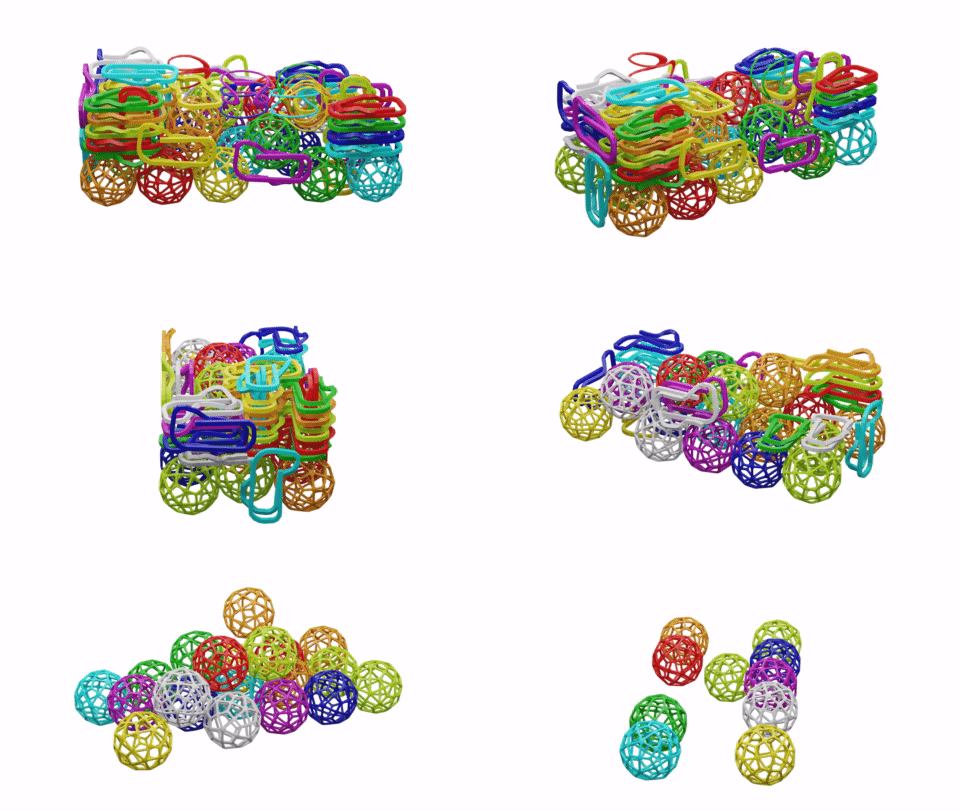
MIT has just developed a new computational method that can figure out how to arrange a dense placement of objects inside a rigid container – while also guaranteeing that the objects are separable/interlock free (can be taken out again without getting stuck on each other).

The optimal way of positioning 3D objects of varied sizes and shapes in a container is still considered an unsolved problem. In fact, it is classified as NP-hard, which means it cannot be solved exactly — or even approximately, to a high degree of precision — without gargantuan computational times that could take years or decades depending on the number of pieces that need to be fit into a confined space.

Researchers from MIT and Inkbit (an MIT spinout company in Medford, Massachusetts), headed by Wojciech Matusik, an MIT professor and Inkbit co-founder, is presenting this technique, which they call “Dense, interlocking-free and Scalable Spectral Packing,” or SSP, this August at SIGGRAPH 2023

The method leverages a discrete voxel representation and formulates collisions between objects as correlations of functions computed efficiently using a novel cost function that can be efficiently solved with a Fast Fourier Transform (FFT).

Definitely worth checking out.

Self aware Tomb Raider

Self aware Tomb Raider

FoxMaster uses a wide variety of AI tools: vision, object recognition, chatgpt, and others to give Laura Croft the AI treatment. She not only can traverse the game, but also has personality and narrates what is going on.

Foxmaster admits some of this is not complete and may be stretched a bit – but his analysis and breakdown of the problems of navigation, identification, and character personality into discrete problems is very interesting.

Nefarious data collection disguised as public art

Nefarious data collection disguised as public art

Beginning early July, mirrored spheres began popping up in cities across the world. It is not public art but a 6.2 pound biometric imaging device designed to scan your eyeballs and capture your irises.

No, it’s not a joke. The company doing this is Worldcoin. Worldcoin was founded three years ago by Alex Blania and Sam Altman, CEO of OpenAI. Their intent is to create â€śa new identity and financial network connecting billions of people in the age of A.I.” via a privacy-ensuring digital identity it calls World ID and a digital currency, WLD. World ID is supposed to be a ‘perfectly safe’ global identity protocol to enable individuals to prove their personhood online in an era of rampant A.I. deepfakes. WLD is a tool to build an “A.I.-funded UBI [universal basic income]”

This should all sound familiar because they’re the same arguments being made for digital currencies like Bitcoin. The company stresses they have security all along the trust chain, but it reads more like a dystopian nightmare in which everyone has been cataloged and identified by an unknown party with unknown motives. This is a company that could be working for anyone. A 3rd party agent that has unknown motives, unknown technical expertise, and unknown longevity to keep your biometric data safe. You do not really know which government, people, nor company is really behind it all nor what their values nor legal protections you would have. It’s a terrify black box of giving up your biometric data to an almost completely unknown entity. I vote a hard no.

In my opinion, this is a violation of privacy and an extremely bad idea. Even if they are secure today – are they really ready to protect your biometric data, collected surreptitiously, without consent, for all time, and never to sell it? It seems pretty unlikely as every country and every company who has promised this before hasn’t lasted 10 years before being hacked, leaking, being forced to turn over that data, or just flat selling you and your data to the highest bidder when they’re bought out or go bankrupt. Ready for North Korea, China, or Putin to have access to your World ID and any money you put in WLD?

So, maybe be sure to wear some good sunglasses when you find a shiny orb laying on the street.

At least some folks are starting to do an investigation – one I suspect will end badly for Worldcoin considering the EU’s less than open stance on collection/storage of biometric data collection and privacy.

Article here.

File Graveyard

File Graveyard

Well, this is different. Instead of just deleting your file, why not bury it in a digital graveyard – marked with its own digital tombstone.

Ulf Schleth’s /death/null offers us – a digital graveyard where our files no longer exist as they were, but are marked with a digital gravestone.

Simply upload your file and it is marked by a 4 x 5 matrix of colored blocks that represents the file. It is registered forever in the graveyard where you can check up on it any time you like.

And now my file has it’s own (very plain) ‘tombstone’.

Unknown: Killer Robots

Unknown: Killer Robots

AI is here. Netflix put out a short show called Unknown: Killer Robots that is largely on-point. If anything, it’s not as up to date as reality – which is a little scary.

Despite our efforts, there’s really no putting the AI genie back in the bottle despite the attempts of artists, politicians, and academic pundits. AI has demonstrated it can teach robots how to walk and fly better than any static system, it can create art faster and with nearly the same quality as real artists. The question is, can we control and limit it in a reasonable way – or will it destroy us?

To that point, the show demonstrates how countries are increasingly seeing AI in military use. We’re already seeing off-the-shelf drones being used extensively in the Ukrainian war – from tiny drones scouting and delivering hand grenades to ad-hoc drones using small plane engines to delivering bombs. They also cover the counter-intuitive reality that trying to save lives by developing military technology has almost always lead to even greater casualties – such as the Gatling gun which was design to put fewer people on the military field but resulted in massive causalities of mis-matched soldiers in WW1

Many of the topics and data they cover in this show are actually old news – the reality is that AI enabled systems are around 5-7 years more advanced. Which is almost half the length of time the modern field has existed.

Still, they cover most major bases:

  1. AI flying drones that go into hostile buildings to map and scope them without risking troops in extremely deadly house-clearing fights.
  2. AI can be used to generate helpful drugs – but the same AI can be used equally to create chemical and biological weapons.
  3. Playing and cheating at games – from chess and Go to StarCraft
  4. Jet fighter piloting systems that are better than actual pilots. I wrote about this 6 years ago.
  5. Swarm drones that can overwhelm forces (something Elon Musk talked about years ago).
  6. Wildfires and the fog of war – multi-system battle managers

The stakes couldn’t be higher. While politicians can argue the ethics, the reality is that when forces are pushed to their breaking point and a force is about to lose – just about nothing is off the table. Especially ad-hoc and terrorist forces which have perpetrated chemical, biological, and conventional weapons attacks (from bombings to shootings).

Some of the better quotes:

  • It will be like people on horseback charging tanks. Forces with AI will absolutely dominate forces without AI
  • There is no prize for second place in war.
  • I think people have largely underestimated the peace we enjoy today due to overwhelming military dominance we’ve had over the last 70 years.