Oregon used to be #1 in this category. Now it looks as if Vermont (75%), New Hampshire (66%) and Maine (66%) are now the top share of adults who say they never or seldom attend church or religious services.
Ironically, half of people believe that’s a bad thing but only 30% of Protestants, 28% of Muslims, 23% of Catholics, and 16% of Jews report they attend services weekly.
There’s a ton of data in the Pew research link. Worth taking a look.
The Riddle Brother Ranch was built in the early 1900s beside the Little Blitzen River. The Bureau of Land Management purchased the historic property in 1986, and since then the ranch has existed as a hard-to-reach tourist attraction. Access is only permitted from Wed-Sun June to Oct via 4WD high clearance vehicles or horses.
The caretaker’s cabin at the ranch has a bed, electricity, running water, a refrigerator with a freezer, and cooking stove with an oven. Another building a half-mile away has a hot shower and additional food storage.
Those looking for more information or who want to apply can call Tara Thissell at 541-573-4400
Old School Gamer outlines a long list of ways to get around YouTube’s recent fight against ad blockers. If you’re frustrated with unskippable ads or getting stuck in a stream of multiple ads, or ads that pop up every 30 seconds in your videos, this article might be helpful.
Two of my favorites:
Set your VPN to a country that doesn’t have ads ( great for mobile devices )
The unemployment rate in the metro area stood at 4.2% in March 2024 – which isn’t that bad. The problem is that from a year ago, total employment fell 1.5% from the same time last year. Portland fared worse than all other US cities.
Local companies are tightening their belts. There have been big layoffs at Nike, Columbia sportswear, Wieden+Kennedy, Axios, and VACASA. The commercial vacancy rate in Portland is now the highest in the country – and is not predicted to recover for about a decade.
This isn’t something people can wave off as just a fluke. It’s been a 3 year trend, and it’s one that’s got demographers sounding alarm bells. Especially when many other parts of the country are seeing very nice population, employment, and civic growth.
There’s been some trouble lately in which free VPN services have been collecting and selling your data. Others have had major leaks or hacks (such as the new TunnelVision attack). So why not set up your own VPN and avoid those issues?
A few important reminders. VPN’s do not make you anonymous. They only create a secure pipe between you and that server. From that point on, your traffic can be collected and used – and many free VPN services do exactly that. Anonymity comes only if you use things like the TOR network.
But instead of paying a VPN service fee or potentially having your data collected and sold, you might set up your own VPN server on a Rasberry Pi.
Create an account on a cloud hosting provider like DigitalOcean
Download Algo VPN on your local computer, unzip it
Install the dependencies with the command lines on this page
Run the installation wizard
Double click on the configuration profiles in the configs directory
It’s important to note that there are some limitations. This setup is good if you need a secure connection from where you are to the location of the server (ex: You’re in China and need access to US services that are blocked). Again, this doesn’t make you anonymous as your data exits the VPN and becomes public again.
Paid VPN services also often offer servers in different countries so you can spoof being in specific countries. This will not do that unless you have paid for hosting in those countries.
I have a small collection of my favorite old big box PC games. It turns out that others do too. BigBoxCollection website has a bunch 3d scanned boxes from your favorite old games. You can combine this with box and manual scans on MobyGames.
Google developed a deep reinforcement learning–based framework for full-body control of humanoid robots, enabling a game of one-versus-one soccer. The robots exhibited emergent behaviors in the form of dynamic motor skills such as the ability to recover from falls and also tactics like defending the ball against an opponent.
An interviewer and a prompt engineer will sit down with the subject whose memory they are trying to retrieve, as the person recalls a specific event or place the promptographer will input the descriptions into an AI image generator and what follows is a bit of back and forth to get the image right.
“You show the image generated from that prompt to the subject and they might say, ‘Oh, the chair was on that side’ or ‘It was at night, not in the day’,” explains Garcia. “You refine it until you get it to a point where it clicks.”
It’s more like guided painting/drawing of a scene from a description – but using generative AI to do the work is pretty unique.
The team recently worked with an 84-year-old woman from Barcelona called Maria. Maria has vivid memories of peering out from her balcony as a child to try and catch a glimpse of her father who was incarcerated in a prison opposite where they lived.
These childhood memories only existed inside Maria’s mind, but the AI researchers worked with her to bring these reminisces to life by describing the place and the historical context (Maria’s father had been jailed by General Franco).
“It’s very easy to see when you’ve got the memory right because there is a very visceral reaction,” Pau Garcia, founder of Domestic Data Streamers, tells MIT Reivew. “It happens every time. It’s like, ‘Oh! Yes! It was like that!’”
AI image from the Spanish Civil War was co-created by a 90-year-old woman called Nuria who vividly remembers men waiting outside bomb shelters with shovels and picks ready to rescue anyone trapped inside.
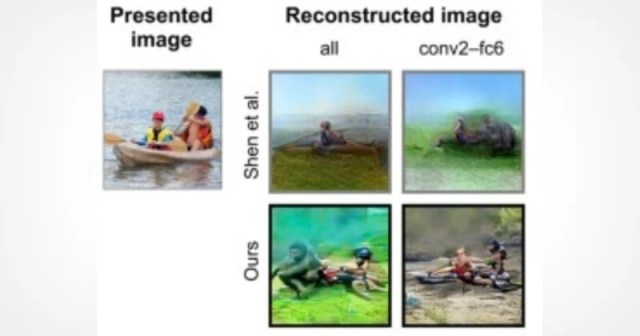
In a paper published in Neural Networks, researchers at the National Institutes for Quantum Science and Technology (QST) in Japan were reportedly able to use artificial intelligence (AI) to reconstruct images solely from people’s brain activity with over 75% accuracy.
They recorded the brain activity of subjects who viewed 1,200 various images while in a functional magnetic resonance imaging (fMRI) machine. “Score charts” that included 6.13 million factors such as color, shape, and texture were also created by making the AI recognize the images. The subjects were then shown another set of images that were different to the original images. Their brain activity was measured under the fMRI 30-60 minutes later while asked to imagine what kind of image they had seen.
According to the publication, the scientists’ groundbreaking method allowed them to use AI to reconstruct original images with a 75.6% accuracy rate — which is a big step from previous efforts with allowed a 50.4% accuracy rate