Japan Day 5 – Golden Gai

Japan Day 5 – Golden Gai

Nestled down a narrow alleyway in the middle of the glitz of Shinjuku, you can encounter a strange nature walkway that stretches off for a block or so.  This nature-lined parkway turns out to be a simple buffer between old and new lines of buildings.

IMG_9190

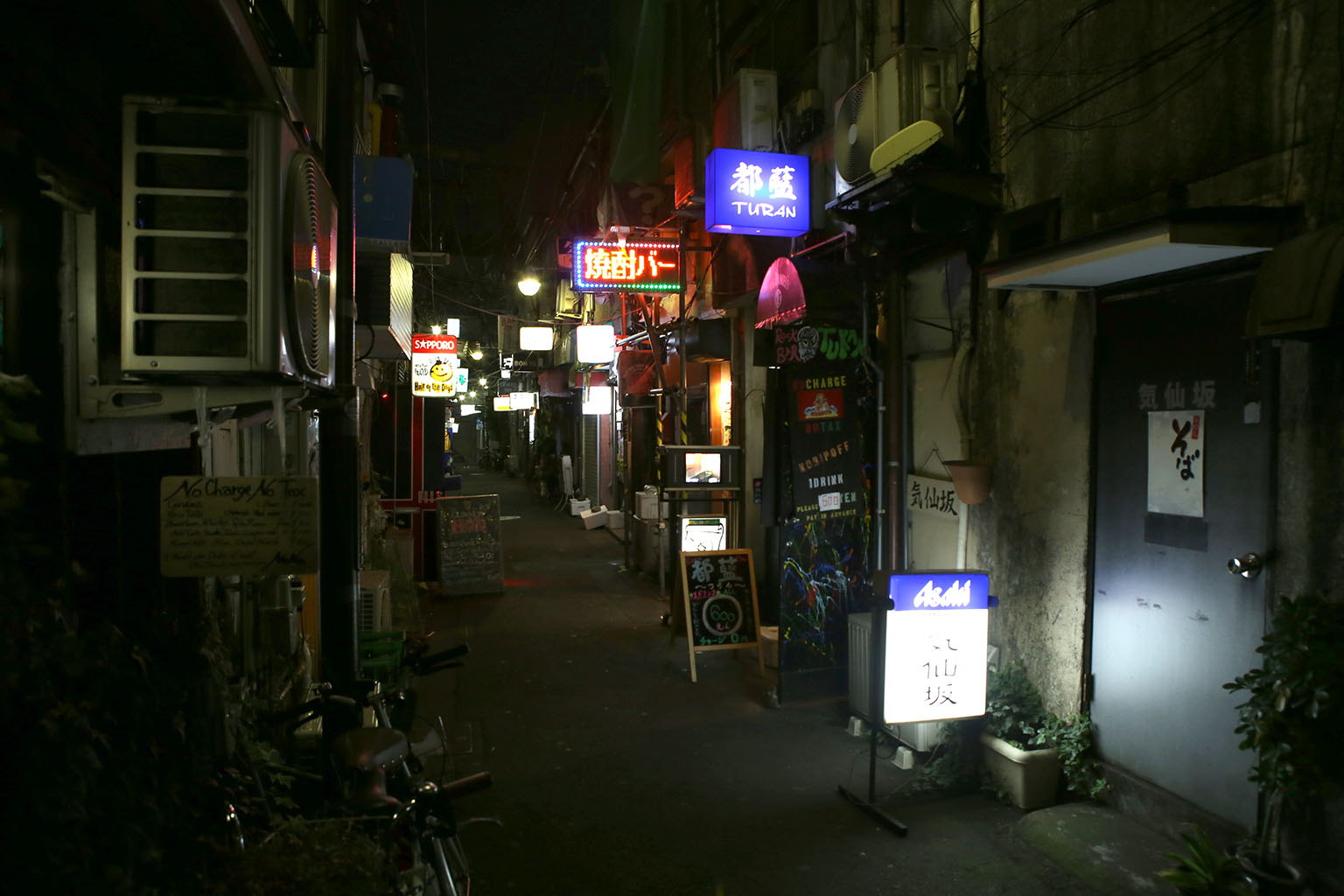
From this point, you can look right/continuing straight from the side street you entered on and you see the entrance to another little set of alleyways.  Congratulations – you just entered Golden Gai.

IMG_9191   

Past the giant Jim Beam building, you’ll find the network of tiny bars and alleyways called Golden Gai.  This map should give you an idea of what Golden Gai is about…

gai1  IMG_9193

As you can see on the overhead map on the left, it’s a collection of very tiny buildings penned in by modern skyscrapers.  The map on the right gives you an idea of how compact it is.  In an area only the size of a small city block, almost 300 bars are squeezed in side by side.  If you thought that Piss Alley had tiny little restaurants – this is even more impressive with 5 full alleyways of tiny drinking establishments.

History of Golden Gai

As before, knowing the history behind this place makes it even more impressive.  Golden Gai is only a few blocks from Piss Alley, so it’s no surprise they share much of the same history.  The area now known as Golden Gai (only a few short blocks away) was also left in ruins after the bombing raids of WWII.  While Piss Alley was known for its food and necessity shops, this particular area was known for rampant prostitution until it became illegal in 1958.  It then turned into a bar and drinking area – and some of the bars can still trace their origins back to the 1960’s.  In the 1980’s, many of these ramshackle areas around Golden Gai were burned down by the Yakuza so they could be bought up by developers during the development boom of the 80’s.  This area survived because supporters would take turns each night standing guard.

IMG_9200  IMG_9221 IMG_9226

Like Piss Alley, this place is architecturally important because it gives you a window into the relatively recent past of Tokyo.  Large sections of Tokyo used to apparently resembled the present-day version of this district.  Namely,  extremely narrow lanes and tiny two-story buildings all scrunched together.  Today, most of these buildings still have a bar downstairs with very narrow and tiny stairs up to a second floor.  Some bars have this second floor open to patrons, some are private drinking rooms, others preserve them as flats.

Many of these bars are so small that they can only hold 5 or so patrons.  Some establishments only welcome regular customers or after introduced by an existing patron.  Others are more open and welcome new customers and foreigners.  It’s important to be very respectful of this fact and only come into places that seem to be welcoming.  The best way is to very politely smile, poke your head in, and maybe hold up a finger or two for how many people in your party while the rest of your party wait quietly outside.  You will be politely declined if you should not come in; or you may be warmly welcomed.  You never know – so be very polite, learn how to say a few words of Japanese, don’t be an ugly tourist, and take a chance.  In many ways, some of these places are like a friend’s house-bar-lounge – so treat it as such.

While the area looks somewhat ramshackle, it’s apparently a sighting spot for famous people.  The area caters to musicians, designers, and artists.  While it may look run down, it’s actually a somewhat upscale price point – so you don’t see low-brow drunks here.

IMG_9213  IMG_9214  IMG_9211

Overall, the area is laid out roughly like a grid.  Each of the tiny alleyways is flanked by buildings that look roughly like this end-cap on the left/middle pictures.  The left building appears to have been recently built, but is very architecturally much like the rest of the area.  The rows are about 2-3 stories tall and only a few dozen feet wide.  Even more impressive is to keep in mind that there are shops on the left AND right (front and back) of each of these buildings.  In America, this entire building depth would barely be big enough for 1 apartment.  Here a building this size is two-sided with full bars/living spaces back-to-back facing away from each other.

If you thought the front-to-back size of buildings is tiny, wait till you see the side-to-side spacing.

IMG_9205  IMG_9231  IMG_9227
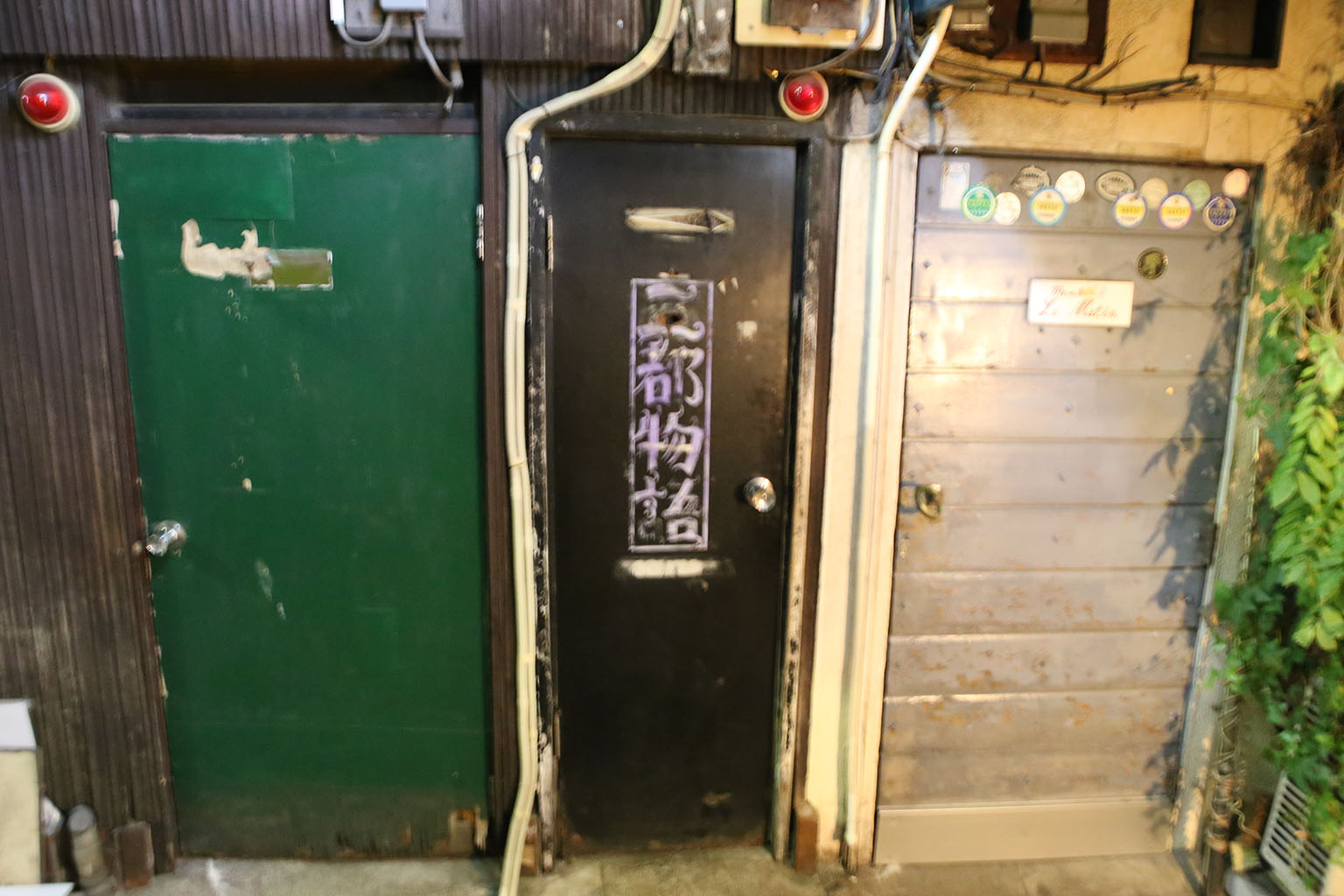
This is a really good example of how tightly things are packed side-by-side all up and down the alleyways.  Each of these entrances is another bar.  That’s right, they’re packed in this tight to each other.


Themed bars

IMG_9218  IMG_9217  IMG_9208  IMG_9210
Many of the bars are themed – such as this Texas chainsaw massacre, Hajime no Ippo, an 80’s style Miami Vice-style bar, and many others.  I wished I’d had been able to get photos of them all – but one could easily have spent days here.

Albatross

IMG_2064  IMG_2062

Sadly, these were the only two pictures I snapped.  There was NO way you were going to pull a big DSLR out of a bag and shoot in such an intimate environment and likely get you thrown out.  The website has better pictures of this absolutely funky interior.

This was one bar that I really wanted to spend a night at – Albatross.  I had heard and read about this bar, so had to check it out.  I had dropped in the night before and done some drinking, but came back on Friday as they had given out cards indicating they were having their 8th anniversary celebration.  I dropped in at the beginning of their night (around 10pm) and brought some of my Florsheim animal donuts.  This quickly made me a lot of friends with my donuts and managed to score a special anniversary t-shirt they were giving out.

The bar is extremely tiny with access to both floors.  There is only room for about 5-7 people on each floor.  The first night I drank on the second floor due to the first floor being full.  Each floor of the bar was probably 15 feet deep and about 6-8 feet wide.  There were gigantic, awesome chandeliers hanging over the bar, and a stuffed deer head as well.  It was kind of a funky take on an English manor house or something similar.  The patrons were all very sociable and I struck up broken conversations both nights.  Even if you cannot speak the language, a phone full of photos does wonders to breaking down barriers.  Be sure to load up your phone with pictures of home as a great icebreaker. 🙂

While I was there enjoying my drinks the second night, I happen to met two expats who were hanging out there.  Just as we got to talking, a 5.5 magnitude earthquake starts rocking the building.  It was a fairly good rolling earthquake that rocked the building for a good 30 seconds.  The bartender simply reaches up and holds the chandelier while continuing to poor drinks, the locals barely even look up.  While not interesting, it was on the larger side than usual according to the locals.

I end up drinking and talking with the ex-pats for many hours.  They were American friends working as English teachers in small towns surrounding Tokyo.  They had come into the city to enjoy a night of drinking and catching up.  They shared all kinds of interesting social tidbits about Japanese culture.  The most interesting parts were certainly when we talked about Japanese dating.  We get to just about midnight when we realize we gotta get going if we’re going to hit the last trains.  One of the ex-pats also was craving Burger King – so off we ran so we could get a bite and catch the last train.  The other ex-pat had a local girlfriend and was staying with her.

Drinking in Japan

As we got our final bites to eat and headed to the train station, that’s when I learned all about drinking in Japan.  As we made our way to the train station, huge HUGE crowds of people were flocking there as well.  Some of them near sprinting.  Many were drunk – but in a funny, happy drunk way.  I didn’t see any ‘ugly’ drunks.  Most of these people were dressed as they likely were all day: suits/suitcases/ties/business skirts/etc.  More likely than not, they had left work and had been drinking the whole time.  Most people were only a little tipsy, but some were falling down drunk.

Most people traveled in groups of friends laughing and helping their more inebriated friends.   As I waited for my train, there was a guy two over from me that was so drunk he was barely remaining upright.  Every so often he’d nod off and completely fall on someone near him in line waiting of the train.  People would just shoulder him back up with nary a second look.  Nobody got angry or beyond just a mildly annoyed look if he really plowed into someone.  As the train came, it was obvious that it was going to be a tight fit.  No, it simply was going to be madness.

More random pictures of Golden Gai

IMG_9204  IMG_9201  IMG_8728 IMG_2057 IMG_2059   IMG_8723 IMG_8724  IMG_8727  IMG_9201 IMG_9203    IMG_9221 IMG_9222 IMG_9226  IMG_9230  IMG_9220


Japan Day 5 – Shinjuku and Kabukichō

Japan Day 5 – Shinjuku and Kabukichō

IMG_8594 IMG_8632

Shinjuku was the next train stop north of where I was staying in Shibuya – and a very different sort of place.  First off, there were a LOT more lights and people out to have a good time.

IMG_8637 IMG_8646

It’s amazing how many people were out even on a weeknight.  Shinjuku on the west side of the tracks is a lot of large skyscrapers and shops that I didn’t get to visit during my short time.  On the east side…well…it’s very different.  This area is a complex of streets with all manner of diversion available.  And by all manner, think a cross between the drinking centers of a large downtown area meets Vegas meets red-light district.  I only spent a few short hours here and barely was able to cover half of it.  And by ‘cover’ I mean just walk around.  Actually going into half these places would have been all-night adventures in themselves…

IMG_8720  IMG_9185 IMG_9184 IMG_9187

First you see some classic and themed bars and restaurants – even a standby or two like this Mister Donut and fast food places like McDonald’s/Burger King.  There were so many themed bars that I couldn’t even begin to know where to start.

IMG_8718

Since it was November, there was already Christmas trimmings available for you to purchase.  That certainly felt odd and out of place.

IMG_8652 IMG_8657

But go about 2-3 blocks and you find the area called Kabukicho.  Like the rest of the area around Shinjuku station – it had been destroyed after the WW II bombing raids.  It was slated for the creation of a Kabuki theater in the 50’s.  The theater never appeared due to financial problems, but the area exploded in development.  This development was led mostly by foreign Chinese investors.  Now it is a world famous red-light district complex that houses over three thousand bars, arcades, nightclubs, love hotels, massage parlors, host/hostess clubs and similar businesses.  Because of the near constant activity of all sorts – it’s sometimes called ‘Sleepless Town’.  A person could spend weeks investigating all the different venues, drinking establishments, arcades, and…er…shows and still not see it all.

IMG_8665 IMG_8686

First off, there’s some pretty standard stuff: karaoke, bowling, pachinko parlors, and buildings full of more innocent diversions.  Many of the buildings here had a whole different experience on each floor.  After passing blocks of buildings like this, one wondered exactly how long it would take to just visit each place once!  There were hordes of young people and businessmen coming and going constantly – which certainly help  it earned its name ‘Sleepless town’.


IMG_8670 IMG_8672 IMG_8674  IMG_8673

Here was the really strange ‘robot restaurant‘ that has become somewhat famous.  I wanted to attend since I heard it was pretty crazy (but mostly innocent) fun, but it looked like I was between shows or they weren’t starting till later and there was nobody to talk to when I passed by.  Most of the action apparently happens downstairs, but the upstairs alone put the gaudiest Vegas casino to shame.

While they weren’t doing a show at the time I came by, this video can give you an idea of the madness that is usually inside (disclaimer: not my video or anyone I know).

IMG_8692

It wasn’t the only place done up in crazy lights.  I just blindly wandered past this place too.

IMG_8675

This is one of the manga-kissa‘s that have recently popped up.  Manga kissa’s (cafe’s) are usually open 24 hours and they let you rent out a small cubical for as many hours as you’d like.  They have different kinds of cubicles depending on what you’re looking for.  Some come with a computer and internet access, others with just a TV to watch shows, and some cafe’s come with amenities like a shower.  A number of them have huge libraries of manga to read, anime, and movies you can rent and watch.   From what I could tell, the cubicals were barely 8×8 little rooms.  But they were fully enclosed and had doors.  You rent the rooms by the hour.

While they do have plenty of manga and other fans that just come to enjoy some quiet, they have also become something of an alternative place to crash for late partiers that have missed their last train and can’t get into one of the capsule hotels.  The hourly rates are so low, they actually can make for extremely cheap lodgings if you don’t mind sleeping in an office chair.  I always kept these in mind in case I ever missed my last train (thankfully it never happened).

Many people think such things as capsule hotels and manga-kissa’s are strange.  In fact, most of the things Westerners think of a strange actually make a lot of sense when you understand the context.  Living space in Tokyo is hard to come by and every square foot expensive. Not only that, but hotels are often booked up weeks in advance (as I found to be the case.  Hostels were booked MONTHS in advance at times).

Also, Japanese trains shut down at midnight and don’t start back up until 4am.  So what happens if you go drinking and miss your last train?  You could pay for an expensive cab – which might be impossibly expensive if you live 50 kilometers or more away from the downtown core (very likely!).  You are left either with staying up drunk with little to do until 4am and then fight morning crowds to get home/back to work.  Maybe you try to get lucky finding a hundred+ dollar a night hotel but could wander around for hours trying that.   All you really need is a friend’s couch really.  So as an entrepreneur, why not make a couple of small places for people to crash at for a few hours until the trains start?  It really isn’t that strange at all.  If all you need is a place to crash – a capsule hotel is just a little more formal than a friend’s couch.

IMG_8667

Speaking of capsule hotels – the capsule hotel of Shinjuku appears to have shuttered – quite literally.  This doesn’t surprise me considering it’s surrounded by a very seedy red-light district and was likely used for all kinds of … activities.  It was also surrounded by love hotels – but more on that in a little bit…

As I worked my way north and away from main drag, things thin out a bit and become…seedier.  You definitely run into the red-light district aspects as you wander around.  Strangely marked nondescript buildings with guys standing around front with cel phones.  Some saying ‘Japanese only’ and others advertising girls with pictures outside. The very shady looking guys outside these establishments were constantly asking you if you’re looking for some fun.  I’ve been told most of these guys are yakuza and judging by the way they dressed, acted, and looked like they’d just assume stick a knife in you as look at you, I tended to agree but never felt in real danger.  I shuffled along through this area and then ran into something I knew about, but didn’t know I’d see.  Host clubs.

IMG_8698 IMG_8699 IMG_8701 IMG_8703

More towards the main street of this Shinjuku, you saw lots of hostess and themed bars catering to men.  There were lots of pretty ladies advertised outside and many were themed much like maid cafes or the robot bar.

There were tank girls bars, maid cafes, singing bars, etc.  If you could imagine a theme – it probably existed.  Based on what I was told about by two ex-pats I met, these bars are actually quite fun with friends.  The girls are very friendly and hang out, talk, and drink with you – for a price.  Often a very HIGH price – so you have to be careful or you might find you accidentally drop hundreds of dollars in just an hour or two.  The understanding is this is all this opposite sex company is very platonic, there is no sex/physicality.  As you move away from the main areas, the ‘Platonic-ness’ quickly fades to blatant sexuality.  Go even further, and closer to the love hotels, and you run into the flip side.

Hostess clubs are not just for men. There is an equivalent for women as well.  These are called Host clubs.

For a price, many very attractive young men (all looked in their 20’s) will hang out and drink with female patrons.  Again, it’s completely platonic – there is no sex or even physicality to it.  Again, it’s purely emotional company.  Here’s a good video that described the trend. The male equivalents with women (hostess clubs) are almost the same – just with genders reversed. In another video I saw, one of the hosts admitted he earned well over $200,000/year.

Past the host clubs, you run into a quieter area…the love hotel district.
IMG_8704 IMG_8705 IMG_8707 IMG_8709 IMG_8711 IMG_8712 IMG_8714

Love hotels also seem strange to westerners at first, but again, they fill a need.  Japanese apartments are very small and expensive.  Young people especially often share apartments and many of them still live at home. In families, parents may share rooms with their kids.  In such conditions, it’s very difficult to enjoy intimate time with your significant other.  Some crafty business people saw a need and filled it.  These fancy hotels can be rented by the hour or by the night.  To distinguish themselves, many of them become themed.  And, well, you have love hotels as you see them today.

This was all tremendously fascinating – but I was somewhat sad because I didn’t have a local guide to help me experience any of the bars and crazy stuff of Shinjuku safely.  Up until a few years ago, this area was notoriously dangerous.  All manner of red-light district scams would take place: most of the drug your drink and you wake up with no wallet and all your cards have been maxed out variety all the way to yakuza street justice. While the area has been apparently cleaned up a lot, it wasn’t a place I’d like to go drinking on my own.  But I was heading to an area called Golden Gai anyway.  I’d been there the night before to check it out, and was coming back to celebrate the bar’s 4th anniversary – which just happened to be happening while I was in town.

So, enough of the Vegas-style Shinjuku – and off to Golden Gai.

Violating your classes Objective-C with method swizzling

Violating your classes Objective-C with method swizzling

Went to a iOS programmers meetup recently here in Portland and they did a talk on the C-runtime.  I missed most of the talk due to other commitments, but the topic of method swizzling came up.

Basically, it allows you to change what class methods are called by a class – at runtime.  In other words, you can start willy-nilly re-pointing your member functions at runtime by:

  1. Create your 2 or more classes as normal (class A, class B)
  2. Create some methods off each class you want to swizzle (A.thisFunc, B.thatFunc)
  3. Swap’em – using the runtime functions:
    1. class_getInstanceMethod()
    2. class_addMethod()
    3. class_replaceMethod()
    4. method_exchangeImplementations()
  4. Profit!


While this is obviously very, very dangerous and likely not something you’d do in production, it does create some interesting opportunities for testing and exercising record/replay and persist/restore code.

Either way – interesting write-up.  Perhaps the title of the talk should have been called ‘Stupid Objective-C tricks’. 🙂


Video game trivia

Video game trivia

Browsing the goofs and trivia for movies on IMDB is one of my favorite pastimes while watching a show (especially bad/low-budget movies).  Did you know the same such collection exists for video games?  Learn all kinds of interesting tidbits about your favorite game here:

http://www.vgfacts.com/

Summing all positive integers = -1/12

Summing all positive integers = -1/12

What if you sat down and added up:
1+2+3+4+5…
all the way to infinity. What would you get? Most people would say – well – infinity.
What if I told you it wasn’t infinity – but -1/12. Hogwash you’d say!
But here he is proving it, and he claims the result is used all over in string theory and astronomical physics.

How? Well, it has to do with how you think about and sum infinite series.

Spoilers:
I remember a prof telling me that depending on how you interpret infinity – you can get systems in which parallel lines converge or diverge or stay parallel at infinity.  It didn’t make a lot of sense at the time, but now you see a real case.

You start to enter the rabbit hole when he proves the Grandi’s Series = 1/2:
1-1+1-1+1…=1/2.

Here’s a link to all those explanations
http://periodicvideos.blogspot.co.uk/2014/01/thanks.html
But how does it really work?  TerryTao goes into tremendous detail of how the summation works and why the Grandi series can sum 1-1+1-1+1… even though it does NOT converge in the classic sense. But that’s the difference between applied mathematics/physics and theoretical.  In applied fields – you really DON’T have infinite things summing – you have real things – and it makes modeled results…unexpected.  Amazingly enough – we had models for these systesms before we even knew of real things that displayed the properties.

Thanks parents…

Thanks parents…

Ever have a parent tell you that you’re getting “A big old car – one made of steel. That way you will be safe in an accident”.

Well – tell them to stop trying to kill you.

Crash Test 1959 Chevrolet Bel Air VS. 2009 Chevrolet Malibu

Stainless – slow-motion train stations

Stainless – slow-motion train stations

Amazing.  Adam Magyar takes high-speed video of crowds as his train pulls into stations and then replays them at slow speed – creating a ghostly passage through the terminal. He did this in New York, Berlin, and Tokyo. Having just been in Shinjuku station a month or so ago, this one is my favorite.

Costco secret pricing guide

Costco secret pricing guide

Next time you are walking through Costco, knowing these secrets may help you with your buying decisions

Price ending in .99 – Full Priced

Price ending in .97 – Discount decided by the manager

Price ending in .79 or .49 or .89 – Discount decided by manufacturer or being tested at Costco. Usually lower than Costco’s price

Price ending in .00 or .88 – Should be the best deal and used to move the product fast

Price tag with an asterisk * on the right/top side – Discontinued item